
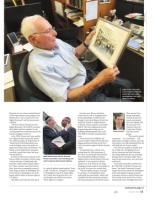

ROBIN SCHWARTZ
Judge Avern Cohn looks
at an old photo of himself
and his late wife, Joyce,
participating in the 1963
Walk to Freedom.
King who, he says, always insisted there be
Jewish representation at any program. She
told him Jews “were a friend to the Civil
Rights Movement” and that always stuck
with him.
“We have a history through the Civil
Rights Movement. The NAACP was found-
ed by blacks and Jews together,” he says.
“Jewish people have always been part of the
freedom struggle in America.”
In the 1990s, Flowers met Syme, and the
two religious leaders became fast friends.
The rabbi’s late father, M. Robert Syme of
Temple Israel of West Bloomfield, was a
vocal civil rights activist who spoke out
against the Ku Klux Klan and all haters. The
family received death threats and police
once had to guard their home, but Syme
was not deterred.
In 1963, the elder Syme took part in the
historic Walk to Freedom in Detroit, along
with an estimated 125,000 people who
heard Rev. Martin Luther King Jr. deliver
his “I Have a Dream” speech for the first
time. Syme also accompanied a group of
black clergy members to Washington, D.C.,
for the March on Washington, one of the
largest political rallies for human rights in
U.S. history.
“My father came back after that march
Rabbi Daniel Syme and Rev. Kenneth
Flowers have built a close friendship and
work to improve black-Jewish relations.
in a state of spiritual transformation,” Syme
recalls. “He told me, ‘I thought I was going
to Washington to march for Negro rights,
but I realize after being there that I was
marching for you and for every person
whose rights are in danger.”
Over the years, Flowers and Syme
worked side-by-side to strengthen black-
Jewish relationships. In 2000, the duo
brought Coretta Scott King to Detroit; she
visited the Charles H. Wright Museum
of African American History and Temple
Beth El. They also collaborated on joint
programming and worship services
including interfaith gospel seders and a
2013 Walk to Freedom commemorative
event.
Detroit Jewish News Publisher and
Executive Editor Arthur Horwitz did some
digging and discovered the Jewish News
never covered the original walk five decades
earlier.
“In preparation for a column I was
writing about the 50th anniversary of
the march, I searched the Detroit Jewish
News Foundation’s William Davidson
Digital Archive of Jewish History,” Horwitz
explained. “I was surprised to find no
mention of it at all. However, Dr. King’s
Washington march made the front pages of
the Jewish News just a few months later.
“Why the sudden change in coverage?”
he continues. “In attempting to better
understand this turnaround, I talked with
a handful of Jewish community members
who had participated in the Detroit march.
Their answer? Even
though individuals
from the Jewish com-
munity participated,
they were aligned with
the American Civil
Liberties Union, the
United Auto Workers
Arthur Horwitz and other secular
groups.
“They said the Jewish
community — as a community — still
hadn’t made civil rights a priority, and some
of its leaders were still traumatized from the
1943 Belle Isle riot 20 years earlier.”
(The 1943 riot erupted on Sunday, June
20, on Belle Isle with fighting between
African American and white Detroiters.
The rioting spilled into the city, including
Hastings Street in Paradise Valley where
many Jewish-owned stores were destroyed
and looted.)
“In the intervening three months since
the 1963 Walk to Freedom,” Horwitz con-
tinues, “the Jewish Community Council
stepped forward to endorse the Washington
march and organized a group of Jewish
community activists to attend. Bottom line:
The coverage by the Jewish News of local
involvement in the Civil Rights Movement
continued on page 14
July 28 • 2016
13