
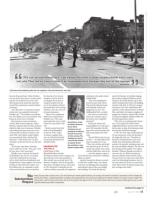

Historical Photo Courtesy of Kenneth Stahl
[The riot] set everything back. It set people who lived in those neighborhoods back; many
lost jobs. They had no place to shop. It set businesses back because they had all this damage.
— David Broner
12th Street still smoldering after the riot erupted at 12th and Clairmount, July 1967
burned all around them, Parker Brothers
was one of the only stores to remain stand-
ing. But, the solid brick structure with
three ground-level storefronts and three
second-floor apartments sustained plenty
of damage.
“Four days later, we came back and the
whole store was completely destroyed,”
Shindler says. “The windows were all bro-
ken. The display cases were smashed. They
looted us and we lost everything.”
Determined to remain in business,
with the help of nine employees, Parker
Brothers reopened. But, the shop could not
afford the high cost of insurance. Shindler
sold clothing and shoes from the corner
of the burned-out block for about a year
until 1968, when Martin Luther King Jr.
was assassinated. Police told him that
afternoon, “You’d better leave.” He did.
And that was the last time he saw the store
intact.
“By the time I got home, Guardian
Alarm called,” he recalls. “They said, ‘They
hit your store. Don’t come back.’”
Shindler never returned. He donated
the building to the city for a recreation
center (he would drive by years later
only to find it had been demolished) and
bought Brody’s Camp Supplies and Custom
Printing in 1969. His loyal workers were
left without jobs. He remained in touch
with several families and even attended
The
Intersection
Project
stationed on the nearby school
football fields.
“They were patrolling the
streets because of the unrest.
They had the National Guard
with all kinds of Jeeps and
equipment,” he says. “Our
building didn’t have a scratch
— but, when we went back to
where our customers were, a
lot of them were completely
destroyed.”
David Broner recalls
At the time, Broner had
his family’s business,
young
children, two sons ages 2
Broner Glove
and
4.
He
remembers the feel-
Company, was not
ings
of
fear
and uncertainty that
damaged, he believes,
kept
many
people
home from
because it was next
work.
to three schools. The
“My wife didn’t want me to go
building was sold to
to
work — we really didn’t know
a church that wanted
what
was going on,” he says.
to expand. Broner
“There
was a curfew and people
Hat and Glove is now
HEADING FOR
were
afraid
to go out. It was an
based in Auburn Hills.
THE ‘HILLS’
unsafe time; people were scared,
David Broner of West
and they didn’t know what to do
Bloomfield believes his fam-
— were they going to reopen or
ily’s business, Broner Glove Company, was
close? Did they have insurance? Could they
spared because of its close proximity to
afford to reopen?”
three schools, just across the street. The
Amid the turmoil, the Broners received
business, founded in 1933 by his grandfa-
an offer they couldn’t refuse. The church
ther, Harry, and father, Barney, was located
next door was thinking about expanding
at 7501 Linwood St. During the riot, he
and wanted to know if they were selling
could see military personnel and equipment their building. The family did sell and
the funerals of two former
employees, but the lack of
an adequate bus system to
transport people from the
city to the suburbs and back
prevented them from moving
with him. The same was true
for many businesses.
“Most [of our employees]
didn’t have transportation,”
Shindler says. “One came
and worked for me for a little
while, but it just didn’t work
out.”
Brody’s moved from Oak
Park to West Bloomfield
in the late 1970s. Today,
it remains a popular busi-
ness on Orchard Lake Road,
owned and operated by the
Shindler family.
moved the business to Ferndale, keeping
their workers onboard. Relatives, includ-
ing Harry and Goldie Broner and an aunt
and her husband who lived in the building,
moved to Oak Park. In 1978, the company
relocated to Troy. Now called Broner Hat
and Glove, with a division known as Broner
Glove and Safety, the business employs 60
people and is based in Auburn Hills. David’s
son Bob and daughter Stephanie Miller are
the fourth-generation owners.
“[The riot] set everything back,” Broner
says. “It set people who lived in those
neighborhoods back; many lost jobs. They
had no place to shop. It set businesses back
because they had all this damage.”
A 1997 New York Times article about the
30-year anniversary of the riot described
the ripple effect this way: “Hundreds of
burned or looted businesses were never
rebuilt. Tens of thousands of Detroiters
moved to the suburbs, including many mid-
dle-class and affluent families. The city’s tax
base shrank and the quality of its schools
declined. ‘Whatever damage you inflict to
your own city, it is likely to remain per-
manent,’ said then-mayor Dennis Archer,
‘because in the very same areas where there
used to be flourishing businesses, they do
not exist today and, in the very same areas
where there used to be dense housing units,
they no longer exist today.’”
Nearly 50 years after a police raid at 12th and Clairmount streets ignited violence and carnage, the Detroit Journalism Cooperative, which includes the
Detroit Jewish News, is exploring whether conditions that produced the civil unrest have improved for Detroit residents in a series of stories called “The
Intersection.” Look for future stories from the JN on this project throughout 2016. To see all the stories done by our partner media agencies, go to wdet.
org/series/detroit-journalism-cooperative.
continued on page 16
June 23 • 2016
15