

An Engaging Figure
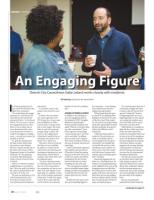
Detroit City Councilman Gabe Leland works closely with residents.
Eli Natinsky | Special to the Jewish News
I
t’s all about getting local citi-
zens involved in decisions that
affect their community.
“I’m excited about this engage-
ment process,” said Detroit City
Councilman Gabe Leland who
represents District 7 in Northwest
Detroit. “If I can create a commu-
nity engagement process where
there’s a win on either side on
every development that comes
to my district and to Detroit, it
would be the biggest accomplish-
ment — not just in my career, but
probably in my life.”
On April 28, Leland hosted
the final of three initial vision-
ing sessions to spur dialogue
between residents and the city on
the future of the former O’Shea
Playground, located at Greenfield
Road and I-96. The gathering
was held at Faith Redemption
Center, Church of God in Christ
in Detroit.
O’Shea is in Detroit’s Grandale
neighborhood, an area that bor-
ders I-96 to the north, Joy Road to
the south, Greenfield Road to the
east and M-39 to the west.
The park was dedicated in 1951
and decommissioned in 2011.
It was then transferred to the
city’s planning and development
department.
A recreation center on the
property also closed five years
ago.
In March, the city entered
into a lease agreement with
DTE Energy for a 10-acre solar
panel installation at O’Shea.
Construction is to begin in late
July or early August. The instal-
lation is expected to generate
enough energy to power 450
homes in the neighborhood.
Leland said it would be the sec-
ond largest solar project of its
kind in a U.S. urban area.
The park is 20 acres in all and
this leaves 10 acres available
for public use. Leland and his
staff and the city’s planning and
development department are now
determining, with the help of
residents, what will be done with
the additional space.
“For these visioning sessions,
we really dug deep to decide the
best use for the vacant land in
this community and how we can
make it all work together in the
larger plan of a walkable commu-
nity, a better-looking community,”
Leland said. “I think we’re going
to prove that a project like this
can be inclusive of community
benefits. It’s my job to meditate
that.”
GIVING CITIZENS A VOICE
In addition to the visioning ses-
sions, the engagement process
has included a SWOT (Strengths-
Weaknesses-Opportunities-
Threats) analysis. Residents were
asked, “What do we do better than
any other communities?” Some
of the responses were touching:
“survive and persevere” and “look
out for each other.” In addition,
plans are under way to organize
three teams of residents to focus on
the areas of research, outreach and
park design.
Leland is particularly impressed
that residents took ownership of
O’Shea after it closed by mowing
the grass on the entire 20-acre site
at their own expense and without
prompting by the city. For that
reason, he feels they are “owed”
something of value at the park.
“This community has residents
who are incredible human beings,
helping each other and stepping up
to make life better for their com-
munity and for the city,” Leland
said.
He hopes the solar array can be
the start of something bigger for
the community — more funding,
more infrastructure and more
employment opportunities.
“When I heard about this proj-
ect, that DTE was thinking about
looking at vacant land to do a proj-
ect like this, I said, ‘Wow, maybe
we can use this as leverage to bring
about other opportunities for fund-
ing from nonprofits, from govern-
ments, from different venues,”
Leland said.
“I think this thing could be a
catalyst for this area where you
create a new identity and say,
‘Can Grandale be the next green
community? Can Grandale take
an asset like this and turn it into
something in such a positive way
where you now have this commu-
nity that’s known for green infra-
structure, green technology, green
jobs?’” he added.
Leland said engaging with resi-
dents was a “learning process.” He
wanted to encourage people living
in the neighborhood to come to the
visioning sessions and talk about
the O’Shea project as well as other
quality-of-life issues. His concern is
that if there isn’t an open dialogue
between residents and the city, this
lack of communication will turn to
anger and impede progress.
“It’s a whole dynamic that a lot of
communities struggle with when
it comes to this new level of devel-
opment,” Leland said, “because
it’s happening before our city, it’s
happening before our eyes, and it’s
very exciting. But residents need
to be at the table, and we need to
know how to get them there.”
Willie Johnson is a Grandale res-
ident who lives a block away from
O’Shea. He said he hasn’t been
involved in local politics before, but
he came to two of the visioning ses-
sions as the development affected
him personally given its proximity
to his home. Johnson was quite
engaged at the meeting, directing
several questions to Leland, his
staff, DTE Energy, and representa-
tives from the city’s planning and
development department.
Now that city council members
are elected by district rather than
solely at large, he expects it will
make these officials more account-
able to their constituents. Johnson
said the visioning sessions are a
positive first step, and the meetings
are, to his knowledge, the first that
have been held in this neighbor-
hood.
Johnson was particularly
impressed that Leland started the
continued on page 12
10 June 23 • 2016
Sean Cook
metro » d et ro it