

arts & life
e x h i b i t
“I began to see
a camera not
as something
that produced a
finished product,
but something that
allowed me to grab
visual bits from the
environment and later
synthesize together
these bits to create a
new picture.”
— Ken Axelrad
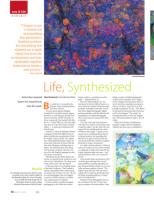
Ancient Evenings
Life, Synthesized
Artist Ken Axelrad
layers his experiences
into his work.
details
Ken Axelrad’s work will be on view for a pop-
up exhibit at the Janice Charach Gallery at
the West Bloomfield JCC 6-9 p.m Thursday,
June 23. (248) 432-5579; jccdet.org. For
information about his work, contact
Michelle Silverstone at (248) 563-0444.
46 June 16 • 2016
Alan Muskovitz | Contributing Writer
B
e careful not to overanalyze the
dynamic works of photosynthetic
artist Ken Axelrad.
A former practicing psychologist,
Axelrad, 69, received his master’s degree
and Ph.D. in counseling psychology from
Boston University and the University of
Texas, respectively. But Axelrad’s life, like
his art — which will be on view one-night
only, June 23, at the JCC’s Janice Charach
Gallery — is made up of numerous and
diverse layers.
Axelrad is a native of Northwest Detroit.
A graduate of Oak Park High School, he
played football and was president of both
the student council and his AZA chapter.
Now a Bloomfield Township resident, he
spent most of the first 30 years of his life
away from Michigan, including stops in
Maine, New York and three years living
with his family in Brazil, where his was
one of the first English-language bar mitz-
vah classes in Sao Paulo.
“Brazil and my late mother Helen’s dis-
tinctive eye opened up the world of art and
color to me,” Axelrad says. “It’s where most
of my artistic tastes were developed.”
At the same time, he is extremely proud
of his father’s influence. “Paul Axelrad is
entirely responsible for the camera being
my artistic tool of choice,” he says. “He was
an avid photographer who even lugged
a camera to WWII and later as a family
man, captured all our vacations.”
It wasn’t until the evolution of digital
photography in the 1990s that Axelrad
forged a path to a revolutionary artistic
genre — photosynthetic art.
The term “photosynthetic art” was
introduced by the late Milton Harris Jr., a
close friend of Axelrad’s during his under-
grad days at Brandeis University. The art
form fuses digital photography, digital
painting and other tools that allow for the
manipulation of original photography.
This creative process awakened the artist
in Axelrad.
“I became more and more fascinated
with what you could do to the picture after
it had been taken,” says the artist who was
inspired by the colorful and loose styles
of Matisse and Chagall. “I began to see a
camera not as something that produced
a finished product, but something that
allowed me to grab visual bits from the
environment and later synthesize together
these bits to create a new picture.”
As a child, Axelrad endured a “relatively
mild case of polio,” he says, which resulted
in a diagnosis of adult-onset muscular dys-
trophy syndrome eight years ago — and
convinced him to chart a new course for
his life.
A few months before turning 66 in 2012,
Axelrad began suffering from cervical
spine problems requiring immediate sur-
gery, physical therapy, months in a cervical
collar and more months off work. “The
longer I spent off from work, the more I
realized that I wanted to spend [my] time
left doing something different. I retired
and never looked back.”
Axelrad’s artistic photographic process
has evolved over the last 15 years, hon-
ing in on plants as his main subject. After
taking a number of digital photographs,
Axelrad extracts portions of the images
on his computer and then layers them on
top of each other, sometimes amassing as
many as 35 layers. “Each layer is at least
partially transparent,” he says. “This allows
for all kinds of interaction effects between
each level of imagery.” The result is an
incomparable burst of color and imagina-
tion, with many printed as large as 40 x 50
inches.
While the innovation of digital pho-
tographic imagery laid the foundation,
Axelrad’s previous career contributed to