

family focus »
What’s In A (Jewish) Name?
What we call our children ... and why.
Shelli Liebman Dorfman | Contributing Writer
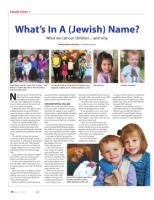
Tovah Berger with her sisters, Nili, 3, Avital, 7, and
Eliana, 5½, before they left on their first trip to
Israel in October 2016
N
ames like Sylvia, Arnold, Oscar and
Lillian that 20 years ago belonged
to grandparents and great-aunts
and uncles, have reappeared on backpacks,
nursery-school walls and the newest mem-
bers of our Jewish communities.
Making “old” names new again is a long-
standing tradition among Jewish babies
named in memory or honor of a loved one.
Alongside children whose names are exact
duplicates of their ancestors are those with
shared initials or similar sounding names.
Twenty-two-month-old Mia Harper
Neumann of Commerce Township has a
modernized version of the names of her
maternal great-grandmother Myra Kuretzky
and her paternal great-grandfather Herman
Fried.
“We each felt a strong, close personal
connection to them and wanted to honor
their memory, as a blessing, by naming Mia
after them,” her dad said. “Unfortunately,
Mia didn’t get a chance to meet them, but
strangely enough we can see some of their
individual character traits shine through
Mia.”
Jewish children may be given an English
and a Hebrew name or, as in the names
Miriam and Adam, one covers both.
A name may be determined by an attri-
bute, like Yaffa, which evokes beauty, or as
an opposite-gender version, like Danielle for
Daniel.
Mostly any name is acceptable in Jewish
tradition, but the Talmud forbids giving a
child the same name as an evil person, stat-
ing, “The name of the wicked should rot
and not be remembered.”
Kveller.com offers lists of Jewish names
34 June 16 • 2016
The Mizrahi children of Oak Park were named in the
Sephardic tradition and in a family tradition as well.
in assorted themes, including those related
to nature, history, seasons, athletes, political
figures and those from Jewish movies.
Mia Neumann
named for the individual closest to him: his
late brother Matt, who passed away in 2008
from Ewing’s sarcoma at the age of 27.
“My brother and I were very close and
he was the best man in my wedding,” Lash
said. “I would easily say he was my best
friend and the biggest loss in my life.
“It was important to me to carry on his
name,” said Lash, who lives in a Grand
Rapids suburb with his wife, Kelley, and
their children. “I want him to have the cour-
er had.
age that my brother
“There are a lot t of times when I call
my son’s name, it makes me think of my
brother. He also has a lot of the same body
sonality of my brother,
language and personality
which is scary. At the same time, when I
call his name it is a strange feeling
plain.”
that is hard to explain.
Five-year-old Matthew’ s
njamin,
middle name, Benjamin,
CIRCUMSTANTIAL CALLING
Children may receive their names based
on the time, place or situation surrounding
their birth. For example, a name might be
chosen based on a Jewish holiday coinciding
with the birthdate. Esther, like the queen,
may be given to a baby born on Purim or
Leora, which means “light,” for a Chanukah
baby.
Former Detroiter Rachel Weiss-Berger
and her husband Rabbi Benjamin Berger’s
first child was born with a congenital heart
defect requiring the first of several surgeries
immediately after she was born in July 2007.
In memory of Rachel’s grandmother
Jean Weiss and Ben’s grandmother Loretta
Berger, the couple gave the eldest of their
four daughters the name
Tovah, meaning “good.”
“Libi, which means ‘my
heart,’ was given to Tovah
as her middle name,” said
Weiss-Berger, whose family
now lives in Columbus, Ohio.
“It is a way for her to know
that her heart defect was not
what should define her but
rather the good that would
come from her heart.”
Babies may be named for
those not personally known
to new parents like Torah
Above: The late Matt Lash with his
scholars or for those who
newborn niece Ella in 2007
perished in the Holocaust.
Right: Matthew and Ella Lash
Jason Lash’s son was
Solomon Ostreicher
was given to him in memory of Lash’s great-
grandfather Barney Elfman. “Family was
really important to my Papa Barney. I hope
Matthew puts value into his family like [his
namesake] did,” Lash said.
Matthew’s 8-year-old sister’s name is a
combination of those of Lash’s grandfathers.
“Papa Ed Lash and Papa Len Morrison
became ‘Ella,’” he said. “Family and hard
work were something both of my grand-
parents took pride in. I hope Ella has the