

Photos by John Hardwick
camp »
Beyond
Fresh Air
Sunshine
&
Tamarack Museum opens June 19.
Vivian Henoch | Special to the Jewish News
W
hat keeps Tamarack campers
coming back, summer after
summer, generation after gen-
eration? Perhaps there’s something in that
fresh air.
From its humble origins serving indigent
children in its earliest days as the Fresh Air
Society, Tamarack Camps has grown into a
multi-faceted agency with assets far more
reaching than its 1,250 forested acres, spar-
kling lake waters and exceptional facilities
in Ortonville.
As one of the largest and oldest Jewish
summer camps in the world today,
Tamarack now serves thousands of camp-
ers, families and school groups year-round
with the mission to build Jewish identity
and strengthen a vibrant community.
Building on its legacy of caring,
Tamarack has been ever responsive to the
needs of the time, providing a welcome
summer home for immigrant children, sur-
vivors of the Holocaust, Israeli children in
the crossfires of the Intifada as well as chil-
dren with a diverse range of special needs.
And, to support services and scholar-
ships for families with respect to their abil-
ity to pay each summer, Tamarack raises
approximately $1 million for financial aid,
more than any Jewish camp in the world.
32 June 16 • 2016
“There’s a story here that needs to
be told,” says Tamarack Camps CEO
Steve Engel. “Spanning five generations,
Tamarack Camps has long been considered
to be a jewel of our community. The time
has come to celebrate our vibrant history
in a permanent home, where summer
campers along with their families and
thousands of alumni and visitors can come
and explore our roots and experience our
organization’s rich Jewish heritage.”
On June 19, Family Fun Day at Camp
Maas, the Tamarack legacy will come to life
in the Clara and Irvin Charach Tamarack
Museum, thanks to the vision and dedica-
tion of many volunteers with the support
of Natalie and Manny Charach in honor of
Manny’s parents, Clara and Irvin. Located
within the gateway to the Camp Maas
grounds, inside the main building of the
Smoklerville Pioneer Village, the museum
occupies a rustic storefront space of
approximately 700 square feet.
At 90, Manny Charach recollects his own
experience at a camp for children of immi-
grants in Pittsburgh back in 1935.
“I’ve always been thankful for my one-
week experience at that camp,” he said.
“When I learned that Tamarack was look-
ing to start a museum for the memories
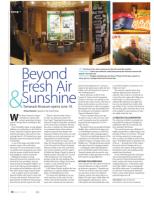
LEFT: The Story Circle, where memories are shared around the campfire.
UPPER RIGHT: T-shirts and craftwork, tucked away among the Tamarack treasures dis-
played in the bunk area.
LOWER RIGHT: Designer and fabricator Joe Hines of Project Arts & Ideas seated in a
sunny spot on a vintage bench from the Green Bus.
that have been gathered over 114 years, I
leaped at that opportunity to help. My wife,
Natalie, and I are honored to be a part of
this wonderful project.”
Sharon Alterman, archivist of the
Leonard N. Simons Jewish Community
Archives at the time, was enlisted to cata-
log Tamarack Camps’ massive collection of
photos and documents as well as to part-
ner with Tamarack to collect and organize
photographs and camp memorabilia from
the community in an initiative called the
Tamarack Memories Project.
“From its inception three years ago,
the project took on a life of its own, and I
count it among the most fun and gratify-
ing professional assignments I’ve ever
had,” she says.
This effort, led by past president Michael
Maddin, then evolved into the larger proj-
ect of building the museum, conceived as
an integral part of the camping program.
“Given the overwhelming response of the
community to the Memories Project, we
realized we had an even larger story to tell,”
Maddin says. “Through the lessons learned
and values fostered in camping programs
— including the adult-related programs
such as the Bubbie Zaydie Family Camp —
Tamarack alumni often become the com-
munal leaders of their generation as well as
better parents and grandparents.”
BEYOND THE GREEN BUS
“Our vision for the Clara and Irvin Charach
Tamarack Museum was that it would be
an immersive experience,” Alterman says.
“Visitors are invited to share their memo-
ries and stories as they view hundreds
of photos, posters and camp artifacts on
display. The rustic space readily allows for
interchangeable components as well as
crafts, photos and memorabilia that camp-
ers and their families are welcome to con-
tribute over time.”
The museum comprises three main
vignettes depicting iconic elements of
camp life. Take a seat for a virtual ride on
a Green Bus, then explore the Village area,
where bunks in a cabin and tent are so
authentically replicated, you might close
your eyes and almost hear crickets chirp-
ing. Finally, for the “record,” at the heart of
the museum, gather ’round the Story Circle
at the campfire to share memories of sum-
mer nights under the stars.
A CREATIVE COLLABORATION
The collection of artifacts on display have
been gathered in large part through the
collaborative effort of a community task
force chaired by Jeff Zeman.
“Our creative process was collaborative,”
explains Joseph Hines, exhibit designer and
principal of Project Arts & Ideas. “Our goal
was to bring camp alive to many genera-
tions, to make each exhibit an active living
space. We grabbed sparks of inspiration out
of the air — drawing much of the content
from items found in storage and in con-
versations with campers of all generations,
hearing their stories and soaking up infor-
mation from their photos.”
As the community portal for connecting
and reconnecting Tamarack alumni, the
Clara and Irvin Charach Tamarack Museum
invites campers and visitors to share their
camping experiences. A web-based compo-
nent of the exhibit is now in development
and will be online soon. To contribute pho-
tos and items to the Tamarack Memories
Project, contact Gabe Neistein at gneistein@
tamarackcamps.com.
*
Vivian Henoch is editor of Federation’s
MyJewishDetroit, where this story first appeared.