

for college students by college students
Hunger Seder
MSU Hillel students, legislators attend seder
focused on food insecurity.
Ilana Woronoff } jewish@edu writer
assover is a holiday commonly associated
with food; cooking and cleaning quickly
take over Jewish homes as families work
to clear their homes of chametz and prepare their
Passover favorites. However, not all families have
the same opportunities to pick and choose the var-
ious foods that will be served at their seder tables.
Yad Ezra’s annual Hunger Seder turns the
traditional Passover seder on its side, creating an
interactive and informational space for community
members to share a table with some of Michigan’s
legislators. This year, Yad Ezra’s Hunger Seder went
on the road to Lansing, giving Michigan State
University’s Hillel Jewish Student Center an oppor-
tunity to get involved.
MAZON: A Jewish Response to Hunger provides
a Haggadah designed to bring awareness to the
unfortunately common issue of hunger. The idea
behind a Hunger Seder is to appreciate that even
though the Jewish people are free, we still need
to recognize that not everyone is living in an ideal
situation.
Every year, MAZON chooses a theme con-
P
nected to the concept of food insecurity; this year’s
theme discussed the heart-wrenching fact that so
many military and veteran families are forced to
utilize food pantries and distribution programs.
Throughout the seder, there are places for reflec-
tion and for discussion in addition to the tradi-
tional seder rituals.
On Wednesday, April 13, MSU Hillel welcomed
Yad Ezra, the greater Lansing community, MSU
students and State Reps. Robert Wittenberg,
Jeremy Moss, Andy Schor, Klint Kesto and Mike
Callton and State Sen. Jim Ananich to Yad Ezra’s
annual Hunger Seder. MSU Hillel’s Senior Jewish
Educator Rabbi Dana Benson led the seder, mak-
ing sure to include brief explanations for seder
elements individuals might not have been familiar
with. At each attendee’s place was empty paper
plate — symbolic of those unable to fill their din-
ner plates and also serving as a “reflection seder
plate” divided into six spaces where participants
could write thoughts throughout the seder. In the
center was a space for a thought to take home to
consider further.
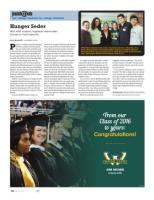
MSU Hillel students at the seder: freshman Jay Sirot, Montville, N.J.;
junior Hayley Siegel, Farmington Hills; sophomore Ashley Schnaar,
Bloomfield Hills; junior Emma Morris, West Bloomfield; freshman Max
Labe, Huntington Woods; and freshman Seth Rosen.
As I looked around the seder table, I couldn’t
help but think about how amazing it was that
people from all different backgrounds were sit-
ting together for a Hunger Seder. State legislators,
Lansing community members and MSU students
all came together to recognize there are people
going to sleep hungry all around us. They came
together to learn.
As a Jew who is used to attending family seders
during Pesach, I could not stop thinking about how
amazing it was that I was sitting next to MSU’s
non-Jewish student body president Dominique
Clemons and that I was sitting across from Jewish
Rep. Moss, and though we were all there for differ-
ent reasons, we recited the same words.
When we reached the last line of the
Haggadah, I found my takeaway: “This year we
are here; next year in Jerusalem. This year we are
pained by hunger; next year may all who are hun-
gry come and eat.”
I am so used to hearing the words “next year in
Jerusalem” that they no longer have true meaning
to me; however, as I am getting ready to graduate
and search for work in the human service field, it
hit me that I will be encountering many individuals
who hope that next year they will be able to eat,
and that they will be the individuals hosting the
Pesach seder, inviting their friends to come and
eat. @
Ilana Woronoff of West Bloomfield recently graduated
from Michigan State University in East Lansing.
From our
Class of 2016
to yours:
Congratulations!
AIM HIGHER
wayne.edu
2017970
58 May 26 • 2016