

health & wellness »
Good CATCH!
A new JCC preschool program helps children establish healthy habits for a lifetime.
Elizabeth Applebaum | Special to the Jewish News
I
f you’re the goose, you get to be chased.
If not, you sit. And sit. And sit.
If you’re great at dodgeball, you’re
always chosen when it’s time for teams.
If not, you hope you won’t be one of the last
kids nobody wants but somebody has to take.
From “Duck, Duck, Goose” to sports,
games are often the exact opposite of what
children need — to be physically active
and feel valued.
At the Jewish Community Center of
Metropolitan Detroit’s Sarah & Irving Pitt
Child Development Center (Pitt CDC), the
ducks have just become a lot more on the
go and that “last kid to be picked” routine
is out the door.
CATCH (Coordinated Approach to Child
Health) is a national initiative dedicated to
helping young children establish healthy
habits. The program “Discover: CATCH”
— co-developed by the Jewish Community
Centers Association (JCCA) — incorpo-
rates Jewish values into the activities.
This year, Discover: CATCH had its
Michigan debut when it became part of
the curriculum at the Pitt CDC.
“It means that kids are involved, mov-
ing and inclusive,” says Shannon Hall, Pitt
CDC assistant director. It means they learn
how to make good choices and how to be
thoughtful, and it gives them tools they’ll
need to maintain a healthy physical and
emotional lifestyle into adulthood.
Consider, for example, the Discover:
CATCH version of Duck, Duck, Goose. Here,
children are paired, one as a duck and the
other as a goose. Everyone plays, everyone is
active and no one is ever the kid not chosen.
Discover: CATCH also provides teach-
ers with new ways to incorporate Jewish
concepts like caring for the Earth into the
school curriculum.
Judaism is filled with directives, as in
Deuteronomy 20:19-20 (“When in your war
against a city you have to besiege it a long
time in order to capture it, you must not
destroy its trees, wielding the ax against
them. You may eat of them, but you must
not cut them down.”). This shows the
importance of appreciating the Earth and
all that it provides. Yet children often have
little knowledge of how food comes into
existence. So the CDC plans to create a
garden where children will be able to plant,
cultivate and then eat their own food.
Maimonides, the Torah scholar
and 12th-century physician, wrote
“Maintaining a healthy body is among the
ways of serving God.”
120 May 26 • 2016
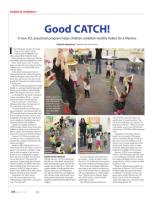
Children ages 2.5-3
play Statues and Rag
Dolls. The children
stretch like statues
and then relax like
rag dolls within the
space of the hula
hoop.
Students
ages 4-5 get
stomping!
GOOD FOOD CHOICES
Through Discover: CATCH, children learn
that there are “whoa foods” and “go foods.”
Before just popping a sugary treat into their
mouths, they are asked to say “whoa” and
consider whether it’s really good for them;
whereas carrots, peas and whole grains —
“go” right ahead! But this is not taught just
with a lecture, which would involve a lot of
sitting around. Instead, kids sort through
magazines and find foods that fall into either
category.
Pitt CDC 2- and 3-year-olds play a
beanbag balance game.
For those moments when kids need to
get moving — which, of course, is often —
Discover: CATCH offers lots of new games
that involve jumping and running around.
But even the most energetic little body
must come to rest, which is why there are
also CATCH activities that are calming, but
still encouraging kids to use their imagina-
tions. “Pretend you’re a Popsicle,” begins
one CATCH exercise. “And you slowly,
slowly begin to melt.”
One of the best features of Discover:
CATCH is that it does not require any
specific place to be put into action. “You
can do it in small spaces; you can do it in
large spaces,” Hall says. “When it’s too cold
to go outside, we go to our CATCH room
where there’s a CATCH box filled with game
ideas.”
A good idea is even better when it’s
shared. So every month, CDC parents
receive a newsletter offering CATCH tips,
like a new exercise for children to try at
home or ways to sneak squash into a kid’s
favorite food. Teachers receive a weekly
email with information about one of the
hundreds of available CATCH activities.
Discover: CATCH is even catching on
with JCC staff. Hall reports that CDC teach-
ers are working out more often, while JCC
Day Camps and Shalom Street are incorpo-
rating Discover: CATCH concepts into their
programs as well.
Things are shaping up for another suc-
cessful year of Discover: CATCH as staff
members begin planning for the future.
In addition to the garden and more fun
games and activities, Hall says the CDC
hopes to invite chefs who could offer
recipes that might even make kids excited
about eating spinach.
*