

yom hashoah »
0DUWLQ %HONLQ '2
is talking multiple
sclerosis (MS) and
treatment.
DW 30
0LGGOHEHOW 5RDG
)DUPLQJWRQ +LOOV 0,
Save a seat for
a friend.
Accessible to folks in
wheelchairs or who
need assistance.
Light meal served.
Validated parking.
Space is limited.
Please RSVP
by calling
1-866-682-7491.
Novartis Pharmaceuticals Corporation
East Hanover, New Jersey 07936-1080
12/15
T-XMG-1325053
0000000
44 May 5 • 2016
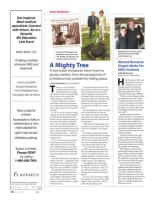
Garry and Viola Kappy at the
dedication of the Anne Frank
Tree Exhibit and Garden at the
Holocaust Memorial Center
A Mighty Tree
A new book introduces Anne Frank to
young readers, from the perspective of
a chestnut tree outside her hiding place.
Lynne Konstantin | Arts & Life Editor
*LQRSROLV 5HVWDXUDQW
© 2015 Novartis
PHOTO BY JERRY ZOLYNSKY
Get inspired.
Meet medical
specialists. Connect
with others. All at a
Novartis
MS Education
Link Event
T
here was a “bare chestnut
tree glistening with dew, the
seagulls and other birds glint-
ing with silver as they swooped through
the air, and we were so moved and
entranced that we couldn’t speak.”
From her hiding place in the attic,
Anne Frank wrote of a horse chestnut
tree, mentioning it three times through-
out her diary as it gave her such pleasure
and hope.
In The Tree in the Courtyard: Looking
Through Anne Frank’s Window (Knopf)
by Jeff Gottesfeld, illustrated by Peter
McCarty, the tree watches the goings-on
in the city of Amsterdam and watches
Anne, a girl who played and laughed
and wrote in her diary before the war. It
notices when the young girl comes to the
annex with her family, saw her peek out
of the curtained window — and when
she and her family were taken away by
uniformed men.
The Tree in the Courtyard is a beauti-
ful, moving and lyrically told picture
book, made more so by its stunning
brown-ink illustrations, each a work of
art in itself. It is a gentle introduction to
the story of Anne Frank for elementary
school-age children and a keepsake for
all ages.
In the back of the book, a note tells the
details of her story — along with the fate
of the chestnut tree, which lived for 172
years before a storm snapped its trunk,
the summer Anne would have turned 81.
Not long before that, however, stew-
ards at the Anne Frank House had the
foresight to take grafts from the tree to
create saplings, with the plan of offer-
ing new “Anne Frank” trees to worthy
recipients around the world as a symbol
of hope and peace.
Local readers of the book don’t have
far to travel to see the tree’s next genera-
tion: The Holocaust Memorial Center
(HMC) Zekelman Family Campus in
Farmington Hills is now home to a sap-
ling (and mentioned in the book), along
with the National Sept. 11 Memorial
& Museum in New York City, Boston
Common and a handful more around
the U.S.
Since its dedication in 2013, the young
tree has flourished in the Viola and
Garry Kappy Anne Frank Tree Exhibit
and Garden at the HMC, named for the
project’s major funders, Holocaust survi-
vors themselves.
“I like that when young people come
to see the tree, the name of Anne Frank
will never be forgotten,” Garry Kappy
says.
The sapling was planted just before
the first of two polar vortexes, says Robin
Axelrod, director of education at HMC.
“The winter was really horrendous. We
were very worried about this sapling —
it was this tiny little thing,” she says.
“It survived and it is thriving. It’s
now three times its original size. It has
the same stubbornness and will to sur-
vive that the original tree had. It was a
mighty, mighty tree. And the fact that it
survived is so fitting. It needs to be there
to bear witness to what happened.
“The sapling speaks to the young,
teenage kids who visit in a way that is
very special,” Axelrod says. “They con-
nect with it. It links them to someone
their age that was there when this hap-
pened.”
The Tree in the Courtyard is available
for purchase in the Eric and Doris Billes
Museum Shop at the HMC. (248) 553-
2400; holocaustcenter.org.
*
Michigan Supreme Court Justice
Richard Bernstein with Hillel
student Noah Lovy
Richard Bernstein
Dispels Myths For
Hillel Students
Gabriella Burman
Special to the Jewish News
H
illel Day School fifth- and
sixth-graders sat in rapt
attention last month as
Michigan Supreme Court Justice
Richard Bernstein, the state’s first
blind judge, helped them dispel
myths about living with a disability.
“When you’re born blind, you don’t
miss what you never saw,” he said.
“It doesn’t mean it’s an easy life, but
it can be an exciting one, and I know
I was born for a purpose, as we all
are. Mine is to use my position to do
something powerful and to create a
new world.”
Bernstein had been invited to
school by Noah Lovy, a sixth-grader
who first met him at a Shabbat meal
in a sukkah. Noah recalled being
mesmerized by Bernstein’s story of
competing in marathons and triath-
lons despite his blindness, and he
wanted very much to share his story
with his classmates.
“Just about everyone has a chal-
lenge, but Justice Bernstein didn’t
let that stop him,” Noah said. “Plus,
he travels around the world helping
communities become more welcom-
ing to people with disabilities.”
Hillel students reciprocated by
welcoming Bernstein warmly. They
peppered him with questions about
how he navigates activities of daily
life, athleticism and any fears he may
have. He answered them all, saying,
“The more personal, the better!”
Noah, who overcame his own
challenge with public speaking by
delivering a soaring introduction
for Bernstein, hopes the afternoon
inspires his classmates to be the best
they can be despite any adversity they
face. If the reception Bernstein was
given is any indication, they surely
will strive to be.
*