

metro » cover sto r y
Test Before You Toke
Entrepreneurial labs check medical marijuana for potency and impurities.
Shari S. Cohen | Contributing Writer
MARKET FOR TESTING
Around the state, business people and
medical marijuana users quickly saw the
potential for laboratories to test marijuana
buds and marijuana products being used
by patients. Michigan is one of 23 states
(plus Washington, D.C.) that have legal-
ized medical marijuana; almost all require
testing for impurities and potency prior to
distribution or sale. Michigan does not.
Photos by Brett Mountain
W
hen Michigan voters approved
the Michigan Medical
Marijuana Act (MMMA)
through a 2008 voter-initiated ballot pro-
posal, they authorized the use of marijua-
na for certain medical conditions. Today,
192,120 Michigan residents hold a medical
marijuana card, according to Michigan’s
Department of Licensing and Regulatory
Affairs.
The MMMA opened doors for new
products as well as businesses engaged in
various aspects of medical marijuana use.
However, many involved in the medical
marijuana industry, as well as state leg-
islators and law enforcement personnel,
believe the law’s lack of specifics has led to
legal ambiguity. There is uncertainty about
which marijuana products are legal and
how they can be legally acquired by medi-
cal marijuana patients.
With a state-issued
medical marijuana
certificate, patients can
grow up to five mari-
juana plants for indi-
vidual use or designate a
caregiver to grow mari-
juana on their behalf.
Caregivers can grow
Dr. Nina Robb
12 plants per patient.
However, cultivating marijuana is not an
easy crop. Experts say that marijuana is a
sensitive plant that requires careful nur-
turing for medicinal use.
“It is a plant that has to be grown under
proper conditions to avoid mold or any
fungus that could be detrimental for some
medical conditions,” says Nina Robb, M.D.,
a physician who works at Greenlite Clinic in
Troy, which examines patients seeking state
certification for medical marijuana use.
In addition, many types of marijuana
exist, and even plants within the same
strain may contain varying strengths of
the two main components cited for their
medicinal benefit — cannabinoids (CBDs)
and tetrahydrocannabinol (THC).
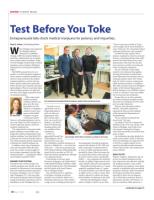
Iron Laboratories founders Michael Goldman, Robert Teitel and Howard Lutz
“I sensed it was an
opportunity to be in a
burgeoning industry,
and I saw what was
happening in states
like Colorado where
there was a need to test
products,” says Robert
Teitel of Orchard Lake,
founding partner and
vice president of Iron
Laboratories.
In 2011, he
approached Howard Lutz Lab manager Claire Moore examines a sample at Iron Labs.
of Birmingham, who he
had known for years, and
they established a medical marijuana test- chromatography. Specialized equipment
ing firm in Walled Lake — one of the first
measures the amounts of THC, CBD and
in the state — with Lutz as president and
other compounds in marijuana flowers
CEO. Michael Goldman of Bloomfield Hills as well as in edible and topical products
joined the firm soon after as COO. All
provided by clients. Other tests assess the
three have business backgrounds, although use of pesticides and the extent and type
not in pharmaceuticals.
of solvents used to remove cannabinoids
Teitel belongs to the Isaac Agree
(CBDs) — a key component for medicinal
Downtown Synagogue and Temple Beth El benefits. In addition, high-powered micro-
in Bloomfield Township. Goldman is affili- scopes identify mold, pests and impurities.
ated with Temple Israel in West Bloomfield
Testing labs typically require a 1.5-gram
and the Friends of the Israel Defense
sample for marijuana flowers, 1.5 grams
Forces-Michigan Chapter.
of an infused produce and a full serving of
Iron Laboratories has 11 employees
an edible, such as a candy or cookie. Each
in Michigan, including six full-time
sample is placed in a solution for testing
scientists, one of whom is Mack Lutz, a
and remainders are disposed of afterward.
biochemist and Lutz’s son. They conduct
Teitel says they photograph contami-
a range of tests, including several types of
nants in samples so clients can see them.
“There is some type of mold on 25 per-
cent of samples and it may be harmful to
some,” Teitel says. “It’s critical that medical
marijuana patients have safe marijuana.”
Dr. Robb says that a patient who is
immuno-comprised or otherwise seriously
ill faces a risk of lung infection that could
spread to the blood stream from a mari-
juana product with mold. She says that
more research is needed concerning safe
levels of marijuana components.
The city of Detroit recently imple-
mented a new ordinance that regulates
licensing and location of medical mari-
juana dispensaries that includes a ban on
marijuana products made with “butane
hash oil,” which is used in creating some
edible marijuana products. According to
Matt Abel, executive director of Michigan’s
chapter of the National Organization to
Reform Marijuana Laws (NORML), butane
is used as a solvent to create some edibles
but is not present after production.
Because there are no state standards
for medical marijuana strength or purity,
those who use testing labs are left to inter-
pret test results themselves.
However, Iron Laboratories follows
ISO/IEC 17025:2005 certified test-
ing protocols that meet the standards
of the International Organization of
Standardization.
“We are setting a benchmark that
doesn’t exist,” Lutz says.
According to Teitel, the company has
doubled its sales every year and has 1,500
clients in Michigan. Last October, Iron
Labs opened a testing lab in Oregon,
where both recreational and medical mari-
juana are legal.
Iron Laboratories provides detailed test
results, posted online, within 24-48 hours.
Prices for individual tests range from $50
to $210 for a complex analysis, but an
annual membership provides discounts.
Clients must present a state medical mari-
juana certificate.
WHO TESTS?
Patients, caregivers, dispensaries and col-
lectives use medical marijuana testing
labs. Dispensaries and collectives typically
sell marijuana products, some created
from patients’ and caregivers’ excess plant
material, to individuals with state medical
marijuana certificates. Robb recommends
lab testing to Greenlite Clinic patients,
especially for those who use dispensa-
ries to obtain their marijuana. However,
dispensaries and other “provisioners,” as
they are sometimes called, operate in a
continued on page 12
10 May 5 • 2016