
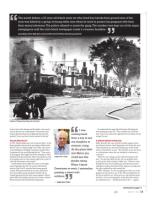

The month before, a 27-year-old black army vet who lived four blocks from ground zero of the
riots was killed by a group of young white men when he tried to protect his pregnant wife from
their sexual advances. The police refused to arrest the gang. The incident was kept out of the major
newspapers until the city’s black newspaper made it a banner headline.
Historical Photos Courtesy of Kenneth Stahl
(according to Hurt, Baby Hurt, a book written from the African American perspective)
by the extent of the damage and the deaths, Levin says he
can’t say the riot was a total surprise “because the racial
tensions that had always been significant had not been
resolved. I’m not sure they’ve been resolved to this day.”
POLICE BRUTALITY
In 1967, Detroit’s police force was 93 percent white. “As the
black population increased, the percentage of black police
did not,” says U.S. District Judge Avern Cohn, who served
on the Michigan Civil Rights Commission and the Police
Commission in the years following the riot. “There were a
lot of programs that singled out African Americans. Police
harshness built up resentment. Police seemed like an army
of occupation and, on a hot summer night at the corner of
12th and Clairmount, it just erupted.”
Jewish attorney Bruce Miller was active in civil rights
issues long before the 1967 riot as part of the Detroit
branch of the NAACP, where he later became general
counsel. He became involved in two areas: discrimina-
tion in local labor unions and police brutality. He suc-
cessfully garnered the first state censure against a Detroit
police officer for brutality and went on to create a Citizens
Review Board for the Detroit Police Department.
Vivian Henoch
A block of Pingree burning out of control
I was
coming back
from a trip to see
my daughter at
summer camp.
As the plane fl ew
into Metro you
Judge Avern Cohn
could see this
smoke rising.
When I drove
Downtown to work, I remember
passing a street with
soldiers.
He understands the anger black Detroiters felt during the
times leading up to the riot. “There certainly was a lot of ten-
sion. It was a case where there appeared to be no redress for any
wrongs,” he says.
A MINOR BREAKTHROUGH
Miller describes the case of police brutality against prosti-
tute Barbara Jackson, which happened years before the riots.
“She had picked up a married Canadian guy at the Purple
Onion on Beaubien,” he says. “She took him across the street
to a whorehouse where she was waiting for a bedroom to
come free.”
While she was waiting, a police officer knocked on the
door. “No one had called for him. He was probably there
to pick up his white envelope,” Miller says. “When he came
through the door, the Canadian guy panicked and started
yelling how Jackson had enticed him. Jackson was lippy and
the police grabbed her and arrested her.”
Miller continues, “As she was getting out of the car in the
garage near the precinct, one of the officers grabbed her by
the hair to pull her out. All he got was a wig and that infuri-
ated him. As he was bringing her inside the police station,
he mashed her face — literally ground her face — against
— Judge Avern Cohn
continued on page 14
April 21 • 2016
13