

metro »
HAPPY
PASS-
OVER!
BDS And Campus
Panelists offer student-based solutions.
T
MB JEWELRY DESIGN
Bloomfi eld Plaza -
6600 Telegraph Rd.
Bloomfi eld Twp., MI 48301
248-671-0087
www.mbjewelrydesign.com
Need extra
spending money?
We buy Gold, Silver,
Stones and Coins.
1995230
18 April 7 • 2016
wo big takeaways came out of the
BDS (Boycott, Divestment and
Sanctions) panel discussion March
27 at Congregation Shaarey Zedek in
Southfield:
• Although divestment from Israel reso-
lutions fail on college campuses, there are
still repercussions that need to be faced.
• If the Jewish community outside the
campus setting wants to help the Jewish
students, do it from the sidelines.
Although 75 percent of the general U.S.
population has favorable views of Israel,
the percentage falls
to 40 percent among
college students, said
Yael Aronoff, direc-
tor of Jewish studies
at Michigan State
University.
“The main danger is
not on any particular
Yael Aronoff
issue, but rather the
broader effort to demon-
ize and delegitimize the State of Israel.
One of the goals of the BDS movement
is to show Israel as the worst demon in
the world,” Aronoff said to a crowd of 80
people.
Whether the resolution is passed or
not, “they still win, in a way, by having the
agenda on college campuses focused so
much on hearing the simplistic story of
Israel. It’s a very simple narrative where one
side is good and the other side is evil.
“Even if a faculty member or student
doesn’t vote for a BDS resolution, they
might be more likely to oppose bringing in
an Israeli scholar to campus or have pro-
gramming on Israel,” Aronoff said.
As a solution, she suggested that uni-
versities provide alternate programming
with more courses on Israel-Palestinian
relations; invite Israeli speakers and visit-
ing professors to campus; give students the
tools to confront BDS directly with facts;
and have universities make clear state-
ments on anti-Semitism in regard to when
anti-Zionism veers into anti-Semitism.
Allan Gale, associate director of the
Jewish Community Relations Council of
Metropolitan Detroit, warned that the BDS
movement is not just on campus, “but a
larger problem that permeates other sectors
of society.”
The BDS movement has affected
unloading Israeli products from ports in
Portland, Ore., and San Francisco. It also
has had a hand in divestment statements in
Methodist and Presbyterian churches, and
Photos by Harry Kirsbaum
Harry Kirsbaum | Contributing Writer
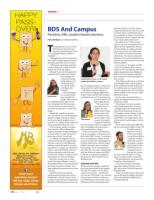
Panelist Becca Levin, a U-M student,
speaks about BDS on campus.
has encouraged entertainers, authors and
artists around the world to boycott Israel.
Tilly Shames, executive director of
the University of Michigan Hillel Jewish
Student Center, said that a BDS resolution
was defeated twice at U-M in the past two
years and said they will
fight it again this year.
“The issue is polar-
izing and divisive on
campus,” she said.
Hillel’s work is to help
Jewish students who
are involved in social
justice navigate “what it
Tilly Shames
means to be a student
in support of Israel and
keep that closeted in order to navigate your
classes, friendships and involvement in
other organizations on campus.
“What we’ve seen since divestment has
come to our campus is a silo-ing of our stu-
dents inside Hillel,” she said. “As profession-
als, we are pushing our students to make
sure they maintain their relationships with
the Black Student Union with the Muslim
Students Association and our breaking-
barrier groups. It is so important that we
don’t allow this to become a football wedge
issue that divides our campus, that Hillel
is still seen as a supportive social justice
liberal place for those students who are
looking for that.”
SIDELINE SUPPORT
Shames spoke of a message reaching stu-
dents from other outside Jewish organiza-
tions that “the campus is on fire and it’s
unsafe to be pro-Israel — and that’s not
true,” she said. “It’s actually a very safe place
to be pro-Israel. You have a strong voice
to be Jewish and pro-Israel. There are pro-
Palestinian and anti-Israel students who
also have the right to use their voices on
campus and they may use their voices; and
we need to help our students find ways to
have confidence in being pro-Israel and not
be intimidated if there’s a student who asks
him a critical question about Israel.”
She told the crowd, “When you ask
what you can do as a community, you can
support all those organizations that sup-
port those groups on campus; and I just
ask that you just leave the campus space
to the students themselves because this
is their home. They need to stand up for
themselves. They need to bring Israel in in
a positive way, and you need to cheer them
from the sidelines.”
Becca Levin, a U-M student, said BDS
scared a lot of students when it came to
campus in 2014, but Hillel and other Jewish
campus organizations began thinking of
different ways for students to talk about
their connection to Israel and openly voice
their concerns.
“A few things we did were to write letters
to the Michigan Daily, work on speeches
for the student government meeting when
the resolution came to a vote and coordi-
nated the response,” she said. “We brought
together students to invest in peace rather
than divest in Israel.”
She also cited a recent Israel Day on
campus that emphasized diversity and col-
laboration on Israel.
When Eugene Greenstein, president
of the Zionist Organization of America
– Michigan Region demanded that the
Detroit Jewish community do more for
U-M students who face freedom of speech
issues of their own, Andrew Moss, the
StandWithUs U-M campus liaison, reiter-
ated the need for outside support from the
sidelines.
“If you want to help students fight BDS,
talk to us first about the fight,” he said. “We
live there. In order to
fight BDS, it needs to
be left to the students.
Any push from adults or
community members
without the consent of
the students is going to
fail. It’s going to make
the whole pro-Israel
Andrew Moss
community look very
bad and only increase
the chance that BDS will have a strong
impact on campus and the community.”
The panel discussion was sponsored by
the Shaarey Zedek Sisterhood.
“The event received an overwhelm-
ing positive response from the commu-
nity,” said co-chair Tali Arbel-Neuman of
Bloomfield Hills.
“What was evident was how thirsty they
were for this kind of intelligent discourse,”
said co-chair Elizabeth Schiff Barash of
West Bloomfield.
*