

arts & life
mu s i c
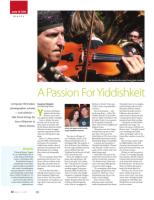
Yale Strom performing at Seward Park, Brooklyn
A Passion For Yiddishkeit
Composer, filmmaker,
photographer, scholar
— and violinist —
Yale Strom brings his
love of klezmer to
Metro Detroit.
details
"A Taste of Klezmer" begins
at 7 p.m. Wednesday, April 6,
at the Holocaust Memorial
Center in Farmington Hills.
The admission charge is
membership in the center,
which provides a household
with a year of complimentary
museum admission. To RSVP or
seek membership, contact Ruth
Stern at (248) 553-2400, ext. 119
or ruth.stern@holocaustcenter.
org. For more about Strom’s
music, books and photos, visit
yalestrom.com.
52 March 31 • 2016
Suzanne Chessler |
Contributing Writer
Y
ale Strom will bring an
audience directly into a
klezmer concert with a
new segment to debut in Michigan.
Strom, a violinist who spent
his early years in the state and
often returns to entertain with
his Hot Pstromi band, has invited
Holocaust survivors to suggest
important songs known in their
early years and help lead a sing-
along.
Strom, 57, a klezmer devotee
since the 1980s, traveled through-
out Europe as he researched
Yiddish music and the culture it
represents. His experiences form
the foundation for recordings,
films, books and photographic
essays.
“It’s very touching to think I’ll be
performing with survivors,” says
Strom, artist-in-residence at San
Diego State University where he
also teaches in the Jewish studies
program.
“I’ve never done this before
although I have learned so much
about traditional Yiddish tunes
from survivors. The lyrics will be
in the program so the audience can
sing with us. Some may just want
to hum.”
Strom will appear with his wife,
singer Elizabeth Schwartz
The concert will begin at 7
p.m. Wednesday, April 6, at the
Holocaust Memorial Center in
Farmington Hills. The program, “A
Taste of Klezmer,” also will feature
his wife, singer Elizabeth Schwartz,
and accordionist Peter Stan.
Traditional Jewish desserts will add
to the mood of the event.
Strom, who enlightens his pro-
grams with song histories, will
have the trio play “Szol A Kakas
Mar” (“The Rooster Is Crowing”)
among the folk songs audience
members suggest. It was popu-
larized by Rabbi Yitzchak Isaac
Taub (1724-1828), who brought
Chasidism to Nagykallo, Hungary.
“I learned that it was sung by
Stoliner shul-goers [from the town
of Stolin in Russia] beginning
in the 1930s at a synagogue on
Elmhurst in Detroit,” Strom says.
“Stolin is where my grandmother
was born.”
Also on the program — and
for the sing-along — will be “My
Yiddishe Momme” by Jack Yellen
and Lew Pollack. Recorded in 1925
by Sophie Tucker, it was requested
for the program by Jeannette
Olson, who survived a childhood of
hiding in France.
“My parents were from Vienna,
and they had to get out in 1938,”
says Olson, who came to the
United States in 1951, lives in West
Bloomfield and performs with the
Metropolitan Singers of Southfield.
A song she also remembers is
“Rozinkes Mit Mandlen” (“Raisins
with Almonds”). It tells a story of
a goat, and her mother used to tell
about having a goat.
Fryda Fleish, who came to the
United States from Poland in 1958
and lives in Oak Park, requested
“The Partisan Song” [about resis-
tance to the Nazis] although she’s
not sure she will be singing.
“It’s a remembrance from home,
but singing will depend on who’s
around me,” Fleish says. “It’s an
international song, but my voice
really is not for singing.”
Strom, who has visited
Holocaust centers around the
world and performed at the Simon
Wiesenthal Center in Los Angeles,
started learning violin at Vernor
Elementary School in Detroit
just before his family moved to
California, where he joined a
youth orchestra. Klezmer became
a strong interest after he heard a
prominent band while in college.
“I had grown up with klezmer
and played some songs,” says
Strom, who came to write his own
klezmer music. “I decided I wanted
to do something with Yiddish
culture and bought a ticket to the
Eastern Bloc countries to search for
music.”
After earning a master’s degree
in Yiddish studies at New York
University, Strom formed his own
band and wrote his first book, Last
Jews of Eastern Europe.
His body of work has grown to
12 books, 15 recordings and eight
documentaries. His film L’Chayim,
Comrade Stalin has been featured
at the Detroit Film Theatre, and
his book Klezmer: The History, the
Music, the Folklore has been fea-
tured at the Jewish Book Fair.
“We have a new CD, City of the
Future: Yiddish Songs from the
Former Soviet Union,” says Strom,
whose visits to Michigan include
spending time with Shirley and
Harold Strom, an aunt and uncle,
as well as cousins.