

world » e s say
Cuban Shabbat
American visitors experience the spirituality.
Photo by Josh Tapper/JTA
Havana, Cuba
W
e arrived in style to greet
Shabbat at Temple Beth
Shalom in Cuba’s capital city
— in a 1956 Chevy Bel Air. It served as
our taxi from Hotel Parque Central near
Old Havana, 25 minutes away.
Vintage U.S. cars from the 1950s
— from before the U.S. imposed a far-
ranging embargo against Cuba in 1960
following the revolution
lifting Fidel Castro and
his communist regime
to power — line the
streets in this bustling
yet largely poor coastal
city hugging the Gulf of
Mexico.
My wife, Beth, and I
Robert Sklar
visited
Cuba as part of
Contributing Editor
a delegation sponsored
by the Adolph and Rose
Levis Jewish Community Center in Boca
Raton, Fla. Celebrating Shabbat at Beth
Shalom — from the egalitarian service in
Spanish and Hebrew to my being asked
to bless the wine at the subsequent com-
munitywide meal — proved a highlight of
the Feb. 3-8 mission.
“We find our inspiration in groups like
yours that come and visit,” Adela Dworin,
the Cuban Jewish community’s resource-
ful president, told us as we settled in on a
Friday afternoon in an inviting synagogue
once closed for 20 years
because of disrepair
until Cuban Jews now
living in Miami paid for
refurbishing.
Marissa Lazar, 23,
part of our travel group
along with her mother,
Karen of Boca Raton,
Marissa Lazar
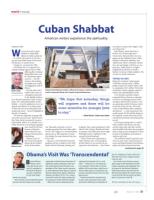
Havana‘s Beth Shalom includes a 300-seat sanctuary, a Jewish community center, a
Jewish community library and a Jewish community pharmacy.
“We hope that someday, things
will improve and there will be
more incentive for younger Jews
to stay.”
— Adela Dworin, Cuban Jewry leader
was “pleasantly surprised to see the
younger generation lead our Friday night
service” and “happy to see Jewish learning
and practice is still important to Cuban
Jews despite the many obstacles they have
to live with.”
Marissa is a 2014 Brandeis University
graduate and now a student at New York
Studio School of Drawing, Painting and
Sculpture. She’s a past participant in both
March of the Living to Poland and Israel
in memory of the Holocaust and in Taglit-
Birthright Israel in celebration of the
ancestral Jewish homeland.
“What I found most captivating in
Cuba,” Marissa said, “was hearing the
Jewish Cubans we met say they do not
experience anti-Semitism — that Cubans
Obama’s Visit Was ‘Transcendental’
B
arack Obama’s
historic visit to
Cuba, the first by a sit-
ting U.S. president to
David Prinstein
the island in 88 years,
was also a milestone
for the small Cuban
Jewish community.
“We are living a transcendental, historic
moment. We have hope and very high
expectations following the restoration of
diplomatic relations between Cuba and
the United States,” David Prinstein, vice
president of the Cuban Jewish communi-
ty, told Argentina-based Agencia Judia de
Noticias/Jewish News Agency, following
Obama’s visit March 20-22. “It’s a unique
moment for both the Cuban people and
for a great part of the American people.”
Obama focused on deepening long-
neglected ties between the U.S. and
Cuba — “what the U.S. was doing was
not working,” he told Cuba in a formal
address. But he also drew a hard line on
human rights abuses, including the sup-
pression of political dissent, by the Castro
government.
Prinstein praised the achievements
in areas such as business travel, trade
and tourism following the relaxation of
are Cuban no matter their religion. They
are Cubans first.”
Beth Shalom, which draws 60 to
80 Jews every Friday night, hews
Conservative. Havana’s other two syna-
gogues are the Sephardic Center, which
includes a Holocaust exhibition, and
Adath Israel, which is Orthodox. Havana
Jews mix and mingle at all three; no one
pays dues. Adath Israel, in a rougher
neighborhood, did have to install a
barbed-wire fence to fight vandalism. The
city has two Jewish cemeteries.
TRYING TO COPE
Before the revolution, Cuba boasted
15,000 Jews among nearly 5 million
people. Today, Jews number about 1,500
in a population of 11 million. The Jewish
community remains engaged, eager for
visitors and unabashedly pro-Israel.
As its dynamic president and gov-
ernmental liaison, Dworin is responsive
to the Jews in outlying provinces while
striving to tailor Jewish activities to vari-
ous age groups nestled in Havana, where
85 percent of the Jews live. The youth
center at Beth Shalom offers computers
and Internet — a vital connection to the
world beyond. The B’nai B’rith chapter at
the Sephardic Center reflects the Jewish
community’s gratitude toward humanitar-
ian aid.
Lack of good-paying jobs in a nation
where, despite wide literacy, the typi-
cal state wage rarely tops $40 a month
amid monthly food rations has prompted
many young up-and-coming Jews to leave
for greener possibilities, particularly in
America and Israel.
The Caribbean island’s repressive econ-
omy, one-party state, restricted Internet
access and dismal attitude toward human
rights and political dissent have been
continued on page 38
the U.S. embargo on Cuba in 2015. But
American Jews never stopped visiting
Cuba, he said.
Last month, Latin American young
adults aged 25-40 interested in Jewish
culture, education and leadership met
in Havana for the Nahum Goldmann
Fellowship seminar sponsored by the
Memorial Foundation for Jewish Culture.
It was the first time the event had taken
place in Cuba since 1959.
*
The JN contributed to this JTA report.
March 31 • 2016
37