

arts & life
f i lm
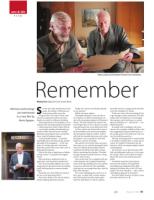
Martin Landau an d Christopher Plummer star in Remember.
Remember
Michael Fox | Special to the Jewish News
Memory and revenge
are intertwined
in a new film by
Atom Egoyan.
Christopher Plummer
S
eventy years after the liberation of the
camps, the number of Holocaust sur-
vivors grows smaller every day.
The good news? The ranks of Nazi crimi-
nals who escaped prosecution and raised
families in comfort are likewise shrinking.
These phenomena on the periphery of con-
temporary life are foregrounded in Remember
— which opened last week in Metro Detroit
— a perversely mordant and ultimately pro-
vocative thriller directed by the Canadian
filmmaker Atom Egoyan from a deceptively
clever script by Benjamin August.
A moral parable cloaked — somewhat
improbably, given the advanced age and fail-
ing health of its protagonist — in the trap-
pings of a revenge saga and a road movie,
Remember presents the viewer with a slew of
philosophical questions.
What is the value or significance of admin-
istering “justice” so long after the original
events?
Who experiences satisfaction from its
application, and what kind of satisfaction?
Does the presumably righteous act of pur-
suing justice for the great crimes of yesterday
justify inflicting harm on innocent people
today?
Should the sins of the father be visited on
the son (or the generation after)?
Does justice matter if the evil, the injuries
and the suffering slip from memory?
Finally, how much of our identity depends
on our memory?
Rabbis, start your engines.
Christopher Plummer carries the film as
Zev Guttman, an elderly nursing home resi-
dent with worsening symptoms of Alzheimer’s
disease. The silver lining of his memory loss,
to the degree there is one, is that Zev is spared
some grieving for the recent death of his wife.
Zev has a grown son, but he defers more to
the ministrations of his friend and neighbor,
Max Rosenbaum (Martin Landau). A physi-
cally frail but mentally sharp man with a plan,
Max figures a way to spring Zev from their
facility on a mission of revenge.
Max and Zev survived the same concentra-
tion camp, you see, and they had agreed (back
when Zev still had all his faculties) that he
would find and kill the Nazi officer respon-
sible for murdering their families. This dubi-
ous plan remained on hold, however, as long
as Zev’s wife was alive.
Now, on the road, Zev is equipped with just
a black dopp kit and a lengthy, handwritten
memo from Max detailing every train and bus
connection and hotel stay. (It’s remarkable
what shut-ins can arrange these days, with the
help of the Internet.)
Zev’s most challenging task, early on, is to
buy a gun. A codger with a serious weapon
and a bad memory provides ample oppor-
tunity for dark humor as well as suspense,
especially when Zev navigates back and forth
across the Canadian-U.S. border.
It’s the rare viewer who isn’t rooting for Zev
to get through customs unhindered. The film-
makers take much pleasure in encouraging
this response, and in inviting us to contem-
plate our definition of — and zeal for — “jus-
tifiable homicide.”
In another nod to intelligent, self-aware
viewers, the screenplay ruefully includes a few
lines suggesting the general obliviousness of
the average person to the Holocaust. Like it or
not, the world has moved on.
The idea of being ignored or condescended
to is familiar to people above a certain age, of
course. It is implicit in Plummer’s fine per-
formance, which encompasses dignity, denial
and humiliation.
All of which is to say that Remember skill-
fully and deliberately enlists us in Zev’s quest
for revenge. That is, until a blast of violence
pitches the movie onto another plane alto-
gether.
It should be noted that Atom Egoyan,
known for his fondness for fragmented
storytelling and complicated time shifts —
deployed to brilliant effect in his 1997 mas-
terpiece The Sweet Hereafter — takes a linear,
chronological approach in Remember.
Do not be lulled, however, for there is more
here than meets the eye.
*
March 24 • 2016
45