

metro »
continued from page 14
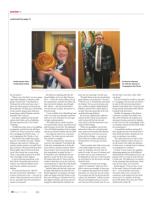
Rachel Chezick with a
freshly baked challah
she was about 7.
“When I was a bit older, I was in a group
called Job’s Daughters, a Masonic youth
group,” Chezick said. “I did identify as
Christian, but in the most basic sense. I
knew this wasn’t going to be the path my
life would take. Growing up, it seemed that
in this country, being a good American
meant being a white Christian, and that
just didn’t ‘click’ with me.”
Even before adulthood, Chezick did
explore other faiths, such as Buddhism,
but each experience felt, in her words,
“isolating.”
“I looked into other areas, even dabbling
in paganism, and felt lost, but still knew
I loved God. When I turned 20, I walked
into a synagogue for the first time — it
was Congregation Shir Tikvah in Troy.
“My parents had actually been going
there for two months,” she said, “without
telling my sister and me. I found a pro-
spective member packet in my dad’s back-
pack and knew where they had been those
Friday nights! Since I’d discovered their
‘secret’ they invited me to come along.
There, I saw people excited to be at shul,
who were happy in their religion.”
It was her growing attachment to the
Shir Tikvah community that made her
realize it was within the Reform move-
ment that she wanted to pursue her
Judaism.
“In my personal practice, I feel I’m
between Conservative and Reform — I try
to daven at least once a day — but even so,
I knew a liberal movement was a better fit
for me, especially where the treatment of
women is concerned.”
16 March 17 • 2016
Ed Chezick celebrates
his adult bar mitzvah at
Congregation Shir Tikvah.
She had been studying about the dif-
ferent holidays, but it was after Passover
2015 — where she tried to follow some of
the requirements, and after her father, Ed,
had converted to Judaism, also through
Shir Tikvah — that Chezick decided it
was time for her to begin “the process” to
become Jewish.
“I went to Rabbi Arnie [Sleutelberg] and
said I was ready to go through conversion,
and he was very excited for me and eager
to begin working together.
“We studied once a month, and there
were many books I had to read, like To Life
and Choosing a Jewish Life,” she explained.
“Once I’d finished reading, I had to explain
and discuss what I’d learned with the rabbi
— this made up much of my conversion
program. The entire process took about
nine months to complete.
“There’s a midrash about why there are
converts,” she explained. “God offered the
Torah and commandments to all the dif-
ferent nations, and they refused to follow
these precepts. Israel was the only nation
that unanimously accepted the laws. I
learned there were individuals who also
agreed to accept, but they were among
the nations that said no. These souls just
needed to find their way to the Torah and
commandments to which they had already
agreed, to find the nation that said yes.”
Rachel’s father also has had a close rela-
tionship with Judaism his entire life and,
Rachel explained, “according to my mom,
dad’s only happy when he’s living as a Jew.
His years of living as a Christian were the
least happy of his life, and mom said even
though he called himself a Catholic, she
knew she was marrying a ‘Jewish’ man.
“My dad’s desire to become Jewish had a
great influence on my decision,” she said.
“When he was 17, he left home and joined
the military. He was sent to Europe, and
met a military chaplain, Rabbi Rayfield
Hellman, who became a father figure to
my dad. This had a great deal to do with
my dad embracing Judaism.”
Ed, who just celebrated his adult bar
mitzvah at Shir Tikvah in late January,
said he always felt he had a Jewish
soul, and his early life experiences only
enhanced that feeling.
“When my grandfather was ill with
tuberculosis, there was a Jewish gentle-
man, known in the family affectionately
as ‘Zolta the Jew,’ who took care of my
father and his siblings — even giving
them brand new clothes and shoes at
Christmastime. He also gave my dad a
duck!
“I knew another man while in the army,
a real tzadik [righteous man], whose
name I’ve forgotten, who also took me
under his wing. We were in Germany and
for three years on each anniversary of
Kristallnacht he took me to where he grew
up and relayed to me the horrors through
which he lived.
“I identified as Jewish even in high
school,” he continued, “and I now feel I
didn’t convert soon enough. At least now
I’ve completed the paperwork. By finally
doing this, I’ve come into my true nature.
I’ve accepted not only Torah, but also the
culture, the ‘Jewishness.’ I think everyone
who goes through the process of conver-
sion was born with a Jewish soul. For me,
the first time I went into a shul, I felt I
was home.”
Ed’s wife insisted he needed to “get back
to a synagogue.” Because she isn’t Jewish,
he said, he felt that practicing Reform
Judaism would allow him to remain in his
loving marital relationship while still fol-
lowing Jewish observance.
Notably, the language of the Reform
conversion certificate does differ from
that of the Orthodox and includes one’s
attesting to having converted to Judaism
of one’s own free will, and pledging “loyal-
ty to Judaism and the Jewish people under
all circumstances.”
A remarkable similarity among all of
these people who have become Jewish is
their belief that all Jews should strive for
unity in relating to one another.
“It’s really unnecessary to call us ‘Jews
by choice’,” Solomon noted, “because we
are all Jewish. Even within the divisions
of observance, we should work to enhance
our togetherness in Judaism.”
Ed said, “I never want to say anything
disparaging against any of the different
denominations within Judaism. In fact, my
greatest wish is to work to erode the barri-
ers that exist. The differences can remain;
it’s the separation that should stop. I don’t
want ‘Jew by choice’ to be a barrier.”
Rachel agreed. “Truly, as Jews, we are
all the same. I believe in Jewish unifica-
tion — we’re all brothers and sisters.
No matter where I am, I am part of a
community, with people who care about
me because I’m a member of the big-
ger Jewish family. We’re all a part of that
whole Jewish world.”
*