

arts & life
mus i c
details
PHOTO BY MITTY CARTER
The Tender Land will be
performed Saturday-
Sunday, March 12-13,
at the Macomb Center
for the Performing
Arts in Clinton
Township and March
19-20 at the Heinz C.
Prechter Educational
and Performing Arts
Center in Taylor. $50-
$55. (313) 237-7464;
michiganopera.org.
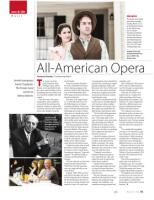
Angelea Theis and
Joseph Michael Brent
star in MOT’s The
Tender Land.
All-American Opera
Suzanne Chessler | Contributing Writer
Jewish composer
Aaron Copland’s
The Tender Land
comes to
Metro Detroit.
T
he Tender Land, the
next production of the
Michigan Opera (MOT)
Theatre, is not specifically Jewish,
but it does express feelings of Jews
assimilating into the American cul-
ture toward the middle of the 20th
century.
That’s the sense of the opera
composed by Aaron Copland as
previewed by Howard Lupovitch,
professor of history at Wayne State
University, where he also is director
of the Cohn-Haddow Center for
Aaron Copland
wrote The Tender
Land after viewing
the Depression-era
photographs of
Walker Evans.
PHOTO BY MITTY CARTER
Ken
Saltzman
Jewish Studies.
Lupovitch recently discussed
the work, with libretto by Horace
Everett, during a program at the
Berman Center for the Performing
Arts in West Bloomfield, where
MOT singers performed selections
from the production.
The opera, to be staged March
12-13 at the Macomb Center for
the Performing Arts in Clinton
Township and March 19-20 at the
Heinz C. Prechter Educational and
Performing Arts Center in Taylor,
takes place on a family farm in the
1930s. A young woman, about to
graduate high school, falls in love
with a drifter and is torn between
staying on the farm and moving.
The opera premiered in 1954 at
the New York City Opera, directed
by Jerome Robbins. This season,
performances are based on MOT
presentations of the work in 1971,
when Copland was the conductor;
it will be conducted by Suzanne
Mallare Acton, MOT assistant
music director and chorus master.
“Copland was part of the second
generation of Jewish immigrants
to America so this is much about
becoming an American,” Lupovitch
explains. “He celebrates being an
American and the greatness of
America.
“For him, adversity was the Great
Depression, the Dust Bowl and
World War II. He felt Americans
were very tough and able to over-
come all that.”
Copland, (1900-1990) was born
and raised in Brooklyn, the son of
Jewish immigrants from Lithuania.
He first learned piano from his sis-
ter, went on to private teachers and
studied in France. His early classi-
cal compositions often included the
sounds of jazz, and projects ranged
through symphonies, ballets and
film scores (Our Town, Of Mice and
Men). He wrote articles and books
about music, taught at universities
and immersed himself in conduct-
ing during later years.
Lupovitch, describing Jewish life
in these times as sharing solidarity
with American culture, explains
that Copland is not trying to trans-
plant songs and sounds from the
shtetl because that had been done.
“To be Jewish in that generation
is to be part of it,” the professor
says. “The young couple in the
opera is living at a time when farm-
ing is becoming more difficult,
and they have to make a choice.
Do they go on living the way they
have been or do they try something
else? Copland saw that choice as
distinctly American.”
Lupovitch compares choices in
the opera to those made by young
members of the Metro Detroit
Jewish community: The young
adults who had to leave to find
themselves but came back to recon-
nect with what they knew.
“[Copland] wrote about a
moment of dissonance and ten-
sion,” Lupovitch says. “But, ulti-
mately, the story he told and the
music always resolved.”
Copland and his generation
had a deep appreciation for being
in America because they knew
what the rest of the world was like,
Lubovitch says.
The piece resonates on a per-
sonal level with experiences of Ken
Saltzman, the production stage
manager who establishes com-
munication among personnel and
schedules work.
This is Saltzman’s 15th season at
MOT, where his 50th production
was The Passenger, an opera about
a former Holocaust guard.
“I like that The Tender Land
harkens back to a simpler time
while presenting a timely issue —
being skeptical of strangers,” says
Saltzman, 55, whose assignments
take him to different opera com-
panies, including Hawaii Opera
Theatre and Arizona Opera.
“Two unknown men cause a
disturbance in the next town over
from the family farm while two
unknown men show up at the farm
looking for work. The men seeking
work are assumed to be the guys
from the other town, but they are
not.
“I’ve certainly felt xenophobia,
not only as a Jew but also as a gay
man. Being one of few Jews in my
school system, I didn’t experience
outright abuse or bullying, but I’ve
always been aware of being that
different person in a sea of others.”
Saltzman, who lives in New York
state but recently attended the bat
mitzvah of a cousin at Temple Shir
Tikvah in Troy, has watched a DVD
from the 1971 production of The
Tender Land.
“One of the musical pieces I
really enjoy is the finale in Act
I,” Saltzman says. “It’s a beautiful
piece called ‘The Promise of Living.’
I think that anyone who knows
Copland will probably recognize it.
“Throughout most of the show,
we hear one or two voices, but at
the end of the first act, these voices
come together to express their
perspectives on life, and it’s a lovely
moment.”
*
March 10 • 2016
43