

metro »
U.S.
Ends
MJI
Aid
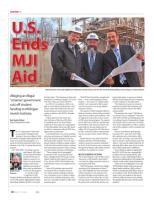
Administrators Fred Leeb, Rabbi Kasriel Shemtov and Dov Stein in 2014 at the site of the MJI building on the Campus of Living Judaism.
Alleging an illegal
“scheme,” government
cuts off student
funding to Michigan
Jewish Institute.
Keri Guten Cohen
Story Development Editor
T
he U.S. Department of Education
is accusing the Michigan Jewish
Institute, a four-year college in West
Bloomfield, of illegally obtaining federal Pell
Grants in its study abroad program. As a
result, the DOE has denied the school recer-
tification in the Title IV student financial aid
program.
From 2009-20015, according to govern-
ment figures, MJI collect-
ed more than $50 million
in federal Pell Grants to
disburse, mostly for stu-
dents in its study abroad
program. MJI retains a
significant percentage of
these funds as administra-
tive fees for that program.
Rabbi Kasriel
In a sternly worded
Shemtov
17-page letter to MJI
President Rabbi Kasriel Shemtov dated Feb.
25, the DOE outlines alleged federal student
aid funding violations by MJI. At one point,
18 March 10 • 2016
the letter states: “The Department will permit
this scheme to continue no longer.” (To see the
DOE letter online, go to bit.ly/1LbvEFE.)
As of Feb. 29, no students at MJI are eli-
gible to receive federal student loans or Pell
Grants, unless MJI is able to have the certi-
fication decision reversed, based on infor-
mation it submits to the DOE by Thursday,
March 10.
Federal agents last July seized more
than 100 boxes of files from MJI offices
in Southfield and at The Shul-Chabad-
Lubavitch on the Campus of Living Judaism
in West Bloomfield, where some MJI classes
are held, in conjunction with the DOE inves-
tigation into recertification.
In its detailed letter, in a section including
interviews and analyses of LinkedIn accounts
for 28 MJI students studying in Israel, the
DOE claimed the students “were not ‘study
abroad’ students enrolled as regular students
at MJI who then traveled overseas to enhance
their educational experience before securing,
or at least further pursuing, an MJI degree.
“These students had no meaningful
connection to MJI, except that MJI used
them to illegally obtain Pell Grants on their
behalf,” stated the letter signed by Susan D.
Crim, director, DOE’s Federal Student Aid
Administrative Actions and Appeals Service
Group.
Nearly all 28 students interviewed did
not mention MJI on LinkedIn and most
were Israeli residents studying at Machon
Lev in Jerusalem or Ono Academic College
in Kiryat Ono, Orthodox institutions. Most
also were “ostensibly enrolled” in MJI’s study
abroad program.
The DOE letter has further examples that
show — from a small sampling of former
students — how some U.S. students admit-
ted they “were connected to MJI on paper
only for the purpose of securing religious
education overseas.”
The majority of MJI’s estimated 2,000 stu-
dents are American citizens living and study-
ing in Israel at yeshivot and seminaries, who
are supposed to take online courses as part
of MJI’s study abroad program. The majority
receive Pell Grants, which can provide more
than $5,000 to each American student. The
grants help low-income students pay for
college. The JN reported in 2013 that about
$2,650 is retained by MJI for administrative
fees; the rest goes to host schools, MJI had
said.
Kasriel Shemtov, also rabbi at The Shul-
Chabad-Lubavitch in West Bloomfield,
would not respond to questions submitted
by the JN. He did, however, issue a statement
through Mort Meisner, MJI’s public relations
consultant. (See sidebar for excerpt.)
MJI TO CONTEST ACTION
The JN also obtained a copy of MJI’s written
“Statement to MJI Students” dated March
1 in which the college expressed surprise at
receiving the DOE letter.
“After having been considered an eligible
institution by the Department of about 17
years, MJI’s eligibility has been terminated
without due process,” the statement, sim-
ply signed Michigan Jewish Institute, said.
“Instead we have been offered the very lim-
ited opportunity to submit [by March 10], to
the person who rendered this decision, any
factual information we possess in rebuttal.
MJI has already begun the task of preparing
a written response to the Department.
“The Department’s action is extremely
harmful and unfair,” MJI’s statement read.
“MJI will contest the action to the fullest
extent possible.”
The statement also stated, “MJI believes
it is and has been in compliance” with rules
of the DOE and MJI’s accrediting agency, the
Accrediting Council of Independent Colleges
and Schools (ACICS), and cited a 2014 letter
from ACICS stating MJI was “fully accredited
and in full compliance with its standards and
criteria.”
This last accreditation, good through
December 2017, came from ACICS after
three deferrals and a critical look at MJI’s
records. After receiving a copy of the DOE
letter to Shemtov, ACICS president and CEO
Albert C. Gray sent the rabbi a letter Feb. 29
directing MJI to show cause why its accredi-
tation status should not be withdrawn.
“As an official accreditor recognized by
the DOE, ACICS also has a responsibility
to enforce the laws among schools,” said
Jake Lynn, a source representing ACICS, a
national accrediting agency that handles 850
schools, mostly career-oriented institutions.
“There are a lot of allegations,” Lynn said.
“ACICS believes firmly in due process and
doesn’t hastily withdraw. [But] to allow a
school to misrepresent itself affects them as
an accreditor as well. The last thing ACICS
wants to do is put students on the streets
with lost credit and money. It was nothing
the students did, but issues with the admin-
istration.”