

metro » on the cover
Loss And
Legacy
Rabbi Morris Adler’s life still resonates
50 years after his tragic death.
Barbara Lewis | Contributing Writer
Historic Photos | Congregation Shaarey Zedek Archive
I
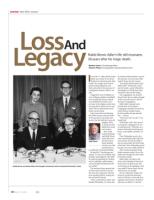
Rabbi Morris and Goldie Adler with daughter Shulamith and her husband, Eli Benstein (1964)
10 March 10 • 2016
t was Feb. 12, 1966, and the Frank
family was excited. It was Steven
Frank’s bar mitzvah day. His older
brother Jay, younger sister Francie,
parents and grandparents were
front-and-center in the sanctuary of
Congregation Shaarey Zedek to see
him.
Gregg Orley went to Shabbat ser-
vices at Shaarey Zedek in Southfield
as he usually did. His bar mitzvah
was scheduled for October, and
everyone in his religious school class
was expected to attend services reg-
ularly. The bar mitzvah boy, Stevie
Frank, was his friend.
Judy Cantor had arrived during
the rabbi’s sermon, when the doors
to the sanctuary were closed, and
stood in the hall with her 4-year-old
daughter, Ellen.
A young man she
didn’t know stood
next to them.
Steve Frank
read the haftorah,
and Rabbi Morris
Adler delivered a
forceful sermon
Judy Cantor
about Abraham
Lincoln, one of his
personal heroes,
in celebration of Lincoln’s birthday.
He asked for “Lincolnesque per-
ception” to “meet our problems with
humility, with judgment, with faith.”
He ended by appealing for “healing
and not suffering, understanding
and not hostility, brotherhood and
not conflict.”
The sanctuary doors opened and,
as Judy Cantor made her way into
the room, the young man who had
been standing with her rushed past
her and onto the bimah.
“I have a statement to make,” said
Richard Wishnetsky, 23, whose fam-
ily, Shaarey Zedek members, were in
the sanctuary to see his sister Ellen
read the Prayer for the Country.
“Everybody off the bimah except
Rabbi Adler!” Wishnetsky contin-
ued. He raised a sawed-off pistol he
had bought at a Toledo pawn shop
and fired a shot into the ceiling.
The congregation was stunned.
Bryna Frank, Steve’s mother, thought
at first it was the start of a skit for
the Junior Congregation.
Rabbi Adler remained calm.
He told those on the bimah —
Congregation President Louis Berry,
Cantor Reuven Frankel, Cantor
Jacob Sonenklar, the bar mitzvah
boy — to leave.
“This boy is sick,” he said. “I can
handle him.”
Wishnetsky read a short speech
accusing the congregation of van-
ity and hypocrisy. “With this act, I
protest a humanly horrifying and,
hence, unacceptable situation,” he
said.
Then Wishnetsky moved a few
steps toward Rabbi Adler and fired
several shots. One hit the rabbi in
the arm and another hit the left side
of his head. Then Wishnetsky placed
the gun to his own temple and fired.
Steve Frank had jumped off the
bimah moments earlier. One of the
bullets tore through the chair where
he had been sitting.
Rabbi Adler was taken to the
former Sinai Hospital of Detroit on
Outer Drive. He spoke to his wife
several times in the ambulance, and
even asked if Steven Frank, the bar
mitzvah boy, was all right.
He was rushed into surgery, but
before he reached the operating
room, he fell into a coma and never
regained consciousness. He died 27
days later, on March 11, with his