

world » commentar y
An Endless Spiral Of Violence?
T
he Palestinian terror attacks are end- Another worshiper was comatose until he
less, a friend moaned recently.
died of his wounds a year later.
But the wave of attacks lacks not
That was a terrible month when it came
just ending but also a definite starting point. to the toll of Palestinian terrorism: Dalia
For some, the latest mini-intifada
Lemkus, 26, of Tekoa was stabbed
began on Oct. 1, 2015, with the hei-
to death at a bus stop near the
nous attacks in which Rabbi Eitam
entrance to Alon Shvut; Sgt. Almog
Henkin and his wife, Na’ama, were
Shilony, 20, was stabbed and killed
killed in front of their four young
at Tel Aviv’s Haganah train station;
children in a roadside shooting.
Border Police Inspector Jidan Assad
Others consider that it started
and 17-year-old yeshivah student
two days later in the Old City of
Shalom Aharon Badani were both
Jerusalem when Aharon Banita-
killed by a Palestinian ramming a
Liat Collins
Bennett, 22, was stabbed to death
car into a crowd near a Jerusalem
Jerusalum Post
on his way to the Western Wall
light rail station.
Opinion
with his wife and two young chil-
In October 2014, Chaya Zissel
dren; Rabbi Nehemia Lavi, a father of seven, Braun, aged three months, was killed in a
was killed as he came to the family’s aid.
similar attack at the same place, when a car
Others start counting from the death of
driven by a Palestinian threw her from her
Alexander Levlovich, 64, in Jerusalem when stroller as the terrorist rammed into a crowd.
rocks were thrown at his car as he drove
Karen Jemima Mosquera, 22, of Ecuador,
home from a Rosh Hashanah meal with his
died of her wounds a few days later.
family.
Before that, there was Operation
There have been more than 30 deaths as a Protective Edge, the war in Gaza, in which
result of Palestinian violence in the last five
64 Israel Defense Forces soldiers and six
months, a recent victim being IDF Reserve
civilians were killed by Hamas, including a
Capt. Eliav Gelman, who died on Feb. 24
4-year-old boy killed when a mortar shell hit
as the result of an attack at the Gush Etzion
his home.
junction.
And before that, in June 2014, there was
But starting the list of violent incidents
the kidnapping and murder of the three
last September is artificial. Ask the fam-
teenagers Eyal Yifrach, Gil-Ad Sha’er and
ily of Malachi Moshe Rosenfeld, 26, fatally
Naftali Fraenkel. That was preceded by the
wounded in a drive-by shooting near Shiloh death in May of Shelly Dadon, killed by an
on June 29 or of Danny Gonen, 25, killed 10 Arab taxi driver on her way to a job inter-
days earlier in a shooting attack after visit-
view. Passover 2014 will be remembered for
ing the Ein Buvin spring near Dolev in the
the death of off-duty police officer Baruch
Binyamin Region.
Mizrahi, on his way to a Seder night meal.
Shalom Yohai Sherki, 25, run down and
Permit me to skip naming victims — the
killed at Jerusalem’s French Hill junction in
information is available on the Foreign
April was a victim of the same terrorism.
Ministry website that notes that “1,303 peo-
And Purim in Jerusalem last March was
ple have been killed by Palestinian violence
also marred by a ramming attack on border
and terrorism since September 2000.”
policewomen at the same spot, fortunately
LONG HISTORY
without fatalities.
There were five fatalities, four rabbis and a But why stop there? There was also the first
intifada (1987-1991) and the victims of the
Druse policeman, who rushed to help when
1993 Oslo Peace process and many — too
two Arabs armed with butcher knives and
many — before those waves of violence.
a gun attacked a synagogue in Jerusalem’s
Sadly, a look at the list of names, places
Har Nof neighborhood in November 2014.
30 March 3 • 2016
and dates of death shows that this is not
something new. This isn’t about the (care-
fully maintained) status quo of Al-Aqsa
Mosque and the Temple Mount. It predates
“the settlements” and the 1967 Six-Day War.
It started before the birth of the State of
Israel in 1948.
There were waves of Arab violence in the
1930s and 1920s and long, long before that.
Daniel Pipes notes some “milestones” in
what is now known as the Israeli-Palestinian
conflict including incidents such as the Oct.
2, 1938, massacre in Tiberias (part of the
1936-1939 “Arab Revolt” in British Mandate
Palestine) in which Arabs killed 20 Jews,
among them 11 children.
The 1929 massacre of Jews in Hebron
(where Jews had lived for generations) took
the lives of 67 members of the community.
According to Pipes, in 1920 there were
142 pogroms and 36 lesser “riots” against the
Jews, incited by Mufti Haj Amin al-Husseini.
The first attack by Arabs on a Jewish com-
munity in this area took place in 1886 in
Petach Tikvah, he notes.
His time line begins in June 1834, in
Tzfat. “[The] First recorded attack on native
Jews in Israel by Muslims ... the massacres
and mass rapes went on for 33 days.” It was
repeated in 1838.
EDUCATING YOUTH
That’s why I laughed when a friend told me
last week that when his first child was born
in the early 1990s, he genuinely believed
that there would be no need for him to serve
in the IDF when he reached the age of 18.
By the time my son was born in
September 2001, well into the second inti-
fada, I don’t think many people had illusions
that peace would break out.
When I saw the cover of the latest edition
of the Jerusalem Report with its headline
“What’s radicalizing Palestinian youth?” I
couldn’t help but snort: “Palestinian adults.”
IDF Chief of Staff Gadi Eisenkot trig-
gered a debate when he said, “When there’s
a 13-year-old girl holding scissors or a knife
and there is some distance between her and
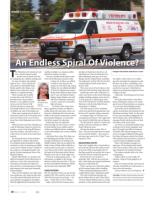
A Magen David Adom ambulance in Israel
the soldiers, I don’t want to see a soldier
open fire and empty his magazine at a girl
like that, even if she is committing a very
serious act. Rather, I want to see that soldier
use the force necessary. I think that our
soldiers are professional enough and moral
enough to do that.”
I salute him. Neutralizing need not mean
killing.
One of the characteristics in this latest
phase of Palestinian violence is the young
age of many of the perpetrators, as young as
11 in one (non-fatal) stabbing incident.
Some of this can be attributed to the
culture of martyrdom and incitement in the
Palestinian territories. Partly, it is the result
of even more incendiary propaganda and
hate by Islamic State, which distributes its
message of death and destruction via slick,
sick videos on the social media.
Last week, in a particularly deadly string
of attacks even by Syrian standards, more
than 150 people were killed in Damascus
and Homs. ISIS released footage of a boy,
not yet a teenager, bidding his father good-
bye before driving an armored truck laden
with explosives into Syrian forces, assured of
a martyr’s death and jihadist’s paradise.
That is why Eisenkot’s message is so
important. The last thing Israelis should
want is for its youth to focus only on suffer-
ing, victimhood and venting frustration.
The violence stretches back so far it has
no beginning.
Neither is there an end in sight. We,
therefore, will go on being judged by our
response.
It has to be moral and fair, not because of
what the world thinks of us but because we
have to live with ourselves.
And we intend to carry on living here.
*
Liat Collins is the editor of the International Jerusalem
Post and has won acclaim for her environmental report-
ing and coverage of Israeli diplomacy and the Knesset.