

Photos by Jacob Giampa
metro » o n the cover
Detroit City Moishe House
Indian Village location can create a hub of young Jewish life in the city.
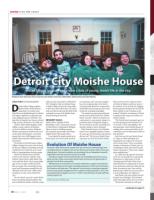
Residents show they know how to have fun: Dan Hacker, Paul Green, Abby Rubin, Hayley Sakwa and Gabe Neistein.
Adam Finkel | Contributing Writer
D
etroit’s Indian Village neighbor-
hood has had a Jewish presence
going back to its earliest years.
Noted lawyer and philanthropist Leo Butzel,
who began a legal firm to represent Great
Lakes shipping concerns, lived there. The
legal firm he founded, now known as Butzel
Long, exceeds 140 lawyers in its 160th year.
Architect Albert Kahn’s daughter, Lydia
Malbin, a major collector of European
art, lived on Jefferson Avenue. Benjamin
Gladwin, prominent in business and social
circles, lived at 866 Iroquois, a mere four-
minute drive from 3460 Iroquois, where
Moishe House opened its 86th location in
late January.
The location in Detroit’s historic Indian
Village is designed to create a hub of Jewish
life for post-college 20-somethings and help
revitalize the city, which has seen a recent
influx of young graduates and new energy.
Detroit City Moishe House (DCMH)
is home to five dynamic residents: Gabe
Neistein, Hayley Sakwa, Abby Rubin, Paul
Green and Dan Hacker. These young adults,
ages 23-28, are eager to build and create
their own grass-roots community by host-
ing at least 60 programs annually that will
ultimately reach more than 1,000 in total
attendance over the course of their first
year.
The new launch is part of a major Moishe
House international growth initiative that
aims to double the number of Jewish, young
adult, peer-led communities worldwide by
2017. Residents of the new Moishe House
in Indian Village will provide young adults
in their 20s a home where they can connect
with each other locally and also build off the
continued successes of the Moishe House
already thriving in Royal Oak.
RESIDENT GOALS
Hayley Sakwa, originally of West
Bloomfield, is now a community associate
at United Way for Southeastern Michigan.
Sakwa is drawn to building meaning-
ful community partnerships and hosting
Shabbat dinners that inspire others.
“I was inspired by people around me in
Jewish spaces who were actively involved
in community, and I was lucky enough to
have a lot of opportunities in the Jewish
community that allowed me to gain profes-
sional skills and encourage my peers to get
involved in something meaningful.
“I’m excited to be partnering with great
friends to kick off the Detroit City Moishe
House,” she said. “I believe in the power of
communities to create positive change. I’m
passionate about enacting that change in
the city of Detroit, and I’m constantly learn-
ing and working to achieve that goal.”
Gabe Neistein has been a fan of Moishe
House since it originally opened in Detroit
five years ago. The Tamarack Camps alumni
director said, “My first-ever Moishe House
experience was at the first Detroit Moishe
Evolution
Of Moishe House
Founded in 2006, Moishe House started when four Jewish 20-somethings began host-
ing Shabbat dinners in Oakland, Calif., for their friends and networks. Moishe House was
originally part of a private foundation, but transitioned into an independent nonprofit
organization when the economic recession hit in 2008.
Through the support of several early funders and snowballing interest from young
adults and their Jewish communities, Moishe House has become the global leader of
pluralistic Jewish life for young adults.
With 86 houses in 20 countries, its innovative model trains, supports and empowers
young Jewish leaders as they create meaningful experiences in their local communities
for themselves and their peers. Their approach is becoming an increasingly recognized
avenue for young adult engagement that is scalable and easily replicated. In 2015, their
young adult leaders engaged more than 115,000 in total attendance through 6,000-plus
unique programs.
*
To learn more, go to moishehouse.org.
House on Ferry Street. I had just moved
to Detroit in Midtown and knew many of
the residents. It was my first real, engaging
Jewish experience living in the city and one
that I attribute to why I continue to stay
involved.” Neistein’s commitment to Detroit
is inspired by the energy and resiliency of
Detroit residents.
“The Detroit Jewish community gave me
so much growing up and continues to do
so,” he said. “I feel a responsibility to the
next generation. I have had the pleasure of
working with so many great leaders in the
community, and I am motivated to follow in
their footsteps.”
Paul Green sees the new Moishe House
as “a place in which individuals and
organizations can coalesce for social and
service-based events.” Green, an assistant
manager at Moosejaw in Detroit, grew up
in Huntington Woods. He’s drawn to mak-
ing the community a “better, more vibrant,
more equitable place.”
As a child, the only exposure Green had
to the city was through the occasional trip
Downtown to a Tigers game or for the
Thanksgiving Day Parade. When Green
realized he’d have an opportunity to be part
of an intentional community within the city
limits, he wasted no time. Even with the
imperfections within the city, Green feels it
is an incredible place to be right now.
Abby Rubin is the only resident who did
not grow up in Michigan. The Cleveland
native feels right at home in the new house.
“Detroit has welcomed me with open
continued on page 12
10 March 3 • 2016