
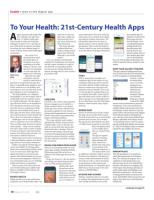

health » je ws in the digita l a ge
To Your Health: 21st-Century Health Apps
A
pple’s App Store and Google Play
(for Android) each offer more
than 1.5 million mobile apps.
That’s enough to make your head spin
looking for an app to serve a specific pur-
pose. While there are apps for just about
everything, the most common inquiry I
receive is always about which health apps I
recommend.
Sure, many of us
download those mind-
less puzzle games to
our phone so we have
something to do while
sitting in a doctor’s wait-
ing room, but ultimately
we crave apps that will
improve our well-being.
Rabbi Jason
Apps that let us play
Miller
word games with our
friends or shoot birds at
pigs keep us occupied, but the apps that
keep us responsible about taking our med-
ication, motivate us to eat healthier and
encourage us to run one more mile are the
game changers in our technology lives.
My late grandfather was a longtime
dermatologist. I can only imagine what he
would think of the 21st century’s innova-
tive mobile health apps. The idea that an
app called First Derm can be installed on
your smartphone and then used to diag-
nose skin cancer is revolutionary. Many
physicians aren’t thrilled about some of
these apps, like First Derm, which make a
trip to the local doctor nearly obsolete, but
that is where tech innovation is taking us.
Health apps come in several categories,
and it is important to know the difference.
There are fitness apps for exercise and per-
sonal training — many work in combina-
tion with a smart watch or other wearable
to track your distance, speed and calories
burned. Some fitness apps now offer a vir-
tual trainer to motivate and teach.
Medical apps can be used to remind you
to take prescriptions, measure your blood
sugar and even track dialysis treatments.
Finally, very popular nutrition apps are
used to eat healthier by tracking calorie
intake and recommending nutritious foods
to eat. In recent years, these apps have
added such features as personal coach
options, video demonstrations of exercises
and social media integration. With the fit-
ness and nutrition apps, you can challenge
family and friends to competitions.
Here are some of the most useful and
user-friendly health apps available today.
Most are available in both Android and
iOS (Apple) versions.
MANGO HEALTH
Mango reminds you to take medications
and guides you to build healthy habits. Not
only does it track your
daily steps, weight and
blood pressure, but it
also warns about adverse
drug interactions.
Like many apps that
combine fitness and
medical, Mango awards
points and rewards for
adhering to your health
routine.
Users can schedule customized pill
reminders for medications and vitamins,
and also request reminders to weigh in
and drink the recommended amount
of water each day. Mango Health gives
advance warning when it’s time to order a
prescription refill.
CAREZONE
CareZone is one of these robust apps that
help you manage your own health or a
family member’s health. A nice feature
of this app is the journal, which lets you
document symptoms for easy reference
during medical appointments, record your
doctor’s instructions and privately share
updates with family members.
The in-app calendar tracks medical
appointments, therapy sessions and pre-
scription refills. Access to the data can
easily be synced with other devices and
shared with others’ calendars. There’s a
section for data storage, where the app
recommends keeping hospital discharge
instructions, advance directives, medica-
tion lists, refill dates and photos of impor-
tant documents.
DRUGS.COM MEDICATION GUIDE
There are an increasing number of medi-
cation apps available, including MediSafe,
Pill Reminder and Pills on the Go, in
addition to the health apps that have this
feature.
Drugs.com, however, is the best app for
researching prescription drugs because
it lets you look up drug information,
identify pills, check
interactions and set
up your own personal
medication records.
After listing your daily
medications, you can
access in-depth con-
sumer information, FDA alerts and drug
interactions, not to mention food, allergy
and medical condition interactions. The
pill identifier feature lets you enter an
imprint, shape or color to quickly search
the database. There is also the Symptom
Checker, which lets you check the databas-
es for side effects and dosage information.
FITBIT
With so many fitness wearables and
companion apps on the market, it’s very
confusing to determine which is best for
your fitness lifestyle. FitBit’s mobile app,
however, remains one of the most com-
prehensive and user-friendly. This is why
it is the top app for tracking all-day activ-
ity, workouts and health. Connecting the
app with Fitbit’s many activity trackers or
smart scales gives you a thorough picture
of your daily fitness stats, like steps taken,
distance, calories burned, sleep, weight
and more.
WEBMD BABY
Parents of newborns have always wished
they had a doctor in their home around
the clock because there are so many health
questions and concerns. It’s no wonder
this app has been downloaded more than
1.5 million times by parents to track their
baby’s development and
receive reliable advice
that was created by phy-
sicians.
The app has separate
trackers for feeding,
diaper changes and
sleep. There’s also a
growth chart and a place
to store photos of the
baby’s key milestones. A
new feature allows users
to collaborate with other relatives and sync
the data across all devices. The app has a
resource center with hundreds of articles
and videos as well as a forum for parents
to ask questions of other parents and
health professionals. (A comparable app is
BabyConnect that has many of the same
features as WebMD Baby.)
MYSUGR AND GLOOKO
Diabetes companion apps are very popu-
lar and have been improved upon in recent
years. MySugr and Glooko are two of the
more popular apps for
diabetics to monitor their
blood sugar and track
their food intake. Users
can upload their glucose
reading directly from
their glucometer and
back up data for com-
parison tracking. Most of
these diabetes apps allow
users to download data
from any of the popular insulin pumps and
CGMs (Continuous Glucose Monitor) on the
market.
BABY FOOD ALLERGY TRACKER
This app is aimed at helping parents keep
track of which foods they have fed their baby
in order to pinpoint any potential allergic
reactions. A section
for untried foods
acts as a to-do list,
and parents can
check those foods
off the list once
they have been
attempted. Tapping
on a food item
brings up a notepad
to record the child’s
reaction and any information to present to
the physician. Users can record foods for
multiple children and also keep track of the
food allergies of other relatives to track any
genetic history with particular foods. Blogger
Erin Konheim Mandras of KickTheScale.
com, who often writes about children’s food
allergies, called Baby Food Allergy Tracker
“an essential app when it comes to monitor-
ing and tracking food allergies and reactions
in a child. Food allergies can get overwhelm-
ing and this app simplifies the process.”
MAKEMYPLATE
This diet app platform is an Israeli inno-
vation that is garnering a lot of attention
lately. Not a diet plan or program, this is
a platform to make dieting more acces-
sible and easier for the user. MakeMyPlate
provides a full solution to managing a diet,
which begins with choosing a diet plan cre-
ated by professionals and building a meal
plan based on preferences. The key factor
is keeping all food intake and exercise bal-
anced. MakeMyPlate offers personal tips and
support from other users and professional
nutritionists.
continued on page 50
48 February 25 • 2016