
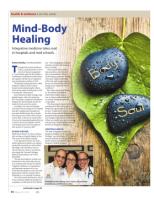

health & wellness » o n the cover
Mind-Body
Healing
Integrative medicine takes root
in hospitals and med schools.
Ruthan Brodsky | Contributing Writer
T
hroughout the nation’s healthcare
system, a growing trend is to move
away from disease management
to a more holistic approach that includes a
combination of mainstream medical thera-
pies together with the best of complemen-
tary and alternative medicine (CAM).
This blended medical approach is called
Integrative Medicine (IM), a patient-
focused model emphasizing the relation-
ship between patient and physician as well
as treating the “whole person.”
Some treatments include massage, yoga,
guided imagery, reiki and acupuncture.
IM is becoming a component of healthcare
programs for many hospitals and also for
medical schools across the country.
According to the American Hospital
Association, the percentage of U.S. hospitals
that offer complementary therapies has
more than doubled in less than a decade,
from 8.6 percent in 1998 to almost 20 per-
cent by 2004. A 2010 survey reported that
42 percent of responding hospitals offer one
or more CAM services together with the
conventional services they normally pro-
vide, up from 37 percent in 2007.
IM AND JUDAISM
Rabbi Jeremy Baruch, 30, chose medicine
after serving as a hospital chaplain in New
York as part of his rabbinic training.
“I was inspired by doctors who used a
holistic approach for patient care, integrat-
ing the best of pastoral care with medical
knowledge, and I decided to return to
school to become a doctor,” says Baruch,
who attends the University Michigan
Medical School and grew up in West
Bloomfield.
“The idea that healthcare includes care-
ful attention to the mind, body and soul
is an ancient Jewish concept,” he explains.
“Integrative Medicine is a contemporary
and important expression of the core
Jewish idea that people are more than their
physical body and that caring for others
holistically is a core principle in Judaism.
“Our Torah teaches that humans, with all
of our emotional, intellectual and physical
complexity, are reflections of God,” Baruch
continued on page 46
44 February 25 • 2016
says. “Acknowledging and caring for
ourselves and others thus becomes a
form of worship.
“Protecting the life of another
takes precedence over almost all
other commandments. When we
ask for healing, we pray for healing
of the spirit (nefesh) and healing
of the body (guf), recognizing that
the two are intertwined and that the
healing of one without the other is
insufficient.”
His younger sister Sarah Baruch,
25, also attends U-M Medical
School (their brother, Adam, is
now an ob/gyn resident there) and
is currently rotating through medi-
cal specialties.
“Practicing yoga for many years has
transformed my life, and my goal is to
bring those yoga concepts to my practice,”
she says. “People tend to look for a quick
fix when facing medical challenges, not
giving themselves enough credit for their
own strength. If they become more aware
of their own health, more open to learning
and practicing a healthy lifestyle, they will
be better at facing these challenges.”
HOSPITALS AND IM
“We think of Integrative Medicine as
integrative healthcare at the University of
Michigan,” says Sara Warber, M.D., clinical
associate professor at U-M’s department of
family medicine and director of the U-M
Integrative Medicine Program.
U-M Medical School siblings (2013): Adam, Sara and Rabbi
Jeremy Baruch, all of West Bloomfield.