

metro »
Volunteer Responders
Leaders champion Israeli program to improve city’s emergency response time.
Courtesy United Hatzalah
Shari S. Cohen | Contributing Writer
W
aiting for emergency medical
care can be frustrating and
frightening because delayed
treatment can have serious medical conse-
quences. Detroiters have complained about
slow emergency response time for years.
“A real crunch item
is the response time
for EMS,” says Mark
Davidoff, Michigan man-
aging partner for Deloitte
in Downtown Detroit
and chair of the Detroit
Regional Chamber of
Commerce.
Mark Davidoff
Detroit Mayor Mike
Duggan has made emer-
gency response time a priority since taking
office. An expanded number of emergency
medical technicians (EMTs) and the pur-
chase of additional ambulances have helped
improve average response time from 20
minutes in 2014 to slightly more than 10
minutes in mid-February 2016. The average
national response time is 8 minutes.
Davidoff, former COO of the Jewish
Federation of Metropolitan Detroit before
joining Deloitte, led a group of Michigan leg-
islators on a trip to Israel in 2013 where their
itinerary included United Hatzalah, a com-
munity-based volunteer medical response
organization. United Hatzalah provides
free on-site emergency care to people of all
backgrounds 24 hours a day throughout the
year. The organization began in 1989 and
now supplements emergency responders
throughout Israel.
“Our 3,000 volunteers
handled 270,000 emer-
gency responses last year,”
explained Dovi Maisel,
United Hatzalah vice
president/director of inter-
national operations.
The idea of volunteer
support
for Detroit’s EMS
Dovi Maisel
resonated with Davidoff,
who organized a Michigan
CEO trip to Israel in November 2015. The
20 business executives were there to explore
Israel’s business climate, seeking ways to
enhance economic development in Detroit
and Michigan. In addition to meetings
with government, business and technology
representatives, they also met Hatzalah staff
and “thought the program was fantastic,”
Davidoff said.
10 February 25 • 2016
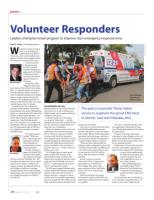
United Hatzalah
volunteers in
action in Israel
VOLUNTEERS ON CALL
Hatzalah volunteers, who include Orthodox
and secular Jews, as well as Christian and
Muslim Israelis, receive extensive training in
emergency medical care.
Volunteers usually arrive at emergen-
cies on special “ambucycles” — specially
equipped motorcycles with extensive first aid
kits. The motorcycles navigate traffic more
easily than cars or ambulances.
Maisel says volunteers arrive on the scene
within three to five minutes, performing
CPR or whatever is necessary to stabilize
the person until the official responders
arrive. Hatzalah and its volunteers use a GPS
smartphone application that pinpoints their
location and notifies them of nearby emer-
gencies immediately. They can choose to
accept the call or not — similar to Uber, the
freelance taxi service.
The Michigan business leaders group,
which included chief executives of the
Detroit Medical Center and Henry Ford
Health System, thought the Hatzalah model
might help Detroit. Hatzalah is not new to
the U.S. — a pilot begun last year in Jersey
City, N.J., has had positive results.
The CEO group engaged Hatzalah staff to
evaluate whether their volunteer emergency
response model could work in Detroit. A
steering committee, composed of a broad
coalition of private and public organizations,
was set up to guide the effort. Study costs are
being covered by donations from the Jewish
The goal is to provide “faster, better
service to augment the proud EMS force
in Detroit,” said John Deledda, M.D.
and general communities.
“We want to cooperate with other volun-
A first step was a trip to Detroit for Maisel teer organizations,” Jaksoll said. In Jersey
and United Hatzalah’s implementation
City, 700 individuals applied for 50 positions
executive, Shai Jaksoll, to meet with Detroit
for a pilot project.”
police and fire officials, health organizations,
The goal is to develop a pilot project
community and church groups, and others.
action plan for Mayor Duggan’s review with-
They assessed the interest for a pilot project
in about four months. One consideration is
of trained medical volunteers in Detroit.
likely to be how this program will be viewed
“This is not about replacing EMS, but
by city and hospital unions.
helping to improve emergency response with
Another issue is “how we keep our volun-
a community-based buffer,” Davidoff said. In teers safe,” said Deledda, referring to inci-
a city with a strong union heritage, he says,
dents of violence against EMTs and firemen
no one wants the city’s EMTs and fire-
in some Detroit neighborhoods.
men to think that volunteers will take
He thinks the pilot program will
their jobs.
need to be located in the city’s
Instead, the goal is to provide
safer neighborhoods where vio-
“faster, better service to augment the
lence is less prevalent.
proud EMS force in Detroit,” said
“Nancy [Schlichting, Henry
John Deledda, M.D., chair of emer-
Ford Health System’s CEO] is
gency medicine at Henry Ford Health
behind this,” said Deledda, who
System, who serves on the steering
is enthused about developing a
Shai Jaksoll
committee.
model system that would work in
Maisel and Jaksoll are encouraged
Detroit.
by the positive response of Detroiters and
“It’s not practical to put an ambulance on
believe that recruiting volunteers would not
every street, but is reasonable to have a vol-
be a problem.
unteer on every street,” Jaksoll said.
*