

health & wellness »
MEN’S HEALTH
Local doctor offers expertise
at White House summit.
A
It
on the
the
It may
may be
be beautiful on
outside
what's on
on the
the
outside but
but it's
its what’s
inside
counts
inside
that that
really
counts.
longtime advocate for men’s
health issues, Michael Lutz,
M.D., of Birmingham, presi-
dent of the MIU (Michigan Institute
of Urology) Men’s Health Foundation,
was invited to share his expertise
on men’s health at the White House
on Friday, Jan. 8.
Lutz participated in “The White
House Dialogue on Men’s Health”
summit at the request of Broderick
Johnson, White House cabinet sec-
retary and chair of My Brother’s
Keeper Task Force; U.S. Surgeon
General Vivek H. Murthy and Michael
Botticelli, director, White House Office
on National Drug Control Policy.
Part of the panel for “Men’s Health
& Sports Partnerships for Men’s Health
Awareness,” Lutz reflected on men’s
health community outreach and part-
nership opportunities, especially in
connection within NFL teams.
Using local examples from the
Detroit community, he emphasized the
role of partnership in improving health
care opportunities for men, especially
in underserved, at-risk populations,
as demonstrated by the MIU Men’s
Health Event. The event, held each fall
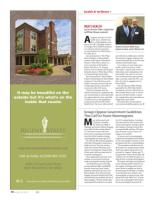
Broderick Johnson, White House
cabinet secretary, and Dr. Michael Lutz
at Ford Field in collaboration with the
Detroit Lions, engages, educates and
screens thousands of men for the most
common men’s health issues.
“As a nation, we must make men’s
health a priority to protect, which
will require a cultural shift in how we
think about men’s relationships with
their health,” Lutz said. “As we have
seen in Metro Detroit, sports partner-
ships, especially within the NFL, can
play a key role in engaging men for
better health.”
Lutz also discussed Blue Monday,
launched by the MIU Men’s Health
Foundation as the first official day of
Men’s Health Week in June to encour-
age men and their families, commu-
nity organizations and corporations to
engage with men’s health.
For details about the foundation,
visit miumenshealthfoundation.org.
*
Groups Oppose Government Guidelines
That Call For Fewer Mammograms
M
regentstreetwestbloomfield.com
*HSS\Z[VKH`H[
4460 Orchard Lake Road
>LZ[)SVVTÄLSK40
Ask about our dedicated Memory Care Unit
70 January 28 • 2016
any professional medi-
cal groups, including
the American College of
Radiology and Society of Breast Imaging,
are at odds with the recently released
U.S. Preventive Services Task Force
breast cancer screening recommenda-
tions that call for biennial screening
mammography for women age 50-74.
The ACR and SBI claim the guidelines
will result in thousands of unnecessary
deaths each year. They also say thou-
sands more women will endure more
extensive and expensive treatment than
if their cancer had been found early by
an annual mammogram.
These organizations and many more
continue to recommend women get
yearly mammograms starting at age 40.
“The final breast cancer screening
recommendations differ considerably
from the American Cancer Society
guidelines released late last year,” said
Murray Rebner, M.D., director, Breast
Imaging, Beaumont Hospital-Royal Oak,
and immediate past president, Society of
Breast Imaging. “We have already vigor-
ously opposed the Task Force, as well as
the ACS recommendations. Screening
saves the most lives when women have
annual mammograms starting at age 40
and continue screening as long as they
are in good health and have a life expec-
tancy of at least 10 years. There is no
change in our position.”
To ensure access to mammography,
Congress passed legislation that delayed
for two years changes to insurance cover-
age based on the new recommendations.
“The moratorium will allow time for
all the data to be analyzed and the whole
Task Force mission and structure to be
reviewed by Congress,” Rebner said. “It
also guarantees women 40 and older will
continue to receive health insurance cov-
erage for their screening mammograms.”
The largest and longest-running breast
cancer screening studies in history con-
firm regular screenings reduce breast
cancer deaths by roughly one-third in
all women ages 40 and older. According
to the National Cancer Institute, since
mammography screening became wide-
spread in the mid-1980s, the U.S. breast
cancer rate, unchanged for the previous
50 years, has dropped 36 percent.
*