

metro » je ws in the digita l a g e
Technology For Good
A
s we look around the technology
landscape at the beginning of
2016, I think it’s fair to say that
the pace of innovation is quite impres-
sive. Driverless cars, drones, connected
homes and 3-D virtual reality have
arrived, and today’s youth don’t even
know of a time without social media or
mobile apps.
We are certainly living in excit-
ing times, thanks to tech innovation.
However, I like to consider three separate
categories of innovation. We can and
should be excited about all three catego-
ries because the technology is impressive
in each.
One category consists of technology
that ranges from the fun to the mind-
less. This includes technology without a
higher purpose — think gaming mobile
apps like Angry Birds. Sure, it helps pre-
occupy your kids by handing them the
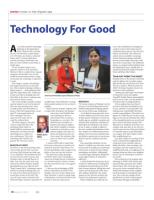
America and Penelope Lopez of Beacon of Hope
iPad while in the doctor’s waiting room,
but it doesn’t advance society.
MEDISAFE
straight hours of the Hackathon creating
The second category includes technol-
their potential solution to the sex slavery I’ve become a big fan of Medisafe over the
ogy that improves our lives but doesn’t
past year. It is the leading cloud-synced
problem.
solve our most pressing issues. Here,
What is Beacon of Hope? Together with mobile health platform helping patients
I would include such innovations as
stay on top of their many medications.
a couple other developers, the dynamic
drones, Uber/Lyft transportation, social-
As the baby boomer generation turns
sisters have used Gimbal’s iBea-
ized TV viewing and advanced
70, their children need to become aware
con technology to alert law
GPS technology. They have
of their parents’ medication. Several new
enforcement when a woman is
made our lives easier, but we
mobile apps are available to monitor and
being taken as a sex slave. The
could live without them.
maintain daily medication schedules for
small beacons are hidden in
The third category is the most
dependents, but Medisafe is the easiest
tampons and sanitary napkins
critical. I argue that this is the
to use. It makes it simple to adhere to
that will be available in women’s
technology about which we
the most complicated medication sched-
restrooms at such places as gas
should really be passionate and
ules, enables care collaboration between
stations, highway rest stops, sta-
enthusiastic. Not only does this
patients, their loved ones and physicians,
diums
and
casinos
because
sur-
technology have a utility, it is
Rabbi Jason
and delivers content and services person-
vivors
report
the
only
place
they
also revolutionary. This is the
Miller
alized to specific conditions and situa-
were ever alone was in a public
technology that will solve the
tions.
restroom.
greatest ills of the 21st century.
Since launching, Medisafe now has
A woman will be able to easily hide
BEACON OF HOPE
almost 2.5 million users who have record-
the beacon in her purse or pocket to be
Sex slavery is the fastest-growing crime
ed more than 250 million successful med-
tracked by local law enforcement. The
in the world, and less than 1 percent
beacon immediately sends a signal to the ication doses on their iOS and Android
of victims (half of whom are under age
smartphones and tablets. Additionally,
police so they can trace her location.
12) are identified. That problem has led
it recently began offering the Medfriend
The sisters have taken advantage
25-year-old twin sisters America and
social support feature on medication
of AT&T’s Smart Cities technology to
Penelope Lopez to develop Beacon of
adherence.
ensure the tracking beacon is monitored
Hope. Last year, the sisters won a top
A study showed that 40 percent of pre-
as it travels because sex slavery victims
prize at the AT&T Developer Summit
viously non-adherent users (taking their
are often moved from city to city against
and Hackathon in Las Vegas for their
medications less than 80 percent of the
their will.
“Body Camera Hack,” a prototype camera
time) became adherent (taking their med-
It also uses the technologies of IBM
with face-tracking technology that can
ications at least 80 percent of the time)
Watson, Intel Edison and AT&T Flow
be worn by law enforcement officers to
after adding a Medfriend. The results
Designer. The next version of Beacon of
record their actions in the field. This
underscore the vital role of family and
Hope will allow a victim to simply make
year, the Lopez sisters returned to the
a hand gesture in front of the beacon dis- friends (non-professional caregivers).
AT&T Developer Summit to spend the 36 pensary to alert law enforcement.
When a Medisafe user adds and con-
16 January 14 • 2016
nects with a Medfriend, the designated
caregiver receives alerts about missed
medication doses and can view the user’s
history and schedule. This makes the
patient more accountable, encourages
positive behavioral changes and helps
prevent serious health events that could
arise from a missed dose. The Medfriend
feature was integral within Medisafe from
the beginning because a double dose of
insulin threatened the health of founders
Omri and Rotem Shor’s father.
TEAM GHS’ ROBBY THE ROBOT
Brandon Dorris is the director of develop-
ment for Sphero, the toy maker respon-
sible for bb8, the cute droid in Star Wars:
The Force Awakens. When he arrived at
AT&T’s Developer Summit, however, he
had more serious ambitions.
Teaming up with Finger Food Studios
of Vancouver, Dorris put together
TeamGHS (Global Human Sustainability)
and set out to create a way for families to
incentivize their recycling initiatives.
Dorris explains that more than 65
percent of American households do not
recycle, and that is not sustainable. The
hacking team created Robby the Robot
on their re:gen platform. The robot’s eyes
appear on a tablet that sits on top of a gar-
bage can. Its sensors determine how much
of the intended product was recycled and
gives credit to the family member who
disposed of it. Residents of the home can
compete with each other to see who recy-
cles the most, but one of the great features
of TeamGHS’ project is that households
can compete with other families within
their neighborhood, too.
Users gain credits for recycling in their
home or around their neighborhood at
connected recycle containers that use
Robby the Robot. After you dump a few
newspapers into the receptacle in your
neighborhood’s park, you might get a text
message letting you know your neighbor-
hood is close to achieving its reward for
the month.
This socialized recycle program takes
advantage of AT&T’s data rewards and
sponsored data, giving out free mobile
data for those who recycle the most. As
you recycle, you’re rewarded with free
mobile data leading to entire neighbor-
hoods focusing on consumption reduc-
tion. This is just one example of how
gamification can lead to improving the
environment through sustainability.