

metro »
Honoring The Past
Family returns to German town to receive family heirloom.
Jen Lovy | Special to the Jewish News
T
he Jewish residents of
Muenzenberg, Germany, are long
gone. Those who didn’t escape the
Nazis were ultimately sent to concentration
camps. Those who survived decided not to
return.
Despite the fact there are still no Jewish
residents in this German town outside of
Frankfurt, the Jewish cemetery was kept
up by a local family who felt a sense of
obligation to maintain it. That family, the
Müllers, was also instrumental in the recent
restoration of the building that once housed
the town’s only synagogue into a synagogue
once again.
Last month, during a dedication cer-
emony, Yifat Golan of Farmington Hills,
along with her parents and a cousin, had
the privilege of being guests of honor at the
event. The synagogue honors the memory
of Golan’s grandfather, Eliezer Katz, who
lived in Muenzenberg before escaping
Germany prior to the war.
During the dedication ceremony, Golan’s
parents donated a small sefer Torah and
chanukiah they brought from Israel.
However, the most touching part of the
event was when the mayor of Muenzenberg
returned a butcher’s knife and its beautifully
crafted case to Golan’s family. The knife
and case belonged to her great-grandfather,
Avraham Katz, before it was confiscated by
the Nazis. It was a knife Katz used as the
town’s shochet (someone certified under
Jewish law to slaughter animals). He was
also Muenzenberg’s kosher butcher and
chazzan.
This was Golan’s first visit to Germany.
It was a trip she never planned on taking
until she learned that the small town where
her family came from would be honoring
her grandfather and returning a family
heirloom.
“When the Nazis came, they took so
much from the Jewish people, including
all my great-grandfather’s knives,” Golan, a
Judaic studies teacher at Hillel Day School
in Farmington Hills, told one of her sixth-
grade classes during a presentation about
her trip. “When the son of the Nazi guard
who took the knives heard we were coming,
he called to say he had a knife his father
took and he wanted to return it to us.”
The person he called was Petra Müller.
She, along with her husband, Uwe, are the
ones responsible for maintaining the cem-
etery and spearheading the efforts to refur-
bish the synagogue. The German couple
took an interest in the town’s Jewish history,
14 January 14 • 2016
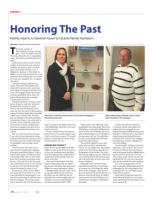
Yifat Golan, a Hillel Day School teacher, at the restored synagogue in
Muenzenberg, Germany
which, according to the Müllers, dates back
to the Middle Ages, when there was a large
Jewish community.
“We also wanted to know more details
about the fate of the Jewish residents,” said
Petra by email from Germany. “We wanted
to find out what happened exactly during
the Nazi period in our city.”
REKINDLING CONTACT
Nearly 30 years ago, the Müllers took their
children to clean up the old Jewish cemetery.
As they were clearing the moss and debris
from the headstones, they couldn’t help but
wonder about the Katz family, which occu-
pied so many plots.
There were no descendants of the Katz
family in Muenzenberg, but one resident
kept in touch with Eliezer Katz and gave the
Müllers his contact information in Israel.
Although initially reluctant to talk to Katz
because they didn’t know how he’d react,
the Müllers not only called him but also
ultimately went to Israel multiple times and
developed a very close relationship they
maintained until Katz’s death in 2003.
Golan’s father, Eliezer Naimank, with the newly
placed mezuzah at the synagogue
“Eliezer and his wife, Nelly, took us, like
grandchildren, into their family,” Petra wrote.
“With Eliezer, we shared his childhood and
youth. We knew the old familiar places and
cities in Muenzenberg; we were members of
the same sports club, too. We could follow
his stories and remembered the old tradi-
tional feasts and his friends.
“We searched together for traces of his
family who were lost in Auschwitz and
Poland. We cried together over the murdered
people by the Nazi tyranny, especially over
the members of their families. The Jewish
and Christian religions were not divisive but
a very unifying element. We found ourselves
safe in the universality of God in spite of dif-
ferences of opinion.”
During their visits, they interviewed
Katz about his family, the war and his life
in Germany. One of the things they talked
about was the synagogue, which served as
the town’s firehouse for decades after the war.
Based on what Katz told them, the Müllers
made sure that when the building was con-
verted back to a synagogue, it matched his
description.
As Golan discussed her experiences
in Germany with her sixth-graders, she
explained that the synagogue was not
destroyed during Kristallnacht because of its
proximity to a German house. Nazi soldiers
instead removed and burned the books,
Torah and other contents of the synagogue,
but unlike many German synagogues, pre-
served the building.
“I never thought I would go to Germany,”
said Golan, a native of Israel. “But I have to
be honest and tell you that everywhere we
went, where people heard us talking Hebrew,
the first words we heard were, ‘I’m sorry.’
Most of those people weren’t even alive dur-
ing World War II or were very young at the
time, but they still felt the need to apologize.
“For us, the young generation, it’s our
duty to remember all that happened and be
ambassadors for the Jewish people so that
nothing like this ever, ever happens again,”
Golan told her students.
Golan’s family donated the knife to the
Jewish Museum in Berlin as a way to help
ensure that the atrocities of the Holocaust are
never repeated.
*