

metro » on the cover
Four-Legged Lifesavers
JERRY ZOLYNSKY
Specially trained dogs enhance owners’ quality of life.
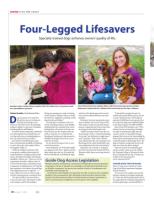
Davielle II adds to Ariella Selesny's quality of life. She suffers from a rare genetic condi-
tion called Williams Syndrome.
Ruthan Brodsky | Contributing Writer
D
ogs are known to be man’s best
friend; they also can be lifesavers.
Specially trained dogs can be
trained to warn their owners of impending
problems related to a spectrum of maladies,
including diabetes and blindness.
In Detroit’s Jewish community, individuals
are enhancing their lives through these ser-
vice dogs and some are training puppies so
they can enhance the lives of others.
Joey Selesny of Southfield spent many
hours researching the possibility of obtaining
a service dog to give more quality of life to
his daughter, Ariella, 13.
“Ariella has Williams Syndrome (WS),
a rare genetic condition characterized by
medical problems, including cardiovascular
disease, developmental delays and learning
disabilities,” Selesny says. “There are very few
organizations that allow children under 18
to work with their dogs. I found that Canine
Companions for Independence (CCI) had the
best reputation in the industry for good dogs.
Their application process is rigorous — it
took us almost two years to receive a dog —
and their training process is among the best.
“Our dog, Davielle II, has been with us
seven years and is part of the family. Ariella
is the recipient, and I’m the facilitator.
10 January 7 • 2016
During our amazing two weeks of training
at their facility in Delaware, Ohio, we found
the staff to be completely committed and the
dogs loveable and brilliant.”
The dogs learn a minimum of 40 com-
mands, including turning on and off lights,
pushing buttons for automatic door access,
picking objects off counters and a lap com-
mand to lay across the recipient when she
needs to calm down. It is estimated that
breeding and training each dog amounts to
$40,000, but all dogs and services are pro-
vided free of charge.
Yet, not all service dogs are free or even
covered by insurance.
Sierra Richmond, 45, of West Bloomfield
was diagnosed with Type 1 diabetes and has
taken insulin since she was 10 months old.
She has had difficulty controlling the highs
Sierra Richmond and her daughter, Blaise, with former foster pups, Baxter and Bree.
Richmond is raising funds for a Diabetic Alert Service Dog; she has Type 1 diabetes.
and lows of her blood sugar levels over the
years and has suffered blackouts and other
problems.
Richmond has been raising funds to pur-
chase a Diabetic Alert Service Dog or DAD.
These dogs are trained to give their human
partners a signal that alerts them when there
are changes in their blood sugar levels.
“Medical insurance doesn’t cover the cost
of purchasing a DAD, so I started fundraising
for my dog,” says Richmond, a single parent
and IT specialist. “With a DAD, I’ll know
more quickly about the rises and drops of my
blood sugar levels, which should help to pre-
vent complications from those fluctuations.”
Richmond, who is Jewish, is waiting for
her DAD from Heads Up Hounds (HUH) in
Nebraska, which trains rescue dogs found at
shelters.
Guide Dog Access Legislation
Michigan statutory law guarantees a blind person the legal right to be accompanied by
a dog guide in harness in all public accommodations and educational institutions and
on all public conveyances. Any person who interferes is guilty of a misdemeanor and
punishable under Michigan law.
The Americans with Disabilities Act guarantees the right of a person with a qualifying
disability to be accompanied by their individually trained assistance animal in public
locations. The Fair Housing Act allows for trained assistance animals in apartments or
other no-pet housing at no additional cost to the person with a disability.
“I selected this company because I’ve
worked with animal shelters and rescues for
12 years,” Richmond says. “HUH dogs are
expensive ($8,000 plus travel expenses), but
less costly than dogs from traditional diabet-
ic alert dog companies ($15,000-$25,000).”
Jamie Cook, HUH president, says, “We’ve
reduced costs by not investing in breeding
our dogs, by matching the right dog with
a person, and by our specialized training
program that focuses on the dog smelling the
client’s saliva and alerting his person if there’s
a rapid fluctuation in blood sugar levels. The
dogs are trained to nudge their person with
their nose when they detect changes.”
When she reaches her fundraising goal
and her number comes up on the waiting
list, Richmond will go to Nebraska for three
days of training with her dog. To donate, go
to https://www.youcaring.com/
sierra-richmond-402327.
LEADER DOGS FOR THE BLIND
Closer to home is the well-known Leader
Dogs for the Blind organization headquar-
tered in Rochester.
“It’s not easy to be a puppy raiser, provid-
ing basic training to the puppies beginning
at 7 weeks old, and then giving them back to
the organization for evaluation hoping they’ll
be future guide dogs,” says Sherrill Platt of