

>>
Nutritionally
Speaking
r i t
By Barbara Beznos, RD/LD/N
Integrated Nutrition, LLC
.....
Dear Barb,
PART 2 1
.. „,.
Ilk , )
How can
combat my
Chronic Fatigue
with daily
action steps?
The goal of the Chronic Fatigue
Syndrome diet is to keep it as
healthy as possible. To make you
feel better, I would like to suggest
that you:
• Avoid a high fatty diet
• Increase nutrients
• Stay away from preservatives
• Increase good protein that
comes from non animal sources.
Include complex carbohydrates,
fresh vegetables, grains, beans
• Increase fish and have small
amounts of beef and poultry.
• Drink at least 8-10 glasses of
water a day
• Stay clear of foods that are
high stress foods which are
difficult for you to digest and
may increase your symptoms.
Examples are: refined flour and
wheat.
• Enjoy Gluten free oats, brown
rice, corn, buckwheat (gluten free)
• Avoid too much cow milk,
cheese, butter, chocolate
• Easy on added salt, commercial
salad dressings, coffee, soft
drinks, and processed foods/
meats.
• Have vegetables, greens,
potatoes, seeds, nuts, fruits,
Olive oil, fish on a regular basis.
• Exercise gently and it will bring
more oxygen in, improve blood
circulation, muscle and joint
flexibility.
• Stretch, do low impact weight
lifting, yoga, tai chi, walk, swim,
massage, reflexology. Meditate.
• Aromatherapy and music
therapy
Contact Barb At:
Integrated Nutrition, L.L.C.
31731 Northwestern Hwy., Suite 105 E
Farmington Hills, Mi 48334
Phone:
(248) 538-8050
E-Mail:
rds@integratednutrition.com
Web:
www.integratednutrition.com
2056870
14 December 31 •2015
See What Pops Up
In The History Of
Jewish Detroit
Archives celebrates 25 years with a
traveling exhibit all around town.
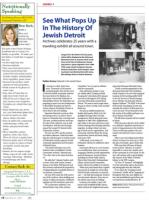
Images from The Shtetl in the City panel,
which will be displayed at the Holocaust
Memorial Center in January: Harsh condi-
tions in the Pale of Settlement in Russia
(top) led to a "great migration"from 1880-
1920; many Jewish immigrants became
business proprietors and managers, open-
ing shops in predominantly Jewish areas,
like Hastings Street in Detroit (bottom).
Robbie Terman I Special to the Jewish News
I
t started in a dark, dusty base-
ment. Thousands of documents
and photographs that told the story
of Detroit's Jewish community cluttered
the lowest level of 163 Madison Ave.,
then home to the Jewish Federation of
Metropolitan Detroit. The Federation was
preparing to move to its new headquarters
in Bloomfield Township and had two
choices: dispose of hundreds of boxes or
move them to the new building.
Important historical records are often
lost during moves; it is easier to throw
boxes in a Dumpster than a moving truck.
This time, a trained archivist, who knew
the value of the collection, was on staff
at Federation. And thus was the begin-
ning of the Leonard N. Simons Jewish
Community Archives.
The year was 1991, and the archivist
was Sharon Alterman. Under her leader-
ship, the collection grew to include records
of Federation's member agencies, Jewish
communal organizations and the papers
of Detroit's Jewry.
"The Jewish Federation was in the
forefront when it established a Jewish
Community Archives:' Alterman says.
"Few other cities in the nation had done
so:"
She adds that "visionary leaders, such
as Avern Cohn, Judy Cantor, Leonard
Simons, Irwin Shaw, Phil Slomovitz and
Bob Aronson understood the importance
of safeguarding the remarkable history of
our dynamic community."
The year 2016 marks the 25th anniver-
sary of the Archives, whose holdings now
surpass 2 million documents, 25,000 pho-
tographs and 100 oral history interviews.
"It's a momentous milestone says
Michael Berke, chair of the Archives
Committee, "one we want to celebrate
with the community:'
That celebration includes a "pop-
up" exhibit called "Creating a Jewish
Community:' which kicks off in January
and will run throughout 2016, hitting
more than 30 locations around Metro
Detroit "We want to reach people where
they go to school, worship, work and play,"
Berke says.
The pop-up exhibit includes four
double-sided panels: Shtetl in the City
spotlights the large influx of Jewish
immigrants to Detroit during the Great
Migration of 1880-1920. Neighborhoods
pays tribute to the areas where Jews resid-
ed from Hastings Street through suburban
migration. Lending a Hand is an hom-
age to Jewish service organizations. And
Connecting with Israel shares the strong
bond between Detroit and Israel, dating
back to pre-1948.
A fifth panel, on the history of
Federation, will also be exhibited at select
locations.
Each panel will move to a new location
on a monthly basis. Hosts are museums,
synagogues, libraries, Jewish organizations
and local businesses. Several locations,
including the Detroit Public Library,
Wayne State University's Undergraduate
Library and the Jewish Community
Center, will host the exhibit in its entirety.
While each panel stands alone, together
they provide an insight into what makes
Detroit's Jewish community so extraordi-
nary — all while showcasing the Archives'
vast and varied collection. Every item in
the exhibit comes from its holdings.
In January, the exhibit, in part, will
launch at the Southfield Public Library,
which will host the Neighborhoods panel,
and at the Holocaust Memorial Center.
"I think it entirely appropriate for the
Holocaust Memorial Center Zekelman
Family Campus to be one of the inaugural
locations for the traveling exhibit Shtetl
in the City, the story of Jewish immigra-
tion to Detroit:' says Executive Director
Stephen Goldman. "The HMC is the home
of the Jewish Genealogical Society and,
naturally, the archives of Holocaust survi-
vors in our area. We are honored to host
this section of the exhibit and hope to see
all our friends at the HMC."
The full series of panels will be revealed
in March.
While the prime objective of the exhibit
is to celebrate a significant anniversary, it
is also to bring awareness to the Archives.
There are still many people in the com-
munity who don't know such a resource
exists.
"After a year of traveling around Metro
Detroit, we hope to be seen not as a 'hid-
den gem, but simply a gem," Berke adds.
With more than 100 years of history
in the Archives' collection, it would be
impossible to convey the complete story
of this community in a few panels. So, the
story will continue with a special display
this summer at the Walter P. Reuther
Library on the WSU campus.
"25 Years, 25 Treasures" will highlight
25 of the noteworthy objects, documents
and photographs from the collection.
To see where the "Creating a Jewish
Community" exhibit will be "popping-up"
throughout 2016, plus more digital con-
tent, visit jewishdetroit.org/Archives and
www.facebook.com/jfmdarchives. *
Robbie Terman is director of the Leonard N. Simons
Jewish Community Archives.