

Sponsored Page
Detroit Journalism
COOPERATIVE
Improving City Services In Detroit
By Rhonda "Roni" Gutierrez
I
mmerse yourself in the customer's
world and get to know their
struggles and triumphs inside out."
— Dane Brookes
Most citizens of metro Detroit realize
that the basic infrastructure of the city
needs tremendous improvement. While
downtown Detroit is bubbling with new
businesses and upcoming artists, city ser-
vices are lacking.
While eating a great lunch at a popular
downtown eatery over the weekend, I
asked the owner about his experiences
regarding opening a business in the area.
The owner (who wishes to remain anony-
mous) complained of slow turnaround
times with inspections, business regis-
trations/licenses, costs and recording of
costs, and all other paperwork shuffling
prior to opening.
Upon interviewing another downtown
Detroit business owner, I was quickly
reminded of the same issues again and
again. Unanswered calls, city clerk work-
ers with no information, constant misin-
formation from workers at the city hall,
price variances for inspections, permits,
registrations, licenses, etc. No record
of business registrar information in city
computer systems was another constant
complaint.
One Asian business owner received a
ticket from the city for not having a busi-
ness license. When the owner visited the
Coleman A. Young Municipal Center, he
was misinformed, ignored and treated
poorly. He states that there are many
workers but none with answers. The
owner was lucky enough to meet a helpful
lawyer in the lobby
Many Detroit business owners were
interviewed and all had the same com-
plaints. The questions remain: Could
potential business entrepreneurs be
scared away from doing business in the
city? How can city services be improved?
What is the underlying problem of poor
city services?
When receiving poor customer service,
one tends to question management. We
wonder if management is taking a posi-
tive or negative role in service. Is training
inadequate? What are the job qualifica-
tions? What is the hiring procedure? What
are the job requirements? Are workers
simply underqualified? Are job candidates
not screened properly? Are city employees
underpaid?
Researching these common concerns
brought about some useful informa-
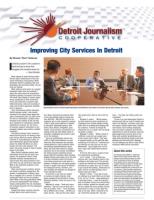
Korean Business owners in Detroit visited Deputy Mayor Isaiah McKinnon and members of his staff to discuss how to improve city services.
tion. Many clerk/clerical positions listed
on the city website range in annual pay
from $40,000 - $60,000. Not bad for an
employee who is only required to possess
a GED or high school diploma in regards
to education. Especially during a time
when police officers, firefighters, para-
medics, social workers, and teachers are
making much less with higher levels of
education. Inadequate pay must be ruled
out in this instance.
Since job qualifications require only
a GED or high school diploma, one can
determine that employees are possibly
underqualified for many positions within
the business development/city clerk's
office. Not that those without a college
education are by any means unintelligent
but simply ignorant regarding several
issues within the business realm perhaps.
Quality training could make up for the lack
of further education within the employ-
ment hiring process but could also be a
problem. If workers are not being properly
trained or taught, they cannot be blamed
for inadequate service; however, com-
mon courtesy and manners are thought to
come naturally to most.
All services of any kind are subject
to reviews on today's internet, even
those provided at the Coleman A. Young
Municipal Building. These are some of the
reviews:
Mikeisha R. writes: "Rude and unpro-
fessional. They lie to you so they won't
have to actually "work ". Each employee
has a different set of rules... Terrible cus-
tomer service. They are the main reason
why people don't want to move into the
city...
Suzanna S. writes: "Worst employ-
ees that make the whole experience an
unpleasant one! Strongly dislike coming
down here for anything and dealing with
the rudeness. It seems as though the
employees are on a power trip and speak-
ing down to people..."
Nathasja T. writes: "What a bunch of
inefficient, rude and sour people work
at the county clerk's office! They have
a hysterical poster on the wall that says
something to the effect of "Customers do
not interrupt our day, they are our day".
Mmmhmhh...Every single time I am in
here I leave with raised blood pressure
levels..."
To be fair, there were a couple of posi-
tive experiences recollected.
Lori H. writes: "I am a family law
attorney and I love handling cases in this
building in the family court. The security
is quick and friendly, the clerks/deputies/
secretaries are super nice, and it is easy
to get around the building. Restrooms are
clean, and for an older building, every-
thing is kept up to date."
Andrea F. writes: "I was able to park
on Jefferson at a meter (there are at least
8) for .50 for 1/2 hour. I was applying for
a marriage license. I went thru security
with no problem, went to the second floor,
took a number, waited five minutes, paid
the fee, waited five more minutes, got my
instructions to return in three days and
was on my way. When I returned to my
car I had three minutes left. No prob-
lems... The folks are helpful, polite and
competent."
To sum it up, post bankruptcy Detroit is
looking great. But we need to handle busi-
ness in an effective, courteous, and capa-
ble manner. Detroit needs smart, efficient,
well-trained, hard-working employees
who can answer questions and directly
assist those in need of answers. City man-
agers/supervisors must be sure to hire
those with excellent qualifications and
skills while dismissing workers with poor
attitudes and bad work ethic. Manage
the city. Manage city offices. Keep Detroit
employed. Make Detroit successful.
About this series
New Michigan Media (NMM) is a collaboration
between the five largest minority media in SE
Michigan (The Arab American News, The Latino
Press, The Michigan Chronicle, The Michigan
Korean Weekly, and The Jewish News) with a
combined estimated circulation of 120,000 weekly.
NMM is also a founding partner of The Detroit
Journalism Cooperative (DJC). Funded by the John
S. and James L. Knight Foundation, Renaissance
Journalism's Michigan Reporting Initiative and the
Ford Foundation, the DJC aims to report about
and create community engagement opportunities
in Detroit and its post-bankruptcy recovery. Each
article in the series appears in all the NMM member
newspapers, and is posted on the DJC website.
This article is from THE MICHIGAN KOREAN WEEKLY.
The DJC is a unique collaboration between impor-
tant media outlets of the region, and includes The
Center for Michigan's Bridge Magazine, Detroit
Public Television, Michigan Public Radio, WDET and
New Michigan Media.