

arts & life
music
Don Cohen I Contributing Writer
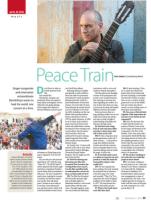
Singer-songwriter
and entertainer
extraordinaire
David Broza wants to
heal the world, one
concert at a time.
•
.
avid Broza is what an
Israeli superstar looks
like.
And sounds like.
Charismatic, energetic and
passionate, Broza was raised in
Israel, Spain and England. All are
reflected in his guitar-playing,
which ranges from flamenco-
flavored rhythmic and percussive
e
details
Eastern Michigan University
Jewish Studies presents David
Broza 7:30 p.m. Sunday, Nov.
15, at the Ark, Ann Arbor. $36-
$75; $10 for students. (734)
761-1800; theark.org. "East
Jerusalem/West Jerusalem: A
Film, A Conversation"will take
place 7:30 p.m., Saturday, Nov.
14; David Broza will be avail-
able to answer questions. EMU
Student Center Auditorium,
Ypsilanti. Free. Email Jewish.
studies@emich.edu for details.
techniques to flying finger-pick-
ing to a signature rock-and-roll
sound.
The now 60-year-old musician
broke big in 1977 with the song
"Yihye Tov" ("It Will Be Better"),
which captured both Israel's angst
and hopes as Egyptian President
Anwar Sadat came to Jerusalem to
talk peace. The verse "people live
under stress, looking for a reason
to breathe; and between hatred
and murder, they talk about
peace" remains as true today as
it was then. Soon afterward it
was said that at least a third of all
Israeli households owned at least
one David Broza album.
Releasing albums in English
and Spanish as well as Hebrew,
Broza has taken his passionate
and expressive vocals and guitar-
playing around the world as a
proud ambassador of Israel and
of peace. For more than 20 years
he's performed an annual sunrise
concert at Masada on the Dead
Sea (left), including one that was
filmed with musicians Jackson
Browne and Shawn Colvin in
1997 for public television. In 2009
he set to music and recorded a
stash of poems by Townes Van
Zandt, who willed them to Broza.
Recently, he's been touring for his
current album, East Jerusalem/
West Jerusalem, which was
produced by Grammy-winning
singer/songwriter Steve Earle
and recorded in East Jerusalem's
Sabreen Studio.
On Sunday, Nov. 15, Broza will
perform at the Ark in Ann Arbor,
sponsored by Eastern Michigan
University's Jewish Studies
Program. The JN caught up with
him in late October.
JN: You'll be showing and
discussing your film East
Jerusalem/West Jerusalem the
evening before your concert.
Can the film and album help
us understand the current vio-
lence, or find a path out of it?
DB: The film East Jerusalem/
West Jerusalem portrays eight
days and eight nights in a
Palestinian studio as I was record-
ing the album with the same
name. I brought together, under
one roof, Israeli and Palestinian
musicians as well as crews and
created a Utopian atmosphere.
The film exposes the thoughts
of some of the participants and
reveals a very candid testament,
thus opening an evocative nar-
rative regarding the conflict. In a
way, it shows how there are ways
to overcome the deep and painful
difference between the people.
Everyone knows there is a
long-standing conflict, but no one
really knows about the options
and ways to build a bridge of
understanding, friendship and
tolerance through music.
JN: You have such a large
body of work and many differ-
ent styles to draw from; what
will we hear at the Ark?
DB: It's been a long time since
my last appearance at the Ark. I
think 20 years ... I will perform
songs from different periods
of mine and will mix material,
from my Spanish albums to my
American albums and my Israeli
hit songs. It will be fun.
JN: If you had to pick a proj-
ect, album or song you are most
proud of, or that has made the
most positive impact, what
would it be?
DB: The one song that has
been, perhaps, the most meaning-
ful and hasn't lost its relevance
is the first song I ever wrote
and recorded, "Yihye Tov:' It's a
song about the arrival of Egypt's
president Anwar Sadat to Israel
in 1977. The song became the
anthem of the peace process.
JN: What is the Israeli music
scene like these days?
DB: It's quite amazing. There
are so many new talents and
bands, [lots of] jazz bands and
the level of playing is remarkable.
The diversity of styles is unique.
Since we are a country of immi-
grants and we are in the Middle
East, the variety and eclectic
sound is a never-ending source of
fascination and inspiration.
JN: You come to Detroit fairly
regularly. What impressions do
you have of our Detroit Jewish
community?
DB: Since the first time that
I visited with the Jewish com-
munity of Detroit, I was struck
by the unique involvement of the
community in the lives of the
families. I have seen many older
communities which felt like they
were aging and out of touch with
the younger generation, and in
Detroit I got the sense that the
community is the center of life
for the families and it generated
a meaningful sense of identity,
which is so important.
JN: Do you have anything in
the works that you would like
people to know about?
DB: I am always working on
my next project or two. I have just
released a new album, Andalusian
Love Song with the Andalusian
Orchestra of Ashkelon. It's a
beautiful album which presents
new arrangements to some of
my greatest hits, but with a very
original approach of mixing my
music with the music of the great-
est Arab composers. It is a very
special album. *
November 12 • 2015
55