
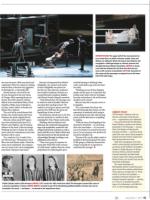

OPPOSITE PAGE: The upper half of the monumental set
is an ocean liner, on which a German couple, Liese and
Walter, are sailing for Brazil. On board, Liese believes she
recognizes a veiled passenger as a former prisoner she
thought had been killed at Auschwitz. ABOVE: In shock,
Liese tells her husband for the first time that she was
once an SS overseer at Auschwitz. LEFT: Her memories of
the camp and the passenger are played out on the lower
half of the split stage.
the music becomes a little more lyrical and
sentimental. When the composer is dealing
with the Nazis, it becomes very aggressive;
it's Shostakovich- or Stravinsky-like:'
Daveda Karanas, who took the role
of Liese, the guard, for the Lyric Opera
of Chicago, will be repeating the part in
Detroit. She will be joined by Adrienn
Miksch as the remembered Marta, David
Danholt as Walter, Anna Gorbachyova
as Katya, Liubov Soklova as Bronka and
Marian Pop as Tadeusz.
The cast is led by revival director Rob
Kearley, who worked closely with David
Pountney, the opera's original director.
Mercurio, whose many MOT appear-
ances have included productions of La
Boheme and I Pagliacci, says the Russian
influence in the music is felt even though
Weinberg was born in Poland. It's contem-
porary music but contemporary music that
functions well in a story.
As a conductor, I try to make it hon-
est," Mercurio says. "Having done a lot of
film scores and Russian music, I found the
music easy to understand. The composer
was very smart in the way he manipulated
tonal music with lesser tonal music:'
Mercurio is being assisted by Michael
Klinghoffer, who conducts and teaches
in Israel. Klinghoffer was present ear-
lier this year when Mercurio conducted
the Jerusalem Symphony Orchestra in a
Leonard Bernstein symphony, Kaddish,
with Richard Dreyfus doing the narration.
"I told Michael about The Passenger, and
he wanted to assist if possible," Mercurio
says about their meeting in Israel. "We
worked it out and got a sponsor and study
grant for him. He'll learn the opera and
hopefully get it done in Israel:'
The production, already seen in Tel Aviv,
has been produced in a number of cities,
including New York, Warsaw and London.
Weinberg, who lost relatives in the
Holocaust, has composed string quartets,
large-scale symphonies, sonatas for solo
stringed instruments and piano as well as
operas and film scores. Many of these have
been discovered over the last decade and
acknowledged through recordings, score
publications and concerts.
"There was a group of composers in
Russia after World War II that we know
very little about," explains Mercurio, whose
preparations for conducting this opera
included listening to Weinberg's other
works, particularly song cycles and cham-
ber music.
"Weinberg was one of those forgotten
people, and this opera is so important that
perhaps many others will now investigate
his music and perform it. He and his music
should be more revered:'
Mercurio says this is one piece never to
be forgotten.
"It's a conversation from those who
have [lived through those times], not [the
expression] of somebody who's trying to
do something 50 years after what has hap-
pened, and that directness is compelling,"
he explains.
"While the issue of not forgetting is fun-
damental in Jewish life — as is honoring
those who came before — it is not neces-
sary to be Jewish to be moved by this story
just as it is not necessary to be Jewish to be
moved by Schindler's List.
"Because of the way the subject matter is
handled, ifs far beyond going to the opera.
It's like going to a Holocaust museum but
seeing it musically. It's so important to
understand the message:' *
Polish-Catholic author Zofia Posmysz (ABOVE, LEFT) wrote the 1962 novel from which The Passenger is based (the cover of
a German translation is shown, ABOVE, RIGHT). Arrested at age 18 for distributing political leaflets, Posmysz was sent to
Auschwitz. The novel — and opera — are based on her experiences there.
explore more
The Passenger is helping unite our
diverse community. Some 60 part-
ners — organizations and individuals
— have partnered with the Michigan
Opera Theatre to build on the themes
presented in The Passenger— among
them, the dangers of denying the
humanity of others — and have devel-
oped their own events. Many programs
already have been held to explore the
ideas and preview the music.
Aside from synagogues and many
Jewish cultural groups, participants are
as diverse as the Chaldean Foundation,
Charles H. Wright Museum of African-
American History, Detroit Interfaith
Outreach Network, Ferndale Public
Schools, Italian Film Festival, Northville
District Library, the Scarab Club and the
University of Michigan.
The Jewish Federation of
Metropolitan Detroit is planning a pro-
gram around the matinee performance
of the opera on Sunday, Nov. 22. There
will be a luncheon and speakers —
including a historical overview with
Professor Howard Lupovitch — starting
at 11:30 a.m. to precede the perfor-
mance. For information, call (248) 205-
2557, or visit michiganopera.org .
JN
November 5 •2015
41