

metro >> on the cover
eN•ning To Learn
City Year members help students make the grade.
Shari S. Cohen I Contributing Writer
E
very weekday morning, a small
group of young adults wearing
red jackets gathers outside the
entrances to 11 Detroit and Harper Woods
public schools, clapping and cheering as
students arrive. These 71 City Year Detroit
AmeriCorps members are there to wel-
come students and get them excited about
a day of learning.
"In high-poverty neighborhoods, stu-
dents face a lot of obstacles that they bring
to school — all the things that affect their
well-being. There is a stress impact of pov-
erty, but there can be an attitude change
when they see the City Year team mem-
bers:' explained native Detroiter Andrew
Stein, who returned home to become vice
president and executive director of City
Year Detroit.
Walking to school takes many students
past burned-out, abandoned houses and
trash-filled lots. Their school buildings are
often old and shabby with security guards
and metal detectors inside the front doors,
but City Year Detroit strives to create a
positive environment inside each school,
nurturing young people and helping them
cope with personal and academic chal-
lenges.
Each team member is trained to build
relationships with students, staff and their
fellow team members all to help elemen-
tary and middle school students stay in
school and on track to graduate despite the
challenges of high-poverty urban districts.
City Year is part of AmeriCorps, a fed-
eral program established in 1988 to offer a
year of public service for young Americans
— a sort of domestic Peace Corps. By
2007, AmeriCorps members worked in 17
American cities; now 27. They provide the
"yeast to other nonprofits' bread:' Stein
said. "Corps members were relating to
schools as no one else was and, by 2009,
schools became the focus."
The need was clear. Large numbers of
students in poor urban districts weren't
graduating, and many who were in school
were way below grade level in academic
achievement. According to Stein, only 4
percent of Detroit fourth-graders read at
grade level and only 7 percent have grade-
level math test scores.
A DATA-DRIVEN MODEL
City Year developed a model to identify
and help students at high risk for not
laktn
v
.....
wi n* io*7==—ipy,.
misam,
MEET THE JEWISH
MEET
CITY YEAR MEMBERS
M
Mai
nu
111111•111 Ink
1 11111•1111
1111111110114
1 ■ 111111111111
MINIM
NM
Jewish participation in City Year
Detroit occurs at several levels. In
addition to Vice President/Executive
Director Andrew Stein and the
AmeriCorps members below, two board
members — Karen Sosnick Schoenberg
and Mark Zausmer — are Jewish.
an
11•11/ \)
NM
ima\
NM ,
Milt r
Mae
CUL
MU
UM=
laNalk,_
ANDREW STEIN
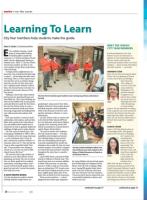
City Year Detroit members greet students every morning to get them excited about
learning.
graduating by using research from Johns
Hopkins University. Those studies showed
that likely dropouts could be identified
while in late elementary school by track-
ing their attendance, behavior or course
performance.
City Year Detroit works in schools with-
in the Detroit Public Schools (DPS) dis-
trict, the Education Achievement Alliance
(a group of low-achieving, former DPS
schools reconstituted in a special district)
and the Harper Woods district.
"We work in schools with conditions
that will maximize impact — with data
availability and principals and teachers
who will help design an intervention:'
Stein said. Participating schools agree
to provide standardized test results and
attendance data so that City Year can track
students' progress. Each school is assigned
an AmeriCorps team and their continuity
throughout the school year is a positive
addition.
Latoya Webb-Harris, principal of Noble
School on Fullerton in Detroit, said, "The
AmeriCorps team is an awesome addition
to Noble. When not here, we miss their
presence Noble is made up of two build-
ings, one dating from 1923, located across
the street from a hulking, burned-out resi-
dence. Eighth-grade classes have 44 stu-
dents who can barely fit in the classrooms.
There are some positives — a school
playground has modern play equipment
SARAH CRANE
City Year members Matthew Fellows and
Jenna Pickman work with students in the
library of Noble Elementary in Detroit as
the librarian looks on.
for young children and special state grants
have funded high-end computers for the
library. And City Year is making a differ-
ence. Among fifth-graders below bench-
mark at the start of the last school year
who were tutored by City Year members,
73 percent and 85 percent respectively met
or exceeded benchmarks in literacy and
math by year-end.
continued on page 14
12 November 5 2015
Stein, 32, was born and raised in Metro
Detroit. He is an alumnus of Detroit
Country Day School and Michigan
State University.
After college, he
served as a City Year
corps member in
Washington, D.C.,
and then attended
Georgetown Law
School. Stein worked
for several years at a
Washington law firm
Stein
while volunteering
on urban-related
projects. He was interested in working
in the nonprofit sector and returned to
head City Year Detroit early this year,
replacing Penny Bailor, who retired.
Stein, his wife and two children live in
Detroit's Sherwood Forest neighbor-
hood.
Crane, a City Year alumna, grew up
in Farmington Hills. After graduat-
ing from the University of Michigan,
she "wanted to do
something that
would make a dif-
ference in her own
community:' Her
father had been in
the Peace Corps, and
AmeriCorps appealed
to her. Crane was
Crane
a team leader for
eight AmeriCorps
members from
2009-2910. She then worked as a
community relations associate at the
Jewish Community Relations Council
of Metropolitan Detroit. Crane subse-
quently joined KPMG, earned an MBA
and is now a senior associate in the
firm's Advisory Practice in the People
and Change area. She lives in Detroit.
continued on page 14