

viewpoints
>> Send letters to: letters@thejewishnews.com
continued from page 5
commentary
Eyewitness To Hadassah Miracles
I
was already in the shock trauma unit
in the Swartz Center for Emergency
Medicine at Hadassah Hospital Ein
Kerem when they brought in the teen-
ager. The medics in orange vests were
short of breath from the run from the
ambulance. Still, they shouted: "Teenage
boy, 15 or 16, head injury, critical condi-
tion:'
He's strapped down. His face is grub-
by, his eyes closed.
He's hoisted onto the hospital bed.
Around him crowd general surgeons,
orthopedic surgeons, anesthesiologists,
vascular surgeons, nurses and techni-
cians. In the trauma unit, the equipment
hangs on beams from above so that the
medical staff can crowd around.
After the medics, the armed guards
arrive. Policeman and members of the
security services.
The boy, it turns out, isn't 16, despite
his size. He's only 13. And he has just
stabbed two people. His name is Ahmed
Manasra.
To the men and women saving his life,
he is a boy. They send him for X-rays
and CAT scans. Doctors gather around
the computer to see the results.
Across town at the other
Hadassah Hospital, this one on
Mount Scopus, another 13-year-
old boy is rushed into the oper-
ating room, unconscious with
serious stab wounds. The surgi-
cal staff, led by Professor Ahmed
Eid and vascular surgeon Dr. Ina
Akopnick, struggle to bring him
back. He had been out riding his
bike with his little brother to visit
their grandmother. He paused to
squat and fill the air in one of the tires.
Ahmed Manasra and his cousin Hassan,
on a stabbing spree that had already left
a young man in critical condition, see
their contemporary. They plunge knives
into him. This patient's name is Nabr
Shalev Ben-Ezra.
I am not part of the medical staff.
I am a writer and the Israel direc-
tor of public relations for Hadassah,
the Women's Zionist Organization of
America. The women of Hadassah have
built both of these hospitals and formu-
lated the ethic that sustains the Israeli
medical system: We treat all without
regard for religion or ethnicity. I try to
be in the trauma center these days to
document the heroic dedication of the
men and women who hold up to these
standards, no matter how hard this is.
The press keeps phoning. They have
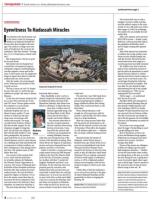
Hadassah Hospital Ein Kerem
heard that Nabr is dead.
Nabr, thankfully, is alive. And so is
Ahmed, despite the international claim
by Mahmoud Abbas, the head of the
Palestinian Authority, that Ahmed was
killed in cold blood. A faked video has
more than 3 million views of
Ahmed supposedly dying. Like
the blood libels of old, Abbas
insists that the Jews like to
murder non-Jewish children.
Not everyone subscribes to
the ethic of equal treatment.
We hear criticism about saving
the lives of terrorists. I have
heard that the medical staff
in Boston was traumatized by
treating Dzhokhar Tsarnaev
while they were saving the lives of the
victims of the Marathon bombing. Here,
where life has few degrees of separation,
doctors and nurses frequently know the
patients, and this is even harder.
Earlier in October, a young and loving
couple named Aaron and Odel Bennett
walked to the Kotel (the Western Wall)
in the Old City of Jerusalem, pushing
two strollers with their 7-month old
daughter Shulamith and their 2-year
old Natan. On the way back, they were
pounced upon by a terrorist, who
stabbed them both and shot their son.
Aaron bled to death before he could get
medical care. As it turns out, doctors in
an open Arab clinic on that street didn't
come out to staunch the bleeding. Odel
and Natan were patients at Hadassah.
How would we feel if our doctors and
nurses refused to treat those whom they
could save?
The only time I saw Odel break down
was when she tried unsuccessfully to
picture herself giving her children a
happy childhood without their doting
Daddy. Who would teach them to ride
their bikes?
When Ahmed Manasra is well
enough, he will not go home with his
parents to ride his bike. He will be taken
away to a closed institution.
Nior has a long recovery before him.
But his parents are determined to cele-
brate his bar mitzvah on time at the end
of November. If he's still in the hospital,
we will celebrate right there — celebrate
life, not death, celebrate healing not hor-
ror.
Henrietta Szold, the founder of
Hadassah, visited Detroit almost a
hundred years ago. Nearly all the terror
survivors are hospitalized in the Sarah
Wetsman Davidson Hospital Tower,
named for her hostess on that trip. Miss
Szold, as they all called her, asked Sarah
Wetsman if the car-making community
of Detroit would supply an ambulance.
And so, in 1918, a Hadassah medical
mission arrived together with the first
medical emergency vehicle in pre-state
Israel.
I think often of that first ambulance
as our rescue forces pull up to the gates
of today's Hadassah Hospitals and the
partnership we share in stopping the
bleeding. *
The terrorist had come in with a
handgun. He shot a soldier and then
used the soldier's weapon to fire more
rounds. It was a rifle and it was used at
short range, so it did a lot of damage.
The soldier who was initially shot ulti-
mately died.
After a few minutes, more and more
MDA EMTs arrived — Israelis, Arabs,
Bedouins, a diverse group that reflects
the population of Beersheva itself —
and we began treating other patients
as well.
Most of the injured were policemen
or soldiers, but we also treated a man
whom security initially thought was
with the terrorist. He had been shot
several times from close range by a
security guard and was badly wounded.
We couldn't come close to him ini-
tially as we're required by protocol to
give the police an opportunity to search
injured terrorist suspects to confirm
that they don't have a bomb on them or
a gun. It was a very hectic scene. The
crowd began beating him, believing
he was the gunman's accomplice. And
even after we were cleared to begin
administering first aid to him, people
were shouting at us. "Why are you
treating him? He's a terrorist!"
They're angry — we understand
that. But we do our job.
My fellow EMTs and I attempted to
stanch the patient's bleeding, then got
him aboard a Mobile Intensive Care
Unit Ambulance (MICU) to Soroka
Hospital. We later learned the man was
not a terrorist, but an Eritrean civilian,
who like everyone else was simply try-
ing to flee the gunman. He was initially
conscious, but ultimately succumbed to
his injuries.
It's not easy to see young people
dead. It's tragic. The last thing we need
is people killing each other.
Here in Beersheva, we have a lot
of Jews and Bedouins living together.
People here are strong and very deter-
mined to live in peace. And life is
stronger than death.
It's one of the reasons my colleagues
at MDA are willing to go into poten-
tially dangerous situations — whether
it's near the Gaza border when rockets
are raining down on the area, as we did
last year during the war, or going into a
scene of a terrorist attack where a gun-
man is still at large. There's a sanctity to
life. And every day, we hope to honor
that by trying to save one. *
Mogen David Adom is government mandated to
be Israel's national emergency medical response
agency, but is not a government agency. Donor
support is crucial to their lifesaving work. For
more information on how you can help, contact
Barbara Sofer is the Hadassah liaison in Israel. To
Can Immerman, Midwest regional director (and
donate, go to http://bitly/1 Mara
Michigan Region director), at (877) 405-3913 or
Clmmerman@afmda.org.
8 October 29 • 2015