
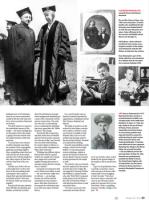

CLOCKWISE FROM FAR LEFT:
Leonard Simons with Eleanor
Roosevelt
Mr. and Mrs. Marcus Cohen, circa
1850, were among the 12 Jewish
families who established the Bet
El Society (now Temple Beth El)
in 1850, the year this photo was
taken. Cohen officiated at the
first services until Rabbi Samuel
Marcus was brought on.
Aid Kushner, a Sears salesman
and Detroit Lions trainer, was a
longtime member of the temple
and volunteered, with his wife
Miriam, to help start the archives.
Rose Netzorg Kerr, part of the
family collection, was nominated
for a Pulitzer Prize for her depic-
tion of period clothing in film.
dedicated team of 10 volunteers,
based in two rooms surrounded
mostly by files but with some arti-
facts, such as portraits of deceased
servicemen.
"Our first mission is to preserve
the institutional memory of the
temple — the board meetings that
set the pattern of how the temple
is going to function and the ways
the temple functions within that
spectrum.
"A second arm of our mission
would be doing the same thing
for members of the congregation,
gathering and putting together
those compelling stories about not
only why they are at the temple
and their time with the temple but
also [other aspects of] their lives
and how they lived in the com-
munity.
"Another arm of this is for me
to let people know we also want
those in the surrounding Jewish
community to have a place to
deposit their personal information
and family archives. We're here
for them to make sure stories stay
together:'
Durecki and her team maintain
about 800 files of individuals and
families, and she has recorded
about 50 oral histories of people
whose backgrounds ultimately give
a sense of the community environ-
ment at various times. The archi-
vist, who uses a conversational
tone in conducting the individual
interviews, appreciates the "tidbits
of history" that emerge.
"Everybody's life is important,
and their stories form a beautiful
quilt of what the Jewish communi-
ty in this area is like says Durecki,
who was hired while finishing
her master's degree in library sci-
ence and archives management at
Wayne State University.
"If siblings take different objects
that had been held by a grand-
mother, for example, the woman's
story might never come back
together. Keeping those items in
one place ensures that the woman's
story is cohesive
Among the recurring items that
can be found across family records
— the ones that heirs might want
to reference — are marriage
licenses, bar and bat mitzvah
remembrances and correspon-
dence. More than 50 percent of
the requests for information have
to do with some aspect of family
history.
On a much broader scale are
historical materials deposited by
organizations, including the Jewish
War Veterans, Hadassah and
NSamat.
The public is invited to use the
archives for local history searches
and is asked to call first to make
sure Durecki is available to help.
Students often come to see the
architectural drawings made by
the late architect Minoru Yamasaki
as he planned the building.
Durecki's responsibilities include
writing a column for the temple
bulletin. An upcoming project
involves initiating a website to
present the histories of those bur-
ied at Lafayette Cemetery, located
on land purchased by the temple
in 1850.
The archivist, who is not Jewish,
has been impressed by the person-
al stories that come to light. She
was inspired by learning of Esther
MacWilliams, a temple member
who, after World War II, prepared
turkey dinners and took them to
the USO in Downtown Detroit —
with help from bus drivers to load
and unload them.
"We want to reach out to the
community and share this his-
LEFT: Born in Hamtramck in 1917,
Raymond Zussman served as a
second lieutenant in WWII, com-
manding tanks of the 756th Tank
Battalion. On Sept. 12, 1944, dur-
ing a battle in the city of Noroy-
le-Bourg, France, Zussman
repeatedly went forward alone
to scout enemy positions and
exposed himself to enemy fire
while directing his tank's action.
Under Zussman's heroic and
inspiring leadership, 18 enemies
were killed and 92 were captured,
liberating the village in the Rhone
Valley. He survived the battle
— but was killed by mortar fire
nine days later. On May 24, 1945,
tory:' says Durecki, whose work is
funded by the general budget of
the temple as well as private dona-
tions.
"I get a lot of gratification when
I can help a researcher connect
with some piece of obscure infor-
mation they've been struggling
to find," she adds. "There have
been times when a researcher will
come in, and I'll locate a photo-
graph of an ancestor they've never
seen before. That's a compelling
moment. I feel like a bridge to the
past:' *
JN
Zussman was posthumously
awarded the Medal of Honor,
the United States' highest mili-
tary decoration, for his actions
at Noroy-le-Bourg. Zussman is
buried at Machpelah Cemetery in
Ferndale.
October 29 2015 63