
2d1111111111swilf
011.
11111110
Sponsored Page
Mr
airy yol"V wyWr
OW out ow
mg
11110 Mr NW
amid 00 pie
ar sr
fag OF
'
,
f p-e
Detroit Journalism 40 opti
110 I I
411,
COOPERATIVE
Pollution Concerns Envelop Neighborhoods
Near New International Bridge
By Natasha Dado
Detroit —
Patricia Gonzalez can't imagine living in
Southwest Detroit's Delray Neighborhood
after the Gordie Howe International Bridge
(GHIB) opens.
"My biggest concern about the second
bridge is increased truck traffic. This area
is already too polluted," said Gonzalez,
a longtime Delray resident. Delray was
chosen as the U.S. site for the GHIB. The
impoverished neighborhood is located near
the Ambassador Bridge, North America's
busiest international border crossing.
Approximately 10,000 trucks cross over the
Ambassador Bridge everyday.
Then known as the Detroit River
International Crossing (DRIC), GHIB is set to
open in 2020 and will connect Detroit and
Windsor.
The GHIB will increase truck traffic by
125 percent, according to Simone Sagovac,
program director of the Southwest Detroit
Community Benefits Coalition.
Jeff Cranson, a spokesman for the
Michigan Department of Transportation
(MDOT), said the most recent published
estimate compiled as part of the DRIC
study is that truck traffic will grow at the
rate of 2.5 percent per year, which will
result in a 109 percent increase in 30
years from today's traffic.
"I don't think that having one or two
bridges is going to change the fact that if
the economy improves, we are going to
have more trucks," Sagovac said. "And if
we have more trucks and only one bridge,
there is going to be more congestion."
Increased truck traffic renews
concerns about hazardous diesel
exhaust emissions
According to Southwest Detroit
Environmental Vision, diesel emissions from
mobile sources is the top issue of concern
for southwest Detroit and South Dearborn
communities. Diesel exhaust is linked to
respiratory problems and cancer. It is a
complex mixture of gases and fine particles
commonly known as soot that contains
several toxic air contaminants. The pollut-
ant can irritate the eyes, nose, throat and
lungs.
In Delray, semi-trucks can be spotted
traveling through the neighborhoods all
day. Delray is situated near the highway,
which also contributes to the heavy truck
traffic. Diesel exhaust from truck traffic
is only one source of pollution. Southwest
Detroit is surrounded by refineries and
heavy industries, making it home to some
of Michigan's most polluted ZIP codes.
Delray's 48209 ZIP code is one of
Michigan's most polluted. A coal fired
plant and the Detroit Water and Sewerage
Plant are close to the homes of Delray
residents who can also see Zug Island
from only a short distance.
Sagovac explained that diesel exhaust
can be just as much a threat to human
health as pollution from industrial sources.
The smokestacks are disbursing the
pollution high above, away from the
community," she said. "But the truck
traffic, the emissions are emitted at the
human level and the diesel particulate
that comes out. There is a whole array
of different toxins that come out of die-
sel emissions and it stays down on the
ground level with people."
Fate of residents who won't
receive buyouts questioned
Residents living within the footprint of
the project will be offered buyouts.
State Rep. Stephanie Chang (D-
Detroit), has been working with the
Southwest Detroit Community Benefits
Coalition and a community advisory group
to ensure Delray is still a livable area
after the bridge opens.
"We want Delray to be a hopeful, vibrant
area for the residents who will still be living
here after the second bridge opens," she
said. According to the 2010 census, Delray
had a population of 2,783 people.
Cranson said 142 residential properties
have been identified for acquisition and
demolition. The project footprint was identi-
fied in the Record of Decision in 2009.
Maria Avila, a lifelong resident of south-
west Detroit, believes all residents in
Delray should be given the option of
moving out.
"They should have a choice," she said.
"Either move them out or give them every
accommodation they ask for; and that
includes installing air filtration systems in
homes."
Environmental impact of bridge
concerns residents
A second border crossing is concern-
ing to Gonzalez's 15-year-old son Haracio
Vargis, who has asthma.
"The pollution gets into my lungs," he
said. "I just try and avoid it as much as I
can."
In southwest Detroit, one in five children
have asthma, according to the Michigan
Environmental Council.
Gonzalez is still grieving the loss of her
eldest daughter, who died of cancer in 2012.
"If you ask a lot of the families from the
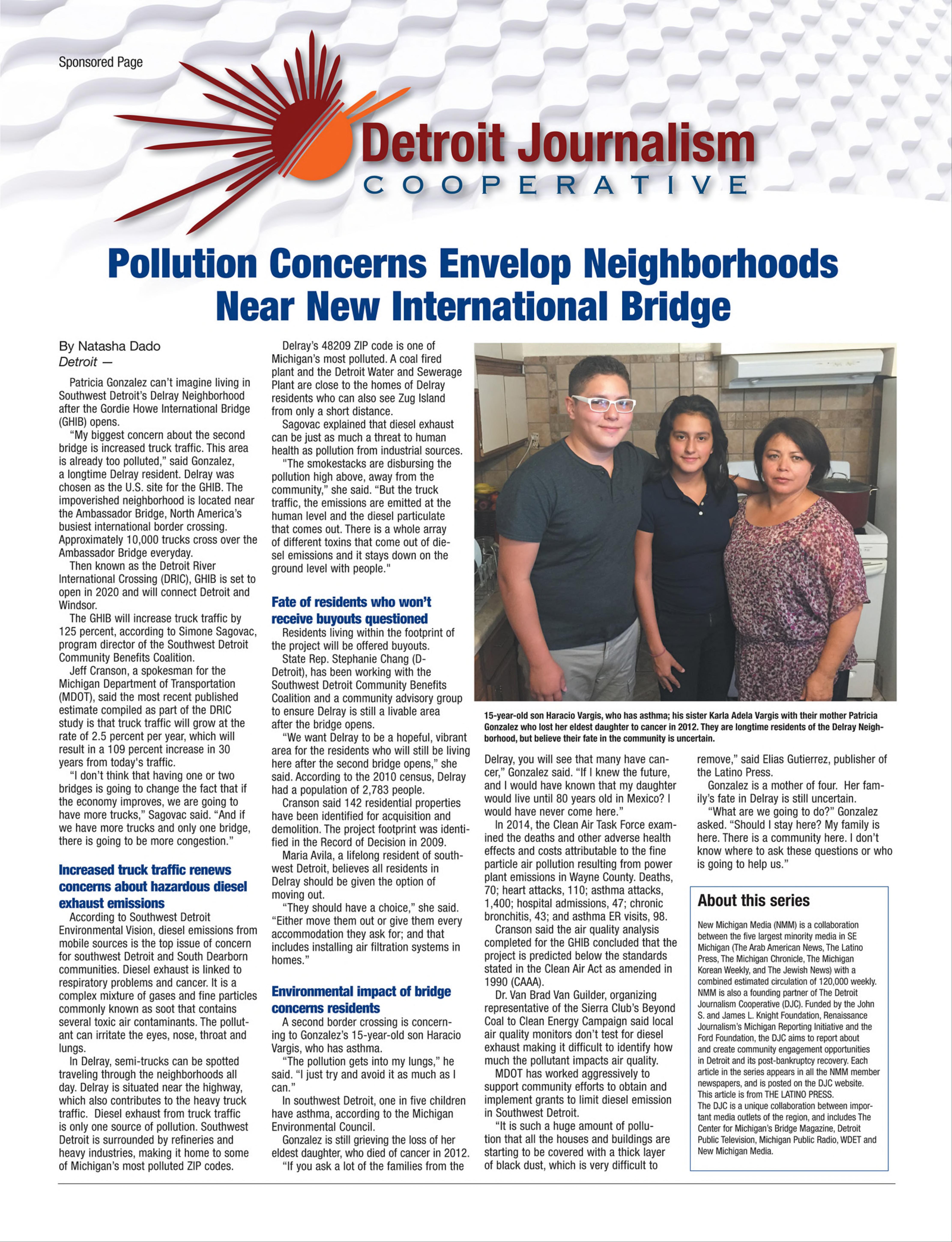
15-year-old son Haracio Vargis, who has asthma; his sister Karla Adela Vargis with their mother Patricia
Gonzalez who lost her eldest daughter to cancer in 2012. They are longtime residents of the Delray Neigh-
borhood, but believe their fate in the community is uncertain.
Delray, you will see that many have can-
cer," Gonzalez said. "If I knew the future,
and I would have known that my daughter
would live until 80 years old in Mexico? I
would have never come here."
In 2014, the Clean Air Task Force exam-
ined the deaths and other adverse health
effects and costs attributable to the fine
particle air pollution resulting from power
plant emissions in Wayne County. Deaths,
70; heart attacks, 110; asthma attacks,
1,400; hospital admissions, 47; chronic
bronchitis, 43; and asthma ER visits, 98.
Cranson said the air quality analysis
completed for the GHIB concluded that the
project is predicted below the standards
stated in the Clean Air Act as amended in
1990 (CAAA).
Dr. Van Brad Van Guilder, organizing
representative of the Sierra Club's Beyond
Coal to Clean Energy Campaign said local
air quality monitors don't test for diesel
exhaust making it difficult to identify how
much the pollutant impacts air quality.
MDOT has worked aggressively to
support community efforts to obtain and
implement grants to limit diesel emission
in Southwest Detroit.
"It is such a huge amount of pollu-
tion that all the houses and buildings are
starting to be covered with a thick layer
of black dust, which is very difficult to
remove," said Elias Gutierrez, publisher of
the Latino Press.
Gonzalez is a mother of four. Her fam-
ily's fate in Delray is still uncertain.
"What are we going to do?" Gonzalez
asked. "Should I stay here? My family is
here. There is a community here. I don't
know where to ask these questions or who
is going to help us."
About this series
New Michigan Media (NMM) is a collaboration
between the five largest minority media in SE
Michigan (The Arab American News, The Latino
Press, The Michigan Chronicle, The Michigan
Korean Weekly, and The Jewish News) with a
combined estimated circulation of 120,000 weekly.
NMM is also a founding partner of The Detroit
Journalism Cooperative (DJC). Funded by the John
S. and James L. Knight Foundation, Renaissance
Journalism's Michigan Reporting Initiative and the
Ford Foundation, the DJC aims to report about
and create community engagement opportunities
in Detroit and its post-bankruptcy recovery. Each
article in the series appears in all the NMM member
newspapers, and is posted on the DJC website.
This article is from THE LATINO PRESS.
The DJC is a unique collaboration between impor-
tant media outlets of the region, and includes The
Center for Michigan's Bridge Magazine, Detroit
Public Television, Michigan Public Radio, WDET and
New Michigan Media.
er