
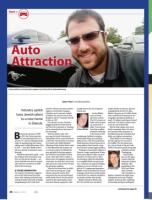

A man and his car: Ford product engineer Josh Fried with his beloved Mustang.
Adam Finkel
Industry uptick
lures Jewish talent
to a new home
in Detroit.
B
etween the summers of 2009
to 2015, the Detroit areas job-
less rate plummeted from 16.3
percent to 5.1 percent. Michigan led the
nation in manufacturing jobs created,
adding nearly 74,000 jobs between 2010
to 2013 — more than 30,000 of those
jobs were specific to automotive manu-
facturing.
Behind the automotive uptick — and
the evolution of the automotive work-
force over the last few decades — are
stories of Jewish execs and recent grad-
uates who have moved here to make
Detroit their new home.
A YOUNG GENERATION
The majority of automotive engineers
move to the Detroit area from other
states. After studying mechanical engi-
neering at Purdue University in Indiana
and graduating in 2013, Josh Fried
I Contributing Writer
moved to Detroit to become a product
engineer at Ford Motor Company.
Fried grew up in Leawood, a suburb
of Kansas City, and now lives in Novi,
though he says he "sometimes feels like
he lives on I-96:'
Over the last 2.5 years, Fried has
plugged himself into Jewish Detroit
and views the community as "amazing,
active, extremely diverse and, most of
all, welcoming:'
When he lacked a seder a few
years ago, the Jewish Federation of
Metropolitan Detroit connected him to
a rabbi who welcomed him to his home
for a family seder. Rabbi Elimelech
Silberberg of Bais Chabad Torah Center
in West Bloomfield has had him over
on several occasions for Shabbat din-
ners, and lately he has been going to
the NEXTGen Good Shabbos Detroit
events, which allow him to explore a
diverse array of synagogues around the
community. At events, he's come across
other peers who work at Ford, GM and
the automotive suppliers.
When he first moved here, he didn't
view Detroit as having such a large,
vibrant community and has been
surprised by the size and involvement
within Jewish Detroit. He also said he's
amazed by the misperceptions many
have about Detroit compared to what
actually exists in the city and greater
Detroit area.
Luciano Blinder
came to Detroit
almost by accident.
The 2012 economy in
Brazil, where he grew
up, increased by a
paltry .9 percent and
Luciano Blinder more than a million
protesters would take
to the streets in 2013
complaining of political corruption,
unreasonable living costs and faulty
public services. The 2012 Credit Suisse
Youth Barometer showed 50 percent of
young adults in Brazil viewed corrup-
tion to be their nation's biggest problem.
Working as a lead product engineer at
Faurecia, a major manufacturer of auto-
motive parts, Blinder's office was short
of projects. Yet, Faurecia's U.S. office
was booming, without the bandwidth
to accomplish all their necessary proj-
ects. A decision was made for Brazilian
engineers to move to Detroit to sup-
port the U.S. engineering department.
Blinder served as the liaison for this job
exchange, and the three-month position
in the Motor City would be extended to
six months and then nine months.
Blinder returned to Brazil in late
2013. By mid-2014, he was offered
another position at Faurecia, this time
working directly for the U.S. office.
Blinder, who grew up in Curitiba, Brazil,
with a small Jewish community of two
synagogues amongst a population of
nearly 1.8 million, would uproot himself
and travel 5,150 miles to make a home
in his new city of Royal Oak.
Here he finds a larger, more active
Jewish community than in his home-
town and also finds uniqueness in
the different branches of Judaism that
define our religious communities.
When Blinder is not working as
the lead engineer for rear seats of
the Cadillac CT6, he's joined activi-
ties, such as Torah on Tap and Latke
Vodka, Federation's annual young adult
celebration around
Thanksgiving.
Daniel Snyder
has seen the oppor-
tunities within the
automotive industry
firsthand. After
graduating in May
2014 from Wayne
Daniel Snyder
State University
with a bachelor's in
logistics, materials and supply chain
management, he became a logistics
engineer at Faurecia after completing
an internship during his undergradu-
continued on page 28
26 October 8 • 2015
Jni