

arts & life
music
The
Power,
°fMusic
Pianist and author
Mona Golabek tells the story
of how music helped saved
her mother's life.
The Children of
Willesden Lane
Beyond the Kindertransport:
A Monoir of Music, Love, and Survival
t.-
NIONA GOLAREK and LEE COH EN
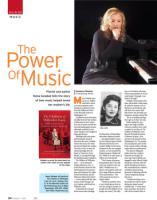
Golabek co-wrote the book about her
mother's life, which she has adapted
for the stage.
Mona Golabek will perform
The Children of Willesden
Lane at 2 p.m. Sunday, Oct.
11, at the Berman Center for
the Performing Arts in West
Bloomfield. $32-$37. (248)
661-1900; thebernnan.org .
34
October 1 • 2015
T.
I
Suzanne Chessler
Contributing Writer
M
ona Golabek grew
up in Los Angeles
and built a career
as a concert pianist, enter-
taining at acclaimed venues
from the Hollywood Bowl
to the Kennedy Center in
Washington, D.C.
Golabek learned instrumen-
tal skills from her late mother,
a Holocaust survivor whose
own love of music and life sto-
ries told during piano lessons
ultimately motivated a dra-
matic change in her daughter's
stage appearances.
Although still at the piano
performing the classical
selections she loves, Golabek
weaves the music into what
she learned about her mother,
Lisa Jura, as the 14-year-old
musical prodigy flees the
Nazis in Vienna for Great
Britain, as arranged through
the Kindertransport initiative.
The Children of Willesden
Lane — to be presented
Sunday afternoon, Oct. 11,
at the Berman Center for the
Performing Arts (in partner-
ship with Seminars for Adult
Jewish Enrichment and the
Holocaust Memorial Center)
— moves along with the expe-
riences of the teenage Lisa
in a London youth hostel on
Willesden Lane.
It describes how the girl
found some solace through
Lisa Jura
the formation of friendships
with other displaced youths
— and opportunities to prac-
tice her beloved piano (which
she learned from her own
mother, Malka) in the hostel
basement as the war ravaged
London. As Lisa boarded the
Kindertransport, Malka told
her, "Hold on to your music. It
will be your best friend:'
"I feel a sense of purpose
and gratitude that I was able
to get my mother's story out
there Golabek says in a
phone conversation amid trav-
els to stage different versions
of her presentation. "The
whole purpose has been to
inspire others.
"I think my mother's story
is very timely given what we
now are seeing in Europe [as
people from the Mideast try to
escape war zones]. The rally-
ing cry of students who have
seen my presentation is 'if Lisa
could make it through, I can
make it through:"
Golabek, whose piano selec-
tions will include a wide range
of works by masters such as
Beethoven and Debussy, also
will show how music itself
tells stories. Her dramatic per-
formances number nearly 500.
"It's an incredible privilege
that I get to do this:' she says.
Before taking her mes-
sage to the stage, Golabek
wrote her mother's story with
co-author Lee Cohen in The
Children of Willesden Lane:
Beyond the Kindertransport:
A Memoir of Music, Love,
and Survival (Grand Central
Publishing; $15). The produc-
tion incorporates parts of the
book, and the author will sign
copies after her performance.
The idea for telling the
public about her mother's
experiences emerged 20
years ago when Golabek was
engaged to play Edvard Grieg's
only piano concerto with the
Seattle Symphony Orchestra.
She remembered her mother's
revelations about having
dreamed of debuting with the
Vienna Symphony playing
that piece.
"I started reaching out to
the people she told me about
during my piano lessons,"
Golabek says. "I wrote down
those storylines and tried to
sell it all as a feature film or