

take care
of you. I
With great rates, an
even better staff, and the
speediest buses in the —1
business, trust Qwik Park e'
to get you to the airport
Qwik as a flash.
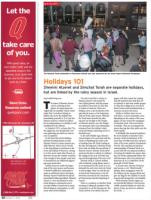
The Simchat Torah celebration in Downtown Detroit last year sponsored by the Isaac Agree Downtown Synagogue
Holidays 11
Shemini Atzeret and Simchat Torah are separate holidays,
but are linked by the rainy season in Israel.
myjewishlearning. corn
Save time.
Reserve online!
qwikpark.com
I
7782 Merriman Rd., Romulus, MI
E7d
Exit 198 from 1-94
Exit 20 from 1-275
1.888.844.7275 • qwikpark.com
30
October 1 • 2015
•
T
he status of Shemini Atzeret
can be confusing at first
glance. Its name means the
"eighth day of assembly:' which would
imply that it somehow belongs to
Sukkot, the seven-day holiday that
immediately precedes it. It is true that
Shemini Atzeret is related to Sukkot,
but its independence as a holiday is well
established in the Talmud.
In Numbers 29:35, we learn that "On
the eighth day, you should hold a sol-
emn gathering; you shall not work at
your occupation."
In his book The Jewish Holidays,
Michael Strassfeld points out that
Shemini Atzeret in many respects par-
allels Shavuot, which can be viewed
as the long-distance conclusion to the
seven-day holiday of Passover, coming
as it does seven weeks after Pesach. At
that time of year, the weather would be
clear enough to have people come back
to Jerusalem for an additional pilgrim-
age some weeks later.
Sukkot, however, marks the begin-
ning of the rainy season, and because
it would be difficult to ask people to
make an additional trip to Jerusalem,
Shemini Atzeret would best be placed
immediately following Sukkot. Shemini
Atzeret is a two-day festival in tradi-
tional diaspora communities and a
one-day holiday in Israel and in many
liberal diaspora communities, as with
many other Jewish holidays.
The only ritual that is unique to
Shemini Atzeret is the prayer for
rain (tefilat geshem), and this prayer
is parallel to the prayer for dew that
is recited on Passover. These two
holidays serve as the bookends of the
agricultural season, at the beginning
and end of the rainy season. Whereas
the Torah does describe the offer-
ing that was brought to the Temple
on Shemini Atzeret, once the Temple
was destroyed, there was nothing that
remained from the holiday's ritual
except the liturgy requesting rain for a
bountiful year.
In the early Middle Ages, Shemini
Atzeret began to be associated with the
ritual of completing the yearly cycle
of readings from the Torah, leading to
the later development of Simchat Torah
from what was likely the second day of
Shemini Atzeret. Simchat Torah devel-
oped into the day on which we celebrate
the ending of one cycle of Torah read-
ing and the beginning of the next cycle.
Simchat Torah is a joyous holiday
with a relatively young history since it
is not mentioned in the Torah. It is tra-
ditionally the only time when the Torah
is read at night, when we read the last
section from Deuteronomy, to be fol-
lowed the next day by the conclusion
of Deuteronomy and the beginning of
Genesis.
There is a tradition on Simchat Torah
morning of calling all members of the
community to say the blessing over the
Torah, known as an aliyah; and syna-
gogues will often repeat the reading
until all members have had their ali-
yot (plural) or split into smaller groups
to chant the reading from several dif-
ferent Torah scrolls simultaneously so
everyone can have this honor.
Similar to Sukkot, there are sev-
eral (three, or more commonly, seven
depending on the custom of the syna-
gogue) circuits around the synagogue
on Simchat Torah. These are known
as hakafot. They are accompanied by
joyous dancing that often spills onto the
street outside.
In Kabbalah (the mystical tradition),
the seven hakafot on Simchat Torah
became a kind of unification of the
seven days of Sukkot and also represen-
tative of the seven sephirot (emanations
of God). This spiritual and mystical
understanding of Simchat Torah is in
accord with the very physical tradition
of turning the hakafot into joyous danc-
ing. The Torah reading that follows the
wild dancing is often very playful and
humorous as it is a celebration of the
great gift of God's Torah.
In recent times, Simchat Torah has
also become a very "child-friendly"
holiday. Many synagogues invite all
the children up for a group aliyah and
give out flags for the children to march
around with during their own hakafah.
While Simchat Torah's origins are
not specifically biblical, it has become
a Bible-centered holiday on which the
hearts of Jews are drawn to celebrate
the Torah.
❑