

arts & life
film
Rescue In The Philippines
)11/t
",4 -r 11.1, 11Er "
Una .z4,
Fter ,, ,zeie.y. 11 . r■ r....•,,94• •
W 04
PA4."4/"H
P • I.
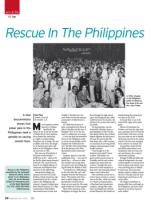
In 1940, refugees
in the Philippines
gather in Manila at
the home of Mr. and
Mrs. Alex Frieder.
A new
documentary
shows how
poker pals in the
Philippines took a
gamble on saving
Jewish lives.
Rescue in the Philippines,
presented by the Holocaust
Memorial Center, will be
shown 7 p.m. Wednesday,
Sept. 30, at the Berman
Center for Performing Arts
at the West Bloomfield
JCC. $13. (248) 661-1900;
theberman.org .
68
September 24 • 2015
Dan Pine
Jewish Journal
of Greater L.A.
M ary Farquhar's earliest
memory is of flame.
Specifically, the
flames of war in the last months
of World War II, when Japanese
forces battled the Americans
in a fight to reclaim Manila,
Farquhar's city of refuge. She was
a toddler at the time, the daugh-
ter of Austrian Jews given safe
harbor in the Philippines, where
she was born in 1943.
Hers was one of hundreds of
European Jewish families —
1,200 Jews in all — taken in by
the Pacific island nation between
1938 and 1941, saved from the
Nazis by an unlikely alliance of
Americans and Filipinos deter-
mined to do the right thing.
Among those benign con-
spirators were the five Frieder
brothers, Jewish Americans who
manufactured two-for-a-nickel
cigars in the Philippines; the
country's visionary Catholic pres-
ident Manuel Quezon; U.S. High
Commissioner Paul McNutt,
who issued scores of visas; and
Dwight D. Eisenhower, a few
years before he became supreme
commander of Allied forces in
Europe.
It's a little-known story of
hope, overshadowed by those of
Oskar Schindler and the Jews of
Shanghai. Yet it is n/o less dra-
matic or emblematic of courage.
A new one-hour documentary,
Rescue in the Philippines, seeks
to set the record straight on this
forgotten bit of Holocaust his-
tory. The film will screened Sept.
30 at the Berman at the West
Bloomfield Jewish Community
Center.
Farquhar appears in the film,
retelling the story — now part of
family lore — of how as a baby
she wouldn't stop crying when
her parents went into hiding dur-
ing the battle for Manila in 1945.
"I remember as a child playing
in the ruins after the war:' said
Farquhar from her San Francisco
home. "My parents went from
place to place, hiding out. My
grandmother would cook on
stones over an open fire. She made
apple strudel out of native squash:'
Most of her memories of the
Philippines are happy. She lived
there through her high-school
years, and though she has called
California home for decades, she
still loves the country that took in
her family.
The documentary was the
brainchild of Barbara Sasser, a
granddaughter of Alex Frieder,
who along with his four brothers
helped engineer the bold rescue.
She says the idea for the film
took shape after a 2005 reunion
in Cincinnati of surviving Jewish
refugees and descendants of the
Frieder brothers.
"That brought it to the
forefront of my mind:' Sasser
recalled. "[My father and
great-uncles] saved as many as
Schindler, and the only reason
people know about that was
a movie. I thought this story
deserved as much attention as
that, and I said somebody should
make a movie about this:'
That somebody turned out to
be her. Sasser served as a consul-
tant on the film, which was made
by 3 Roads Communications,
a Maryland-based production
company. Among other tasks,
Sasser provided hours of home
movies filmed by the Frieders in
Manila during the tranquil pre-
war days in the 1930s.
As Sasser likes to say, it all
started with cigars and a poker
game.
Natives of Cincinnati, the
Frieders went into the cigar busi-
ness, opening a factory in Manila.
Each brother took turns serving
two-year stints on-site in Manila.
All became devoted to the nation,
which at the time was emerging
from centuries of colonial rule.
Among their closest friends
and fellow poker players were
Eisenhower, then an Army colo-
nel, and Quezon, the country's
charismatic president.
Though of different faiths and
cultural backgrounds, the team
worked together to extricate Jews
from Germany and Austria, issue
visas and bring them to Manila.
It wasn't easy. The noose had
already started to tighten around
the Jews of Europe, and the State
Department wasn't keen on the
rescue effort.
All refugees would have to
possess skills they could apply in
the Philippines, and none could
depend on any form of govern-
ment welfare.