

Nutritionally
Speaking
By Barbara Beznos, RD/LD/N
Integrated Nutrition, 1,1,C
Dear Barb #2
How did sugars in
the diet become so
complicated and
difficult to under-
stand? Rachel
WHAT IS THE ROLE OF
SUCROSE OR TABLE SUGAR?
Sucrose/table sugar is used:
• In cooking for texture, viscosity,
emulsifying
• As a preservative
• To lower freezing point
• To cover up bitterness in drugs and
medicine
• As fermentation in food
• As a source of energy just like other
carbohydrates
• As an additive or sweetener
• As a tenderizer
• For carmelization
• For color
• In sport drinks, for instant energy or
with electrolyte replacement
• In chewing gum, frozen desserts and
frosting
SO WHAT HAPPENS TO
EXCESS SUGAR WE EAT?
Excess sugar:
• Goes into urine to be discarded
• Stores as fat for future use
• Is made into fatty acids to become a
triglyceride fat which later travels to
cells, organs, and becomes stored
• Can even be converted by cells into
fat, protein and fattening glucose
• Can raise blood glucose levels and
elevate insulin levels
• For those who are genetically
susceptible, may contribute to insulin
resistance. This sugar then adds to
weight gain, diabetes, or Syndrome
X (a metabolic condition)
• Is oxidized as a glucose molecule and
is stored as glycogen in the liver or
muscles
• Is broken down quickly and then
releases blood sugar rapidly. The
Glycemic Index number for table
sugar is 65; which is a high number
— Barbara Beznos
Registered Dietitian
Licensed Dietitian/Nutritionist (FL)
Contact Barb At:
Integrated Nutrition, L.L.C.
31731 Northwestern Hwy., Suite 105 E
Farmington Hills, Mi 48334
Phone:
(248) 538-8050
E-Mail:
rds@integratednutrition.com
Web:
www.integratednutrition.com
2025750
16 September 17 • 2015
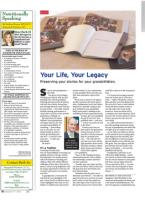
Your Life, Your Legacy
Preserving your stories for your grandchildren.
S
modern stimuli. As you communicate
o you're now grandparents —
with relish.
to your grandkids about your past, you
You devour the privileges.
offer them alternative roads to their
Watching your kids do what you did.
future.
Spending time with the grandkids.
We all want to preserve our legacies
Enjoying special moments of intimacy
and life experiences for future genera-
with each one of them. Seeing them
tions. Grandparents, here's your chance.
grow through lifecycle events, both joy-
Inspired by a simchah coming or just
ous and serious — brit milah, simchat
past, initiated by your grandchild's
bat/baby naming, performances at
family roots project, standing on the
school and in activities, b'nai mitzvah,
scaffolding of memory generated by the
graduations, weddings, etc.
moment, give your grandkids
But what about the respon-
the gift of your lives. Your
sibilities? Some grandparents
grandkids want — and need
can't figure that one out. The
— to hear you, both now and
practical responsibilities of
in the future.
caretaking — those belong
Preserve your story for
now to your kids. Are you
them and for the generations
destined solely to observe,
beyond. Record or write it
attend, give birthday pres-
yourself or with the seasoned
ents and — if you live in the
help of a personal histo-
rian — who will interview
same area — to offer spot
By R abbi
babysitting?
you, hear your story, ask the
Mark R obbins
Far from it.
right questions, draw out the
Specia I to the
formative moments, relation-
Jewish News
It's A Tradition
ships, themes and emotions,
According to Jewish tradi-
and tie them together.
tion, the responsibilities of teaching and
A few guidelines:
guiding only grow with age, wisdom
• Focus on life-changing decisions,
and experience. You remain parents,
transitional moments, moves, influen-
still in the business of teaching your
tial relationships, mentors and those
children, albeit with wholly different
you have mentored.
challenges of time, place, style and fre-
• Consider your core values and how
quency. And you are grandparents, with you have lived them. Discern what your
the unique opportunity to take the role
life goals have been and whether you
of teacher and mentor to an entirely
have achieved them.
new level.
Remember that the goal is not to
As grandparents, you become the
determine exact history — but rather to
main link for your grandkids to the
grasp the riches you can from your past
past, to lives lived in a different way, to
and to reflect on how they made you
values highlighted when they are now
feel, what impact they've had on your
hidden, to traditions less obscured by
life and the lessons you've learned that
you'd like to pass on to the next genera-
tions.
• Go beyond and arrange transcrip-
tions and written text in a life story
book — replete with photos, memora-
bilia and other scans that illustrate the
life you've led. Create a visual timeline
of your life that correlates events in
your life with events in the world
around us. Frame an ethical will to
accompany your estate planning. These
are just a few of many options to choose
from as you preserve your story for
your family.
As a rabbi and personal historian, I
have had amazing experiences seeing
the eyes of grandparents and others like
you light up as you explore your past
— as you reflect on subjects as diverse
as who mentored you as young people,
what shaped your key decisions, how
life was different in America decades
ago and whether you've achieved your
life's goals. Your eyes light up with the
past and they also peer ahead to the
legacy in formation — for your kids,
grandkids and beyond.
Grandparents, take heart as you
reflect these High Holidays—and as
you refocus on what's really important.
You are not just bonuses to your grand-
kids' lives, not just happy observers.
You are essential to them — no more
so than when you bequeath to them
your stories, the foundation for their
futures. ❑
Mark Robbins is a rabbi at B'nai Israel
Synagogue in West Bloomfield. He also
records and writes people's life stories, and
is the founder of jewishlifestory.com . This
story first appeared on myjewishdetroit.org .