

Rosh Hashanah
Ultimate Involvement
Congregational prayer leaders often see their honor
as an expression of giving back.
I
Stacy Gittleman
Contributing Writer
D
uring the Middle Ages, an
unknown cantor, humbled
at the task of praying on
behalf of the entire congregation so
that God would inscribe them into
the Book of Life, penned the prayer
Hineini, meaning "Here I Aim"
Before the invention of the
printing press, leaders of tefilot, or
Jewish worship, carried the weighty
responsibility of keeping an entire
congregation engaged and focused.
Fast forward several centu-
ries, and not much has changed.
Although the words of the Rosh
Hashanah and Yom Kippur liturgy
are widely available in printed
machzorim (High Holiday prayer
books) or even transmitted elec-
tronically onto large video screens,
it is still the task of the leader to be
the shaliach tzibbur (literally trans-
lated as "messenger of the commu-
nity") in shepherding today's Jews
through the most prayer-intensive
time on the Jewish calendar in an
increasingly secular society.
Throughout Metropolitan
Detroit, many consider it an honor
to volunteer leading services along-
side professional clergy as an ulti-
mate expression of contributing to
the Jewish community.
Rachel Jacobson, 28, of Silver
Spring, Md., each year returns to her
hometown B'nai Israel Synagogue in
West Bloomfield to be with family
and to lead various parts of services.
Inspired from her years in Jerusalem
learning from pioneering women
leading tefilot in egalitarian con-
gregations, she was one of the first
female prayer leaders for B'nai Israel
during the high holidays.
"I never was formally trained to
lead:' Jacobson said. "It is some-
thing I picked up over the years in
school, at Camp Ramah and living
in many different Jewish com-
munities. It is when I can do my
best praying because I am not only
responsible for my own davening,
but for the congregation before me:'
Jacobson credits her singing abil-
ity to her school days performing in
musicals, though it is not necessary
62
September 10 • 2015
to be able to carry a tune to lead
tefilot. But just as in show business,
services must go on, even when the
prayer leader is sick.
"Sometimes I think God does not
want me to daven," Jacobson joking-
ly said, thinking about leading Rosh
Hashanah services while fighting a
cold. "It is moments like that when
I really must remind myself that I
am not up there [on the bimah] to
sound pretty. I am an emissary for
the congregation's tefilot to deliver
them to God. That is what leading
prayer is all about:'
Stepping Up
Last Rosh Hashanah, Rabbi Norman
Roman of Temple Kol Ami in West
Bloomfield found himself not on
the bimah but in the hospital. It
was then that the congregation
showed its strength and proudest
moments, according to congregant
Diane Siegel Di Vita of Northville,
who helps coor-
dinate monthly
lay-led ser-
vices at Kol Ami
throughout the
year.
She said the
entire execu-
tive board filled
Diane Siegel
in to lead the
Di Vita
services and
deliver sermons
under the facilitation of Cantorial
Soloist Tiffany Green. Roman's
stepson Chad Rochkind delivered
the Yom Kippur sermon.
"What happened at Kol Ami last
year was very community affirm-
ing:' Green said. "It was important
for our mem-
bership to see
fellow members
stepping up to
the plate at a
moment's notice,
and showed how
they
care for
Tiffany Green
their community
through their
leadership. Leading prayers shapes
and grows our small congregation.
It shows that our members care
about what happens here:'
In an effort to bring to his fellow
JN
congregants the meaningfulness of
the season, Bruce Plisner, an active
congregant at Temple Beth El in
Bloomfield Township, designed
with Rabbi Mark Miller a one-hour
text study for Yom Kippur after-
noon that will focus on the central
themes of the day: the sounds of
the shofar, fasting, repentance and
forgiveness.
Plisner, 68, of Farmington Hills
said that Jews for generations
have recited prayers such as the
Ashamnu and the Unetana Tokef,
but may not know their origin or
significance. Through text study
and rabbinical and contemporary
commentaries, he hopes to enlight-
en worshippers by offering them
something less passive and more
participatory.
"During Yom Kippur, we say
certain prayers over and over again
that few people understand what
or why we are saying them:' said
Plisner, who said he tries to get to
services during the year as much
as he can to usher and lead. "We
thought it would be meaningful
to take a different approach to
reading about the prayers through
rabbinical interpretation. We will
also examine the tradition of fast-
ing and, through various texts, will
explore who fasts and who is par-
doned from fasting:'
In synagogues and temples that
do not have a cantor, rabbis such as
Steven Rubenstein of Congregation
Beth Ahm in West Bloomfield
rely upon a deep
core of capable
and willing con-
gregants to lead
prayers. This year,
there will be some
A new Torah read-
ers joining the
.
.
ranks of volun-
Rabbi Steven
teers, he said.
Rubenstein
"Leading tefilot
is a big part of our congregation's
culture Rubenstein said. "Leading
gives people the opportunity to be
invested and involved in congrega-
tional life. It makes services more
enjoyable, not only for the High
Holidays, but also throughout the
entire year:'
❑
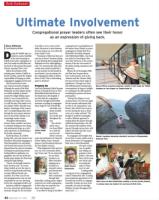
Bruce Plisner practices blowing a shofar to get ready for Tekiah
Gedolah on Yom Kippur at Temple Beth El.
Rachel Jacobson davening shacharit services in Shenandoah
National Park
Bob Levine of West Bloomfield, leading a service during Sukkot,
is among many lay leaders for services at Beth Ahm.