
arts & life
essay
' I
M
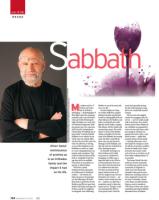
Oliver Sacks'
reminiscence
of growing up
in an Orthodox
family and the
impact it had
on his life.
104
September 10• 2015
JN
y mother and her 17
brothers and sisters
had an Orthodox
upbringing — all photographs of
their father show him wearing a
yarmulke, and I was told that he
woke up if it fell off during the
night. My father, too, came from
an Orthodox background. Both
my parents were very conscious
of the Fourth Commandment
("Remember the Sabbath day, to
keep it holy"), and the Sabbath
(Shabbos, as we called it in our
Litvak way) was entirely differ-
ent from the rest of the week. No
work was allowed, no driving,
no use of the telephone; it was
forbidden to switch on a light
or a stove. Being physicians, my
parents made exceptions. They
could not take the phone off the
hook or completely avoid driv-
ing; they had to be available,
if necessary, to see patients, or
operate, or deliver babies.
We lived in a fairly
Orthodox Jewish community
in Cricklewood, in Northwest
London — the butcher, the
baker, the grocer, the greengro-
cer, the fishmonger, all closed
their shops in good time for the
Shabbos, and did not open their
shutters till Sunday morning. All
of them, and all our neighbors,
we imagined, were celebrating
Shabbos in much the same fash-
ion as we did.
Around midday on Friday,
my mother doffed her surgical
identity and attire and devoted
herself to making gefilte fish and
other delicacies for Shabbos. Just
before evening fell, she would
light the ritual candles, cupping
their flames with her hands, and
murmuring a prayer. We would
all put on clean, fresh Shabbos
clothes, and gather for the first
meal of the Sabbath, the evening
meal. My father would lift his
silver wine cup and chant the
blessings and the Kiddush, and
after the meal, he would lead us
all in chanting the grace.
On Saturday mornings, my
three brothers and I trailed
our parents to Cricklewood
Synagogue on Walm Lane, a
huge shul built in the 1930s to
accommodate part of the exo-
dus of Jews from the East End
to Cricklewood at that time.
The shul was always full dur-
ing my boyhood, and we all
had our assigned seats, the men
downstairs, the women — my
mother, various aunts and cous-
ins — upstairs; as a little boy, I
sometimes waved to them dur-
ing the service. Though I could
not understand the Hebrew
in the prayer book, I loved its
sound and especially hearing
the old medieval prayers sung,
led by our wonderfully musical
chazzan.
All of us met and mingled
outside the synagogue after the
service — and we would usually
walk to the house of my Auntie
Florrie and her three children to
say a Kiddush, accompanied by
sweet red wine and honey cakes,
just enough to stimulate our
appetites for lunch. After a cold
lunch at home — gefilte fish,
poached salmon, beetroot jelly
— Saturday afternoons, if not
interrupted by emergency medi-
cal calls for my parents, would be
devoted to family visits. Uncles
and aunts and cousins would
visit us for tea, or we them; we all
lived within walking distance of
one another.
The Second World War deci-
mated our Jewish community
in Cricklewood, and the Jewish
community in England as a
whole was to lose thousands
of people in the postwar years.
Many Jews, including cousins of
mine, emigrated to Israel; oth-
ers went to Australia, Canada
or the States; my eldest brother,
Marcus, went to Australia in
1950. Many of those who stayed
assimilated and adopted diluted,
attenuated forms of Judaism.
Scanned image of the page. Keyboard directions: use + to zoom in, - to zoom out, arrow keys to pan inside the viewer.
September 10, 2015 - Image 104
- Resource type:
- Text
- Publication:
- The Detroit Jewish News, 2015-09-10
Disclaimer: Computer generated plain text may have errors. Read more about this.