

metro >> on the cover
Judge Bernard Friedman's decisions guided by that one position.
Berl Falbaum I Special to the Jewish News
CONTINUED FROM PAGE 1
The cases ended up before Friedman by
chance or, as the court describes it, blind
draw. Friedman couldn't duck, but even if he
could he wouldn't have because he loves and
respects the law and thrives on intellectual
and legal challenges.
In the affirmative action case, he ruled
against the University of Michigan program,
issuing what would be described as a con-
servative opinion. The other was a liberal
opinion in which he held that the ban on
same-sex marriage approved by Michigan
voters was unconstitutional.
Nothing unusual in the opposing political
philosophies, he explains, because he decid-
ed both cases on the same principle: the 14th
Amendment of the U.S. Constitution that
provides for "equal protection under the law:'
"Equal protection under the law demands
and means equal protection under the law:'
Friedman said in an interview. It is really as
simple as that.
"Whenever we've manipulated the right
to equal protection someone gets hurt:' he
said. "We simply can't take away the rights of
people:'
This is so basic to him that he seems
puzzled that anyone would not understand
this constitutional protection designed by the
Founding Fathers.
The Right To Marry
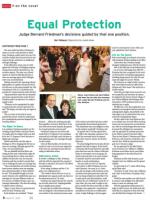
Last weekend, Friedman presided over the
wedding of April DeBoer and Jayne Rowse,
18 months after his ruling in their case that
led to the U.S. Supreme Court's decision to
legalize gay marriage.
DeBoer and Rowse sued the state of
Michigan in 2014, charging that the ban on
same-sex marriage, although approved by
voters, was unconstitutional.
The two plaintiffs had first filed a suit
stating that the state violated their rights by
not permitting them to adopt each other's
children because they were not married.
Friedman said they needed to amend their
case to challenge the same-sex marriage ban.
"They amended their suit and the primary
issue became whether same-sex marriage
had a detrimental effect on their children;
he said. "The plaintiffs brought in several
expert witnesses who testified that same-sex
marriages do not have different results on
the outcome of children living in same-sex
marriage relationships. The state did nothing
to disprove these witnesses.
"Again, it came down to equal protection
under the law:' Friedman said.
In his decision, he concluded: "Today's
8
August 27 • 2015
made it to the Supreme Court, which, last
year, upheld the voters' decision.
Above: Jayne Rowse and April DeBoer
walk down the isle after the ceremony.
Left: Judge Bernard Friedman and his
wife, Rozanne.
decision ... affirms the enduring principle
that regardless of whoever finds favor in the
eyes of the most recent majority, the guaran-
tee of equal protection must prevail:'
Friedman's ruling was one of four that
reached the U.S. Supreme Court simultane-
ously and led to the high court's decision in
June legalizing same-sex marriages through-
out the country.
Given its liberal politics, the Jewish corn-
munity, he said, was much more supportive
of his same-sex marriage decision than his
ruling on affirmative action.
Affirmative Action
In Grutter v. Bollinger in 2001, Friedman
said that while he supported the concept of
diversity in education, he found U-M's efforts
unconstitutional.
In his ruling, Friedman said the U-M
policy over-emphasized race.
"The evidence shows that race is not, as
defendants have argued, merely one factor in
the admissions process:' he wrote.
Friedman also argued that the law school's
use of racial criteria was "indistinguishable
from a straight quota system:'
He said experts testified that admission
tests are designed to discriminate and that he
was sensitive to the testimony because many
of the nation's universities had years earlier
systematically discriminated against Jews.
"The admissions tests were designed so that
Jewish students would fair Friedman said.
He agreed with U-M that argued diver-
sity "adds to the education experience but
added, the university had at its disposal
many other means to achieve its diversity
objectives.
He acknowledged that his decision did not
engender the kind of support in the Jewish
community that he had hoped for, especially
given that Jews were the victims of discrimi-
nation at universities not too long ago. He
said he expected them to be more sensitive
to decisions made by universities based
heavily on racial considerations.
The case made it to the U.S. Supreme
Court where, in 2003, Friedman was over-
ruled. However, the court, in a 5-4 deci-
sion, did not disagree with Friedman on his
conclusion that equal protection under the
law was being violated, but ruled that U-M,
to make up for past discrimination, could
continue the use of affirmative action for 25
years when, the court said, it might no lon-
ger be needed. But three years later, in 2006,
Michigan voters approved a constitutional
amendment to ban the use of affirmative
action. A legal challenge to the ban again
Life On The Bench
Both cases brought an avalanche of reaction,
with hundreds of letters landing in his office.
Asked about this, Friedman simply
shrugged, implying it goes with the territory.
Now in his 28th year on the federal bench
— he served as chief judge from 2004-09 —
Friedman has been recognized for his work
on the bench by several legal organizations,
including being named one of the 25 most
respected judges by Lawyers Weekly.
His eminence as a legal scholar is particu-
larly noteworthy because he suffers from
dyslexia and "other issues" that made him a
terrible student.
Given his poor high school record, he was
not accepted by any university. By chance,
he stopped by the former Detroit College of
Law (which affiliated with Michigan State
University in 1995) and discovered it was
relatively easy to apply.
He filled out a very short application, was
admitted even though he had not earned an
undergraduate degree, and probably is the
only judge to sit at a federal level who never
earned an undergraduate degree.
He did a stint in the Army Reserves, first
as an enlisted man, but took officer training
classes and was promoted to second lieuten-
ant. After he was discharged from the Army,
he passed the Michigan bar examination
and was appointed an assistant prosecutor
in the Wayne County Prosecutor's office.
There he met Robert S. Harrison and Dalton
Roberson, with whom he would form a pri-
vate law firm. While he enjoyed the law, his
goal was to become a judge.
He was appointed to the 48th District
Court by former Gov. William G. Milliken.
Friedman served there for six years before
being appointed to the federal bench by
Reagan.
Friedman and his wife, Rozanne, a psy-
chologist, have two children and five grand-
children.
So, given that he is 71, when will he hang
up his black robe?
"No plans," he said, "Every day is different,
and I enjoy it immensely. I'm going to keep
going:'
Would he want another case with the pub-
lic pressure and spotlight of an affirmative
action or same-sex marriage case?
With the appropriate temperament of a
judge, he didn't answer. He smiled and indi-
cated that he is prepared to deal with what-
ever the blind draw brings to his bench.
❑