

Hamas from page 45
Commentary
Clearly, Hamas
isn't in a position
to coax Israel into
another war
anytime soon.
ing Israeli work permits to help
tend the agricultural fields just
inside Israel. Gaza suffers from a
40-percent unemployment rate,
according to Times of Israel.
The Prospects
A Hamas-Israel treaty is as much a
possibility as a pipe dream.
Clearly, Hamas isn't in a position
to coax Israel into another inconclu-
sive, debilitating war anytime soon.
Hamas claims it even has tried
to restrain splinter factions from
inciting Israel. Still, said an officer
on the IDF panel: As long as Gaza
remains an economic cauldron,
there's potential for another round
of fighting:'
Israel isn't likely to accept two
other llamas demands: reopening
of an international airport in Gaza
and release of dozens of prisoners
arrested in the political flames of
three Israeli teens being kidnapped
and murdered by Hamas terrorists
in the West Bank in June 2014.
Israeli security officials have
long been intrigued by the idea of
a real truce with Hamas, largely, as
WorldJewishDaily.com reports, "to
give the Palestinians something to
lose in any future war with Israel:'
Since last year's war, Hamas has
become internationally isolated
outside of its anti-Zionist alliance
with Iran and its flirtation with the
Islamic State's affiliate in Egypt's
lawless Sinai Peninsula, southwest
of Israel.
As the U.S. Congress, including
our Michigan delegation, weighs
the U.S.-brokered nuclear limita-
tions deal between world powers
and Tehran, it must mull the con-
sequences of freeing up billions
through sanctions relief and the
unfreezing of assets.
Israel fears such a windfall
not only would help reinforce the
Islamic Republic's regional hege-
monic aspirations, but also would
further its funding of terror by
rogue proxies — like Hamas.
❑
46
August 20 • 2015
Why We Oppose Iran Deal
hen the Joint Comprehensive
mantle Iran's nuclear infrastructure;
Plan of Action (JCPOA) was
that it in fact created a legitimate
announced in Vienna on July
pathway for Iran to emerge as a
14, the American Jewish Committee
nuclear threshold state even if it never
(AJC) issued a press release indicat-
violated the deal; that at least some of
ing that we would first study the full
Iran's new infusion of funds would be
text and its implications, and then
used to stoke further terror and insta-
take a position on the deal, as the U.S.
bility in the Middle East and beyond;
Congress launched into its 60-day
that America's allies in the region were
review period.
profoundly unsettled by the agreement
Over the past three weeks, AJC
and its broader implications; and that
engaged in a very intensive, open-
there were concerns about Iran's abil-
minded and thorough process of exter-
ity to deceive the international com-
nal consultations and internal delib-
munity, as it had done in the past at
erations, involving many lay and staff
Natanz and Fordo, and as other coun-
leaders.
tries, including North Korea
During this effort, we had
and Syria, had also done.
the privilege of meeting pri-
In the end, AJC's leader-
leader-
vately with, first, Secretary
ship concluded overwhelm-
of State John Kerry, and,
ingly that we must oppose
later, Under Secretary of
this deal.
State Wendy Sherman, both
Much as we respect those
0
of whom visited our New York
in the P5+1, led by the
headquarters. We also had
United States, who pains-
the opportunity to speak with
takingly negotiated the
Democratic and Republican
agreement over the span of
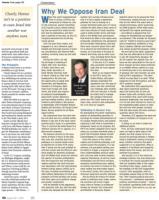
David Harris
Dav
i
members of Congress; diplo-
years, and who confronted
AJC
mats from Europe, the Arab
one challenge after another
Executive
Execu
world, and Israel; and respect-
with Iran and also, it should
Director
Direc
ed analysts knowledgeable
be noted, had to manage
about both nuclear diplomacy
the complex interaction
and Iran-related matters. And we were
within the P5+1 itself, there are too
invited to participate in discussions
many risks, concerns and ambiguities
in Washington with President Barack
for us to lend our support.
Obama and Secretary of Energy Ernest
Moniz. We are grateful for all these
Validating A Nuclear Iran
opportunities.
By abandoning the earlier negotiating
We understood from the start that
posture of dismantling sanctions in
the Iran deal was not a simple matter.
exchange for Iranian dismantlement of
Rather, it was one of the most conse-
its nuclear infrastructure, and instead
quential policy issues in a generation.
replacing it with what is essentially a
Thus, it could not be boiled down to a
temporary freeze on its program, the
reflexive reaction for or against, or a
P5+1 has indeed validated Iran's future
glib one-line response.
status as a nuclear threshold state, a
We listened carefully to the argu-
point that President Obama himself
ments of those in favor of the deal,
acknowledged in a media interview.
who, inter alia, asserted that Iran's
Given the nature of the Iranian
pathways to a nuclear bomb would
regime and its defining ideology, AJC
be blocked for at least 10-15 years;
cannot accept this prospect. It is too
that it would use the cash windfall of
ominous, too precedent-setting, and
unfrozen assets and the lifting of sanc-
too likely to trigger a response from
tions largely for domestic purposes;
Iran's understandably anxious neigh-
that the Middle East would not witness
bors who may seek nuclear-weapons
the specter of nuclear proliferation;
capacity themselves, as well as, more
that the inspection and verification
immediately and still more certainly,
regime would be the most intrusive
advanced conventional arms, adding
ever developed, with the International
an entirely new level of menace to the
Atomic Energy Agency (IAEA) up to
most volatile and arms-laden region
the task, including ascertaining pos-
in the world. Surely, this cannot be in
sible military dimensions of Iran's past
America's long-term security interests.
program; and that perhaps Iran would,
And by lifting the freeze on Iranian
with time, open up to positive change
assets in relatively short order, remov-
and greater cooperation.
ing sanctions will surely trigger
And we listened to the opponents,
many visits to Tehran, as evidenced
who asserted, inter alia, that this deal
already by German Vice Chancellor
at best only delayed but did not dis-
and Minister of Economy Sigmar
171
Gabriel's desire to be among the first.
Furthermore, ending the ban on arms
flow to Iran within five years and on
missile technology, which would help
its ICBM program, within eight years,
will benefit the regime enormously
– and without a demand that Iran
change its destabilizing and danger-
ous behavior. This includes its frequent
calls for "Death to America and Israel,"
and its hegemonic ambitions in Iraq,
Syria, Lebanon, Bahrain and Yemen.
AJC cannot accept this prospect, either.
We are told by the deal's supporters
that the only alternative to this deal
is war. We respectfully disagree. We
do not support war against Iran, nor
have we ever advocated for the use of
force, though we have always believed
in a credible military option as a way
of convincing Iran of our seriousness
of purpose. But until recently, we were
told by P5+1 negotiators: "The alter-
native to a bad deal is no deal." What
happened to that formulation, and why
did it suddenly change?
We understand that opposing this
deal raises important questions
about the future that no one can
answer today with certainty, much
as we believe that, faced with strong
American leadership, Iran would find
it in its own best interests to return to
the negotiating table sooner or later.
But we know with greater certainty
that this deal raises still more ominous
questions about the future.
Therefore, AJC opposes the deal and
calls on members of Congress to do
the same.
In doing so, we wish to make two
additional points.
First, we fully understand that pas-
sions run high on both sides of the
debate, but that should not be an
excuse for personal attacks or inflam-
matory statements having no factual
basis, whether voiced by the deal's
supporters or its opponents. What is
needed is a full-blown and respectful
debate about the issues, and not ad
hominem accusations.
And second, it is in the American
strategic interest, now more than ever,
to maintain the closest possible links
with our longtime allies in the region,
including Israel, Egypt, Jordan and
the members of the Gulf Cooperation
Council. Their geography, which is
immutable, places them on the front
line. Their ongoing political and secu-
rity concerns – sometimes expressed
publicly, sometimes privately – need to
be carefully considered, both now and
in the future. They need us, as, yes, we
need them.
❑