
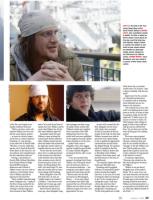

LEFT: In The End of the Tour
Jason Segel plays writer
David Foster Wallace (LOWER
LEFT), who committed suicide
in 2008. The film is based on
David Lipsky's book about his
five-day road trip-interview
with Wallace. Segel's father
is Jewish; his mother is not;
while he was raised Jewish,
he attended an Episcopal
middle school, followed in
the afternoons by Hebrew
school. LOWER RIGHT: Jesse
Eisenberg, who was raised in
a secular Jewish home, plays
Lipsky.
of the Tour, sees Lipsky as an
equally conflicted character.
"[He] is not just a writer who
admires Wallace, but who actu-
ally has some ulterior motives
— at worst as a kind of sniper
and at best as a kind of exposer"
Eisenberg, 31, says during a
recent interview in Beverly Hills.
"But then, of course, while play-
ing the role, I found all these dif-
ferent layers in the character: not
just jealousy and competitiveness
but also admiration and love:'
During a conversation in
Beverly Hills, Michael Silverblatt,
host of Santa Monica College-
based KCRW's program
Bookworm and a friend of
Wallace went so far as to refer to
Lipsky as a "douchebag" whose
envy of Wallace spurred his
approach to the interview.
"But I wouldn't make that judg-
ment" Margulies says. "Lipsky in
the film is being coached by his
editor, who accuses him of not
wanting to ask the tough ques-
tions because he likes Wallace,
and to 'be a prick if you have to
Lipsky does envy Wallace, and he
wants what Wallace has, but he
also wants Wallace's approval:'
Eventually, Lipsky does get
Wallace to open up about his
rumored past heroin addiction
(false, Wallace insists) and also
about his battles with alcohol and
his eight-day suicide watch in a
hospital when he was in his 20s.
"At the time the movie takes
place, he's at a really good point
in his journey, but at the back
of his mind he knows that that
other sensation exists, that it's
around any given corner, and
that's a terrifying thing to live
with" says Jason Segel, 35, who
plays the novelist and was inter-
viewed along with Eisenberg.
Before Margulies wrote The
End of the Tour, he says, he
"couldn't claim to be a fanboy"
of Wallace. "I had tried to read
Infinite Jest 20 years ago, and I
just didn't get sucked into it:'
Fast forward to about four
years ago, when Margulies' long-
time manager sent him a copy
of Lipsky's book, written after
Wallace's suicide and compiled
from transcripts of the 1996
Rolling Stone interview. The
article itself was never published
in the magazine because Lipsky's
editors decided to nix the story.
Lipsky's book came to
Margulies with a note suggest-
ing that it might be good fodder
for a play. Instead, Margulies
envisioned what he calls "a road
picture"
"I was very excited by the
prospect of putting David Foster
Wallace, one of the great chroni-
clers of American culture, on
the American landscape — just
seeing his iconic figure travers-
ing the fast-food joints and the
7-Elevens and even the Mall
of America [in Bloomington,
Minn.]. ... It was only when I
read Lipsky's book that I fully
mourned the loss of David Foster
Wallace and was drawn to read
Infinite Jest again, but with a new
appreciation" he says.
As part of his research for the
film, Margulies met for hours
with Lipsky, who recounted
for him an anecdote he did not
include in his book: the time that
Wallace, incensed over what he
perceived to be Lipsky hitting
on his ex-girlfriend, aggressively
confronted the reporter about
the alleged flirting. The incident,
which is included in the film,
alludes to Wallace's darker side;
as Silverblatt noted, Wallace
could get "ferociously upset" and
had been known to hit some of
his girlfriends.
"I'm surprised Lipsky didn't get
beaten up" Silverblatt says.
Eisenberg said he grappled
with how to understand Lipsky's
motives during that lengthy
interview. As an actor, he is used
to being the subject of reportage.
In fact, "A few months prior to
reading the script, I had done
a three-day interview that I
thought right at the offset was
antagonistic" Eisenberg says.
"So this role pushed me to really
think about why a journalist
would want to be invasive. I had
to learn to identify with the jour-
nalist"
Segel, known for his comedic
yet vulnerable performances
in comedies such as Forgetting
Sarah Marshall, says he was
drawn to his character.
"The material was in line with
stuff I was thinking about at that
point in my life, in terms of what
was going to make me feel OK,"
Segel said. "It didn't seem to be
success or money or status. It's:
What happens when things are
going as well as they could pos-
sibly go and you still feel less
than, 'I'm not there yet: and the
sense of being part of a ranking
system"
The actors were surprised
last year when Wallace's family
released a statement that said
they do not consider the film an
"homage" to the late Wallace and
that "David would never have
agreed that [Lipsky's] saved tran-
scripts could later be repurposed
as the basis for a movie."
In response, Segel insists,
"Everyone who worked on the
film had nothing but reverence
for Wallace."
"Wallace is not just theirs"
Margulies says of the author's
family. "He is a part of our cul-
ture [and someone] who has had
an impact on a lot of people. And
if Lipsky gave us this entree into
learning a little bit more about
Wallace and introducing him to a
new generation of potential read-
ers, that's the collateral benefit of
all of this."
❑
August 6 • 2015
39