

arts & life
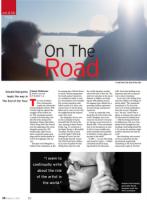
A still from The End of the Tour
Naomi Pfefferman
Jewish Journal
of Greater L.A.
Donald Margulies
leads the way in
The End of the Tour.
T
he work of Pulitzer
Prize-winning play-
wright and screenwriter
Donald Margulies (Dinner With
Friends) long has explored the
struggles of the modern art-
ist. After newspapers panned
a couple of his early plays, and
after the brisk closing of his
Manhattan Theatre Club debut,
What's Wrong With This Picture?
near the beginning of his career,
Margulies penned his 1991
breakout play, Sight Unseen,
about a superstar painter grap-
pling with his Jewish identity as
well as the trappings of his suc-
cess.
That play earned Margulies a
Pulitzer Prize nomination, as did
his ensuing play, Collected Stories,
in which a student appropriates
her Jewish mentor's memories
of a youthful love affair to write
her own breakout novel. Brooklyn
Boy revolves around an estab-
lished novelist, Eric Weiss, who
returns home to visit his dying
father and to come to terms with
the neighborhood that inspired
much of his work.
Now Margulies, 60, has writ-
ten the screenplay for James
Ponsoldt's film The End of the
Tour, opening in Metro Detroit
Friday, Aug. 14, exclusively at
the Maple Theater in Bloomfield
Township. The film is based
on David Lipsky's 2010 book,
Although of Course You End
Up Becoming Yourself: A Road
Trip With David Foster Wallace,
an account of Lipsky's five-day
Rolling Stone interview with
the scruffy, legendary novelist
when both were in their 30s. The
interview took place in the snowy
Midwest as Wallace was finish-
ing his 1996 publicity tour for
his magnum opus, Infinite Jest, a
sprawling, brilliant exploration
of ennui among contemporary
Americans.
"I seem to continually write
about the role of the artist in the
world:' Margulies says of one
reason he was drawn to the proj-
ect, during a recent interview in
Beverly Hills. "That may hearken
back to my having been an artis-
tic kid in a lower-middle-class
Jewish unintellectual household
in Brooklyn, trying to figure out
my place in the world:'
In 2008 — 12 years after being
interviewed by Lipsky — Wallace
committed suicide by hang-
ing himself in his Claremont,
Calif., home after battling severe
depression that did not respond
even to shock treatments.
At the time of the Rolling Stone
interview, Wallace was feeling rel-
atively stable: "The conundrum
dramatized in The End of the
Tour is his tortured ambivalence
about his success," Margulies
says. "He says, 'I don't want to
appear as someone who wants to
be interviewed by Rolling Stone'
— while he's being interviewed
by Rolling Stone. He's sort of tan-
talized by the limelight but also
dreading it and hating himself for
it. He worries the attention might
somehow diminish and taint his
work:'
Jesse Eisenberg, who received
an Oscar nomination for play-
ing Facebook mogul Mark
Zuckerberg in The Social Network
and portrays Lipsky in The End
"I seem to
continually write
about the role
of the artist in
the world."
Pulitzer Prize-winning
playwright Donald
Margulies wrote the
film's screenplay.
38 August 6 • 2015
JN