

>> ... Next Generation ...
Dig It
OU students take archaeological trip to Israel.
ZOE SCHUBOT JN INTERN
igging through dirt
for ancient historical
artifacts might seem like
something that's meant
for the History Channel, but a group
of students from Oakland University
got the chance to live out this
experience on a recent study abroad
trip to Israel.
Last month, students from OU
took part in an archaeological study
abroad that served to educate
them about the complexities of
archaeology while providing them
with exposure to the rich culture of
Israel's ancient site of Lachish, an
area full of rich culture and history
that dates back to 2500 B.C.E.
The program allows participating
students to immerse themselves
in a historical site, experience the
complexities and "appreciate how
history is uncovered and what
things mean in historical context,"
according to Mike Pytlik, visiting
assistant professor in anthropology
and director of Judaic studies at
OU, who has been accompanying
students since the trip was founded
seven years ago.
Through collaboration with
Hebrew University, students are
trained for fieldwork and then
able to get firsthand experience
with excavation techniques and
analysis of the artifacts, pottery
and other things that they find.
From these findings, students then
make determinations about the
architecture, history and culture of
the area.
While the trip is geared
mostly toward archaeology and
anthropology students, Pytlik said
it's open to any student who "shows
the proper interest and understands
what the trip is about."
He went on to say that "there's
so much more that's gained from
the trip besides just archaeological
work," so it remains open to any
students who display interest,
even if they have little to no field
experience.
Sam Noveck, an Oakland
University senior majoring in
communications with a minor in
36
August 6 • 2015
Judaic studies, fit into this category
of students. Noveck said that despite
having no prior experience with
archaeological excavations he was
initially drawn to the trip because
of its appeal to his Judaic studies
minor.
While prior experience is
suggested for students taking the
trip, instructors train students in
proper field techniques before
they are sent out on excavations.
Instruction comes from a mix of
doctoral students and professionals,
instructors from OU and trained
Israelis.
Pytlik said they generally aim to
take only around 15 students for
financial reasons.
"We are the only study abroad
trip that actually goes out and
solicits funding for our students,"
he explained. "We have generous
donors in the Jewish community and
elsewhere who help support the
students' trip. In order to allow that
funding to be a meaningful amount
for students, we usually limit it to
15."
Pytlik believes that the trip is
beneficial for students beyond the
archaeological skills they develop.
"Overall, they get a better
appreciation for the culture, for Israel
as a country and also the diversity
of people there," Pytlik said. "To see
the cultural sites, the religious sites,
to make international friends, to be
good ambassadors when they come
back and want to learn more, that's
what we really hope they get out
of it."
Noveck agreed that the trip
was beneficial and educational in
a variety of ways and pointed out
that while he has previously been to
Israel on Birthright, this trip provided
him with a new perspective.
"Birthright was a much more
spiritual experience, but this was
seeing Israel in a whole new way,"
he said. "This was seeing it in a
much more historical, archaeological,
cultural sense. This trip was definitely
a huge, wonderful frame of reference
for when I take my other courses to
complete my minor." ❑
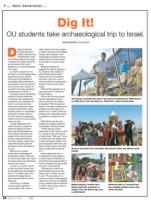
Sam Noveck, excavating the slope of the mound investigating the Middle Bronze
(C. 1800 B.C.E.) and Late Bronze (c. 1300 B.C.E.) walls and destruction
Group at the ancient site of Herodion, King Herod's palace and ultimate burial
location
Madison Hayman, working with a
Hebrew University supervisor, in
Asaph, in the Late Bronze Age area,
(c. 1300 B.C.E)
Numerous finds are recovered each
day, including grinding stones, sling
stones and tools.