

world >> point / counterpoint
Iran
Nuclear
Agreement:
Good Deal
Or Bad?
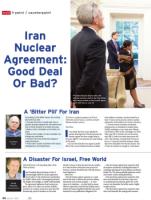
President Barack Obama talks with
national security staff in the Oval Office
after being notified of the nuclear agree-
ment with Iran on July 13.
A 'Bitter Pill' For Iran
According to the White House, the nuclear
deal with Iran will:
• Increase the time it would take Iran to
acquire enough material for one bomb from
two to three months to at least one year.
• Reduce Iran's stockpiles of enriched ura-
nium.
• Reduce the number of Iran's installed cen-
trifuges by two-thirds.
• Prevent Iran from producing weapons-
grade plutonium.
• Track Iran's nuclear activities with robust
transparency and inspections.
(Uzi Even is a physics professor at Tel Aviv
University and served as a scientist at Israel's
Dimona nuclear reactor.)
Ynet News
I
f you think that Iran won't uphold the
nuclear deal signed in Vienna (because the
Iranian regime has been caught lying in
the past, right?), I recommend you stop reading
at this point.
I am sure the deal that was signed is prefer-
able to the current situation because it delays
Iran's ability to develop a nuclear bomb by at
least 15 years and in practice ends its nuclear
aspirations. Don't believe me? Look at the facts.
• Current Iranian uranium enrichment
infrastructure is estimated to include about
20,000 centrifuges at two main sites (Natanz
and Fordow). Most of the centrifuges are of the
older type (IR-1) and the rest are the newer
type (IR-2), which are three times more effi-
cient. The Iranians currently hold 10 tons of
low, or 3.5 percent enriched uranium, which
they have stockpiled over the last decade. The
10 tons of uranium is enough to create about
A Disaster For Israel, Free World
David Horovitz is the founding editor of the
Times of Israel.)
ran's President Hassan Rouhani on July 14
unsurprisingly hailed the nuclear agreement
struck with U.S.-led world powers and derided
the "failed" efforts of the "warmongering Zionists:'
His delight, Iran's delight, is readily understandable.
The agreement legitimizes Iran's nuclear pro-
gram, allows it to retain core nuclear facilities,
permits it to continue research in areas that will
dramatically speed its breakout to the bomb
34 July 23 • 2015
should it choose to flout the deal, but also enables
it to wait out those restrictions and proceed to
become a nuclear threshold state with full interna-
tional legitimacy.
Here's how:
• Was the Iranian regime required, as a condi-
tion for this deal, to disclose the previous military
dimensions of its nuclear program — to come
clean on its violations — in order both to ensure
effective inspections of all relevant facilities and to
shatter the Iranian-dispelled myth that it has never
breached its non-proliferation obligations? No.
• Has the Iranian regime been required to halt
all uranium enrichment, including thousands of
centrifuges spinning at its main Natanz enrichment
facility? No. The deal specifically legitimizes enrich-
ment under certain eroding limitations.
• Has the Iranian regime been required to shut
down and dismantle its Arak heavy water reac-
tor and plutonium production plant? No. It will
convert, not dismantle, the facility under a highly
complex process.
• Has the Iranian regime been required to shut
down and dismantle the underground uranium