

A Jazz
Story
LITTLE
BLAC
LIES
MUSIC IS FOREVER
A local man writes
a book about his
friendship with
Dizzy Gillespie.
the Garden (Ecco, an imprint of Harper
Collins, Aug. 18), which brings alive the
tumult of early 20th-century Iran and the
complex, tragic history of a wealthy fam-
ily of Persian Jews. The suspenseful novel
highlights a crisis of inheritance and offers
a poetic, intimate view of young women
bound by the confines of an oppressive
male-dominated society.
The main character is Rakhel, a barren
young bride, whose husband makes a fate-
ful choice that will shatter the household
and drive Rakhel to dark extremes to save
herself and preserve her status within the
family. The story is inspired by events
in the author's own family and is told
through the eyes of the family's only sur-
viving daughter.
■Former U.S. diplomat (who handled
Holocaust issues in Poland) and bestsell-
ing author (The Kommandant's Girl and
The Diplomat's Wife) Pam Jenoff turns her
focus from wartime Europe to stateside
in the forthcoming The Last Summer at
Chelsea Beach (Mira Books; Aug. 2015).
Following a young refugee from Fascist
Italy, newly arrived in America, Jenoff tells
of the girl's summer by the sea, her affec-
tion for the boisterous Irish-Catholic boys
next door, the oncoming creep of war and
finding her way home.
■NY Times bestselling author and
host of a hit A&E H2 history series, Brad
Meltzer is out with his latest novel, The
President's Shadow (Grand Central
Publishing), a taut political conspiracy
thriller. The novel delves into little-known
parts of American history to reveal gov-
ernment cover-ups, secret military loca-
tions and the key to national archivist
Beecher White's father's untimely death
while in the Navy special unit called the
Plankholders.
Meltzer, a University of Michigan alum,
has strong connections to the Detroit area.
A Jewish-American author who embraces
this identity in his work and public life,
Meltzer delivers yet another high-energy
page turner.
■"In the moment after Robert Mason's
condom broke he rolled off me, propped
himself on his elbow, and said, 'What you
do doesn't help anybody"' So opens The
Sunlit Night (Bloomsbury USA), Rebecca
Dinerstein's debut novel, which follows
Lofoten, her bilingual English-Norwegian
collection of poems.
Frances has arrived in summertime
Lofoten, six tiny islands in the Norwegian
Sea where sun is a constant, to recover
from a sudden breakup, taking refuge at
an artists' colony. At the same time, Yasha
arrives to bury his Russian immigrant
father. What they find "at the top of the
world:' in each other and themselves,
yields hope and surprises for both.
■Benjamin Markovits' new novel, You
Don't Have to Live Like This (Harper),
is a big, daring and prescient work set
in the racially charged landscape of con-
temporary Detroit. The protagonist, Greg
Marnier, finds purpose in a new venture
to gentrify five square miles in a burnt-out
and half-abandoned black neighborhood
in Detroit. He tries to make a home in the
new biracial community, but things go ter-
ribly wrong when a black teenager is criti-
cally injured in a vigilante act by a white
man. Markovits raises urgent questions
about the future of a once-great American
city, the state of race relations and the wid-
ening gap between rich and poor.
plex, touching life. "The streets are dirty,
but they're home, and they're beautiful
to me. If you can't see the beauty in the
dirt, then I feel sorry for you:'
■Sydney and Violet Schiff were
trendsetters in the Modernist liter-
ary movement of early-20th-century
England, friends with T.S. Eliot, James
Joyce, Marcel Proust and Pablo Picasso.
In Sydney and Violet (Anchor Books),
Stephen Klaidman tells how this power
couple overcame snobbery and anti-Sem-
itism to help bring artistic genius to light.
■In The Archive Thief (Oxford
University Press), Lisa Moses Leff recon-
structs the story of Zosa Szajkowski, a
man "who salvaged French Jewish his-
tory in the wake of the Holocaust" We
get his life from humble beginnings to
refugee scholar, who illicitly moved tens
of thousands of documents from Nazi
buildings and public archives to New
York. Leff gives a welcomed insight into
the debates over the ownership of the
archives and the struggles to preserve
remnants of our Jewish past, based on
the question of whether such actions
were unethical acts or a desperate bid to
save Jewish culture from destruction.
SUMMER READIN
on page 34
Suzanne Chessler
1 Contributing Writer
ave Usher grew up amid a
family business of recycling
motor oil and a family inter-
est encouraging attention to clas-
sical music. In his 80s, Usher still
is at the helm of cleaning up oil,
only in waterways, but he long ago
switched his musical priorities to
jazz.
Being a fan wasn't enough.
Since connecting with jazz
trumpeter and bandleader Dizzy
Gillespie after a Detroit show in the
1940s, Usher traveled to watch the
acclaimed musician perform and
went on to establish himself as a
record producer, moving beyond
the star he most admired.
Usher's recollections — centered
on both friendship and a business
relationship with the musician —
are chronicled in a book co-written
with Berl Falbaum, who also details
Usher's work heading up Marine
Pollution Control operating out of
Detroit.
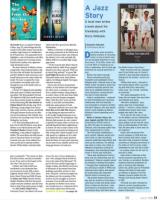
Music Is Forever: Dizzy, the
Jazz Legend, and Me (Red Anchor
Productions; $17.95) came to
be after 20 years of coaxing by
Falbaum, who had done public-rela-
tions assignments for Usher.
The two quickly established a
work routine. Falbaum would inter-
view Usher on tape recordings,
research additional information and
write up the material. The editing
was done by Usher, who relied on
Falbaum's experience writing for
newspapers and developing longer
works of fiction and nonfiction.
"Dave was mentioned in Dizzy's
book, but the relationship was not
developed," Falbaum explains about
his interest in starting the project.
"I thought their relationship [last-
ing until Dizzy's death in 1993] was
important jazz history and should
be saved along with important
Detroit history involving jazz.
"We started almost three years
ago with six months of interviews. I
used Dizzy's book and books about
Dizzy to flesh out the facts. I also
did research in presidential librar-
ies because Dizzy and Dave went to
D
Dizzy Gillespie, the Jazz Legend, and Me
Dave Usher
with
Bed Firm
the White House a few times."
When musician met fan, Gillespie
was 25 and Usher was 14. Usher's
interest in jazz had been piqued by
listening to his brother's record col-
lection.
"Within that music, I started to
feel excited about what I was hear-
ing and what Dizzy was doing,"
Usher says. "As a result, I became
an advocate."
The racial segregation of the
times did not impact the way Usher
and Gillespie got along.
"We had a simpatico," says
Usher, who lives in Downtown
Detroit. "I lived in a mixed Detroit
neighborhood where there were
people who didn't like Jews.
"As it was for the Jews, it was
for the blacks, and our relationship
was easy. I had no barriers with
black people, and he had the same
kind of understanding of life that I
had. We were able to work and cre-
ate together."
Usher, who started his first
record company in 1948 and has
been involved with other compa-
nies after that, traveled to foreign
countries as Gillespie performed. In
the midst of all his travels, Usher
celebrated his bar mitzvah in 2013
— on a plane, where he sat next to
and met a rabbi.
Usher also is chairman of the
marine business operated by his
son, Charles, as president. Besides
meeting American presidents as
part of working with Gillespie,
Usher was called upon by President
George H.W. Bush to help clean
up millions of gallons of oil that
Saddam Hussein spilled into the
Persian Gulf during Desert Storm
in 1991.
The book has been released by
Usher's current recording enter-
prise that included Gillespie on the
board of directors. ❑
July 16 • 2015
33